Plenty of agencies treat the Google Quality Rater Guidelines as a ranking cheat sheet, and that’s a mistake. The document is a detailed public statement of what Google means by quality, which makes it a useful lens to apply across many client accounts. Below you’ll find what it says, what it leaves out, and how to turn it into a repeatable audit.
What Are the Google Quality Rater Guidelines?
The Google Quality Rater Guidelines, formally the Search Quality Evaluator Guidelines (QRG), are instructions for human raters who assess the quality and usefulness of search results. The General Guidelines primarily address two ratings: Page Quality (PQ) and Needs Met (NM). Google’s Creating helpful content page notes that site owners can use the criteria to self-assess E-E-A-T.
What the Guidelines Are Not: Not a Direct Ranking Algorithm
The QRG don’t work as a ranking algorithm, and they won’t tell you how to rank first. An individual rating cannot directly change how a page appears or move it up or down in Search (Google). Raters’ individual ratings also cannot directly change how a site appears in results.
Clients need to hear this clearly. Rankings come from automated systems using many factors and signals. The QRG lay out the standards human evaluators apply, and are not a guide to which signals Google’s ranking systems use or how they’re weighted.
Who Search Quality Raters Are and How Their Data Feeds Evaluation

A search quality rater is a human evaluator who judges results against the guidelines instead of personal preference. Raters represent people in their rating locale. Their feedback helps Google see whether algorithms deliver good results and confirms that changes work well.
In side-by-side tests, raters see two result lists, one with a proposed change and one without, and say which they prefer and why. In 2023, Google ran 719.326 Search quality tests and 124.942 comparison tests (google.com). Rater data is one input among several evaluation methods.
Latest Google Quality Rater Guidelines Update: Changelog Summary
To know the current version, read Google’s own PDF rather than a third-party headline. Articles with a year in the title often don’t confirm which revision is current. We only summarize what we can verify.
Google’s November 16, 2023 update is a documented past revision. It simplified the Needs Met definitions, added guidance for different page types and newer formats such as short-form video, removed outdated or redundant examples, and expanded forum and discussion guidance. Google described it as having no major or foundational shifts. A guideline revision is not automatically a ranking update.
Current Version and Where to Read the Official Google PDF
Google publishes the document itself. The official Google PDF is titled “General Guidelines,” carries a 2025 copyright notice, and includes a “Guideline Change Log” appendix. Check that appendix for revision details instead of relying on our summary or anyone else’s.
Its contents cover Page Quality, E-E-A-T, Lowest Quality pages, spammy webpages, scaled content abuse, low-effort or low-originality main content, and Needs Met.
How Raters Judge Page Quality
Page Quality asks how well a page achieves its purpose. A rater receives a URL and a rating grid, explores the landing page and website, and judges the result. Pages of different types and purposes can be high or low quality, so page type alone doesn’t settle the rating.
Purpose of the Page and Main Content Quality
Understanding purpose comes first. Raters separate main content from supplementary content and from advertising or monetization. A commercial purpose is not low quality in itself. The test is whether the page genuinely helps people.
Main content quality considers effort, originality, and skill or talent. The assessment also looks at website and creator reputation. Monetization should stay distinguishable from the main content and shouldn’t stop visitors from using the page.
E-E-A-T: Experience, Expertise, Authoritativeness, and Trust
E-E-A-T stands for Experience, Expertise, Authoritativeness, and Trust. It works as one interconnected framework, and you can’t optimize the four parts separately. Trust matters most, and the other elements contribute to it.
E-E-A-T is not a specific ranking factor. Google’s automated systems use a mix of factors to identify content that demonstrates it. E-E-A-T work, then, comes down to making credibility visible and verifiable. The guidelines also distinguish experience from expertise on YMYL topics. Self-description alone doesn’t establish credibility, so independent reputation evidence counts.
If you want to check and improve it, you can use our Free EEAT Score Checker.
YMYL Topics and Why the Bar Is Higher
A YMYL (“Your Money or Your Life”) topic is one that may significantly affect health, financial stability, safety, or the welfare of society. Errors cost more there, so clear YMYL pages get the most Page Quality scrutiny.
It’s a spectrum. As illustrations only, the guidelines treat when to go to an emergency room as clear YMYL, toothbrush replacement as possible YMYL, and how often to wash jeans as unlikely YMYL. Tsunami evacuation routes and purchasing prescription drugs are other clear examples. Raters make a risk judgment here, and no keyword list decides it.
Lowest-Quality Signals: Spam, Deception, and Scaled Low-Effort AI Content
Lowest Quality covers harmful or harmfully misleading information, untrustworthy pages, deceptive purpose or design, deliberately obscured main content, suspected malicious behavior, and spammy pages, including scaled content abuse.
AI use alone doesn’t decide quality. Scaled content abuse means generating many pages primarily to manipulate rankings rather than help users, whether automation, people, or both produced them. Examples include republishing others’ material without original value and light rewriting through synonym substitution (Spam policies for Google web search). Generative AI can help with research or structuring original content. Using it to mass-produce pages without adding user value may violate that policy (developers.google.com).
How Raters Judge Needs Met

Needs Met rates how well a result satisfies the user’s needs for a query. The scale is Fully Meets, Highly Meets, Moderately Meets, Slightly Meets, and Fails to Meet. It is separate from Page Quality, which rates how well a landing page achieves its purpose. The guidelines also distinguish rating a result block from rating its landing page.
Because of that separation, a trustworthy page can still be a poor result. These illustrative queries show it:
-
Know: “how long does a tax refund take” calls for a clear, direct explanation.
-
Do: the query “download invoice template” needs something the searcher can use right away.
-
Visit-in-person: someone searching “pharmacy open now near me” wants a physical place.
A well-written explainer could have strong Page Quality and still fail the second or third query. A relevant page may be untrustworthy, while a high-quality page can miss the query entirely. Needs Met depends on how well the result matches the query.
How the Guidelines Connect to Google’s Helpful Content Guidance
Both resources push the same idea: content should be made primarily for people, not to attract search visits. The QRG explain how raters assess Page Quality and whether results meet users’ needs. Google’s helpful content guidelines turn related principles into self-assessment questions for creators.
The former helpful content system became part of the core ranking systems in March 2024. The Google helpful content update is no longer a separate event to wait for. The self-assessment prompts include:
-
Does the content offer original information, reporting, research, or analysis?
-
Is the description substantial and complete?
-
Does it add value beyond other sources?
-
Is sourcing clear, and is first-hand expertise shown?
-
Are the author and publisher clearly identified?
Google’s warning signs of search-engine-first content include extensive automation across many topics, summarizing sources without added value, and changing a page’s date without substantially changing it. Writing to a supposed preferred word count is another, and Google has no preferred word count. A people-first approach can coexist with SEO, as long as discoverability work supports useful content. Neither document guarantees rankings.
How to Apply the Guidelines to Your Content
Use the QRG as a guide for evaluating quality. They offer no formula. Results vary by industry, competition, and execution, and a clean audit may help content be evaluated more favorably but promises no traffic or timeline. For agencies managing many accounts, the value is consistency: one shared lens instead of each editor’s gut feel.
Audit a Page Like a Rater: Step-by-Step Process
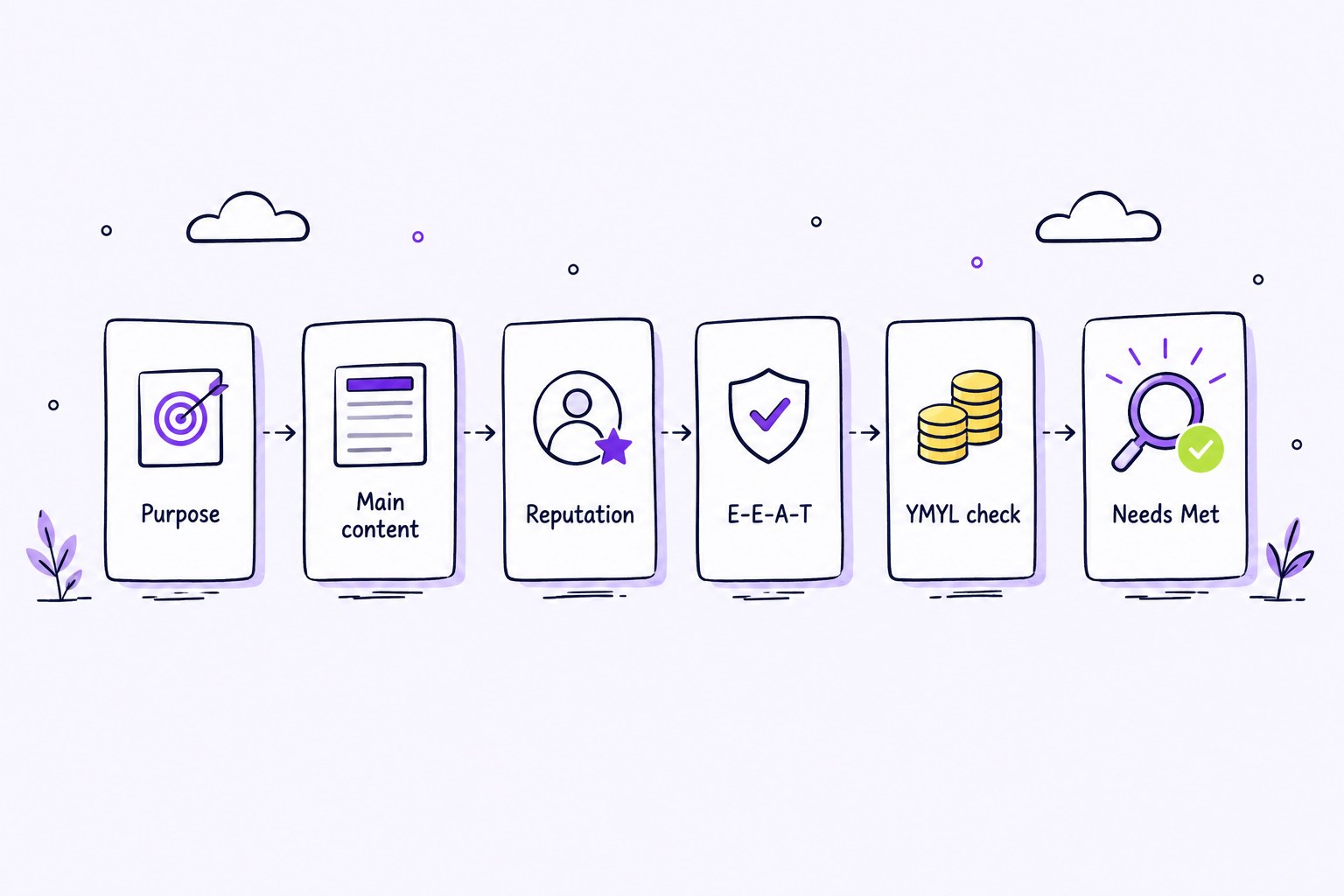
Run these six steps in order and record the evidence behind each judgment.
Purpose of the page: What is this page for, and does that purpose benefit users?
Main content quality: Does the main content show real effort, originality, and accuracy?
Creator and site reputation: What do independent sources say about who made this?
E-E-A-T: Is the experience or expertise appropriate to the topic, and does the page earn trust?
YMYL check: Could an error here significantly affect someone’s health, finances, or safety?
Needs Met rating: How well does this page satisfy the query it targets?
Use the Needs Met scale to label the result of step six:
| Rating | What it looks like | Typical fix |
|---|---|---|
| Fully Meets | Fully satisfies a clearly defined need with little extra effort. | Keep it current and monitor for outdated details. |
| Highly Meets | Very helpful, though some searchers may want more. | Add depth or examples, and fill in any missing sub-answers. |
| Moderately Meets | Useful but incomplete or only partly aligned with the query. | Refocus the page on the main need and fill gaps. |
| Slightly Meets | Touches the topic but leaves the need mostly unresolved. | Rewrite around the real question or retarget the page. |
| Fails to Meet | Wrong topic, unusable, or misleading for the query. | Replace or remove the page. |
For a quick pass, use this rater-style checklist:
-
Who created it, and is that clear?
-
Why does it exist?
-
What effort and originality went into it?
-
Does it satisfy the query?
Strengthen E-E-A-T Signals and Fix Common Quality Problems

Most fixes involve making real credibility visible. Never fabricate it. Invented author identities and fake headshots are deceptive, and made-up credentials do the same damage, so the page becomes untrustworthy. Strong E-E-A-T signals come from truthful detail. These before/after fixes cover the usual problems.
- Missing author info. Before: no byline, only “Admin.” After: a named author with relevant, accurate qualifications and a clear publisher identity.
- Thin “AI-spun” pages. Before: a lightly reworded summary of top results. After: original analysis and examples, plus sourced data that add value beyond other sources. This is where AI article writing fits when humans verify and enrich the output.
- Unsupported YMYL claims. Before: confident health or money statements with no sourcing. After: claims tied to reliable sources, reviewed by a suitably qualified person, with limits stated.
- Missing first-hand experience. Before: generic product advice. After: how many products were tested, the results, and how testing was done, with evidence such as photographs.
For agencies, embed this audit as a quality gate before client delivery. A human reviewer should make the final E-E-A-T call. Review catches problems, but it doesn’t prove the content is high quality. Google also suggests seeking honest assessment from trusted people unaffiliated with your site.
Common Myths About the Quality Rater Guidelines
Most myths start when people read a human evaluation document as if it were an algorithm spec.
-
Raters control rankings. They don’t; their evaluations inform how Google assesses search systems.
-
The guidelines reveal the algorithm. They describe evaluation standards and are not a guide to which signals Google’s ranking systems use or how they’re weighted.
-
E-E-A-T is a measurable score. It is a framework with no public metric.
-
An author bio establishes expertise. It supports transparency only if accurate and consistent with the content.
-
All AI content is penalized. Quality, purpose, and value matter, regardless of the tool.
-
Human-written content can’t be scaled abuse. Manipulative, low-value production can come from people, automation, or both.
-
Commercial pages are low quality. Monetization is compatible with usefulness.
-
Every guideline update means a ranking update. Revisions can clarify instructions without any ranking-system change.
Google Quality Rater Guidelines FAQs
- Where do I find the official document? Read the Google-hosted PDF and check its change log appendix. Treat third-party summaries as secondary.
- What does a search quality rater do? A rater evaluates results against the guidelines, scoring Page Quality and Needs Met. Ratings don’t directly move individual pages.
- Does every author need formal qualifications? No. The experience or expertise needed depends on the subject, purpose, and potential harm.
- Is every page mentioning health or money YMYL? No. A YMYL topic is defined by the consequences of inaccurate information.
- Is AI assistance disqualifying? No. Editorial review must still check accuracy and value, along with why the content was produced.
- Are rater evaluations the same as manual actions? No. Rater evaluations, manual actions, and algorithmic changes are separate processes.
- How fast will an audit improve rankings? We can’t promise a timeline. Guideline-based changes carry no guaranteed outcome.
Turn Rater Criteria Into an Ongoing Content Quality Process
The Google Quality Rater Guidelines only help if they become a routine instead of a one-time audit. Keep internal scores separate from Google ratings. Internal scores are operational tools and shouldn’t be read as predictions.
How We Build the Routine at SEOwind
At SEOwind, a white-label content production partner for marketing agencies, we built that routine into a system called the CyborgMethod. AI handles structure and speed, while humans take care of subtlety, tone, and accuracy.
The foundation is a human-in-the-loop approach, where people don’t just review the final output. They guide AI decisions, validate results, and step in at critical stages to ensure quality throughout the process.
Three parts matter most here:
-
A brief, draft, score, refine workflow with a human in the loop at each step.
-
RAG grounding in real sources, plus an EEAT scoring engine and automated quality gates that trigger refinement when standards aren’t met.
-
Human editorial control for tone, brand alignment, and fact-checking, with CMS-ready, fully white-labeled delivery.
Get Rater-Style Quality Across Client Accounts
If you want rater-style quality across client accounts without building the process yourself, explore our White-Label Content Services.