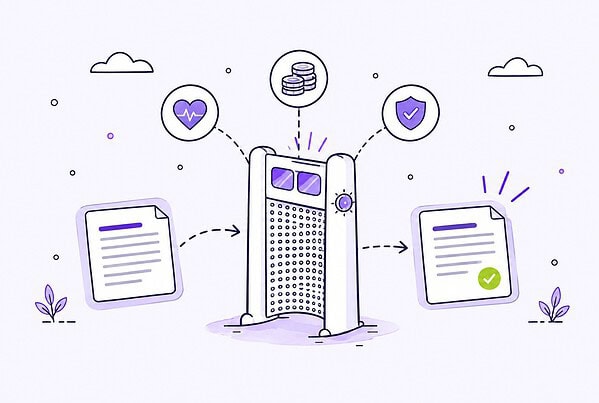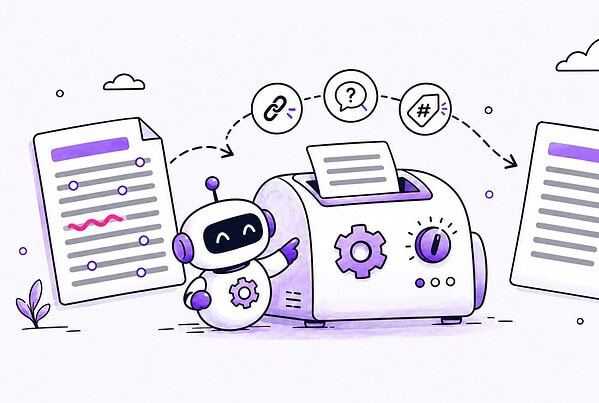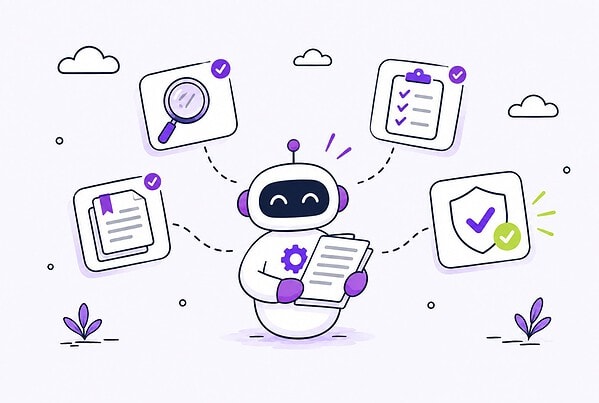

Most teams add people to an AI workflow by making them review everything. It feels safe. It also burns the one resource you can’t scale, which is human attention. Good human in the loop AI asks where a person can actually change the outcome, puts them there, and keeps them out of everything else.
We run content production at volume, so for us this is an operating problem, not a theory. Our approach follows.
What Is Human in the Loop AI? A Working Definition
Human-in-the-loop AI is a system designed to spend human judgment only where that judgment can materially change the outcome. That’s the definition we work from. Approving every output isn’t part of it.
In practice, it’s a design choice about where people sit in a workflow, and it applies to content pipelines, LLM agents and plenty of other setups. In a human-in-the-loop LLM setup, the model drafts, checks and iterates, while people set the bar and handle what the model can’t reliably judge. The term also shows up in human-in-the-loop machine learning, where people supply feedback during training. This article covers the operational side: people steering live production workflows.
Human in the Loop vs. Human on the Loop vs. Human out of the Loop
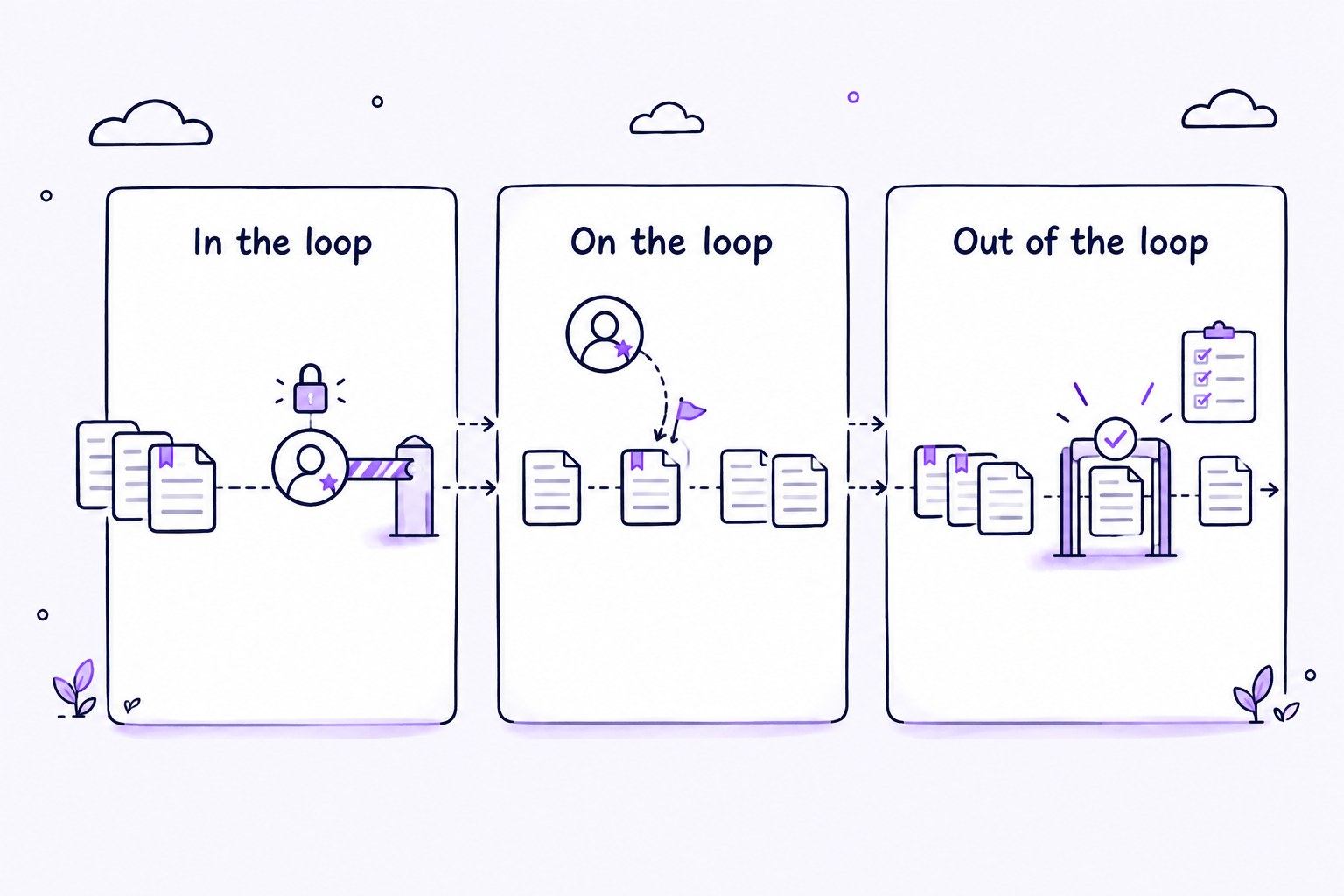
The difference comes down to when the person acts. In the loop, they authorize before anything proceeds. On the loop, they watch and step in. Out of the loop, the system runs alone, usually with checks built in.
| Mode | Human role | When to use | Risk level | Example task |
|---|---|---|---|---|
| Human in the loop | Authorizes an action before the workflow continues | High-impact, irreversible or ambiguous decisions | High | Approving a correction that changes a consequential claim |
| Human on the loop | Monitors the system and intervenes on exceptions | Steady volume where most outputs are routine | Medium | Reviewing flagged drafts while the rest move through quality gates |
| Human out of the loop | Sets rules upfront and audits periodically | Mechanically verifiable, low-consequence work | Low | Checking formatting, link validity or required fields |
Most real systems mix all three. Different steps in one workflow deserve different modes.
The Real Goal: Maximize the Impact of Human Judgment, Not Human Involvement
Our target is human judgment that counts for as much as possible. Maximizing human involvement is a different goal. A person who spends a day checking outputs that were already right has created activity without creating oversight.
Why Human Attention Is the Scarce Resource
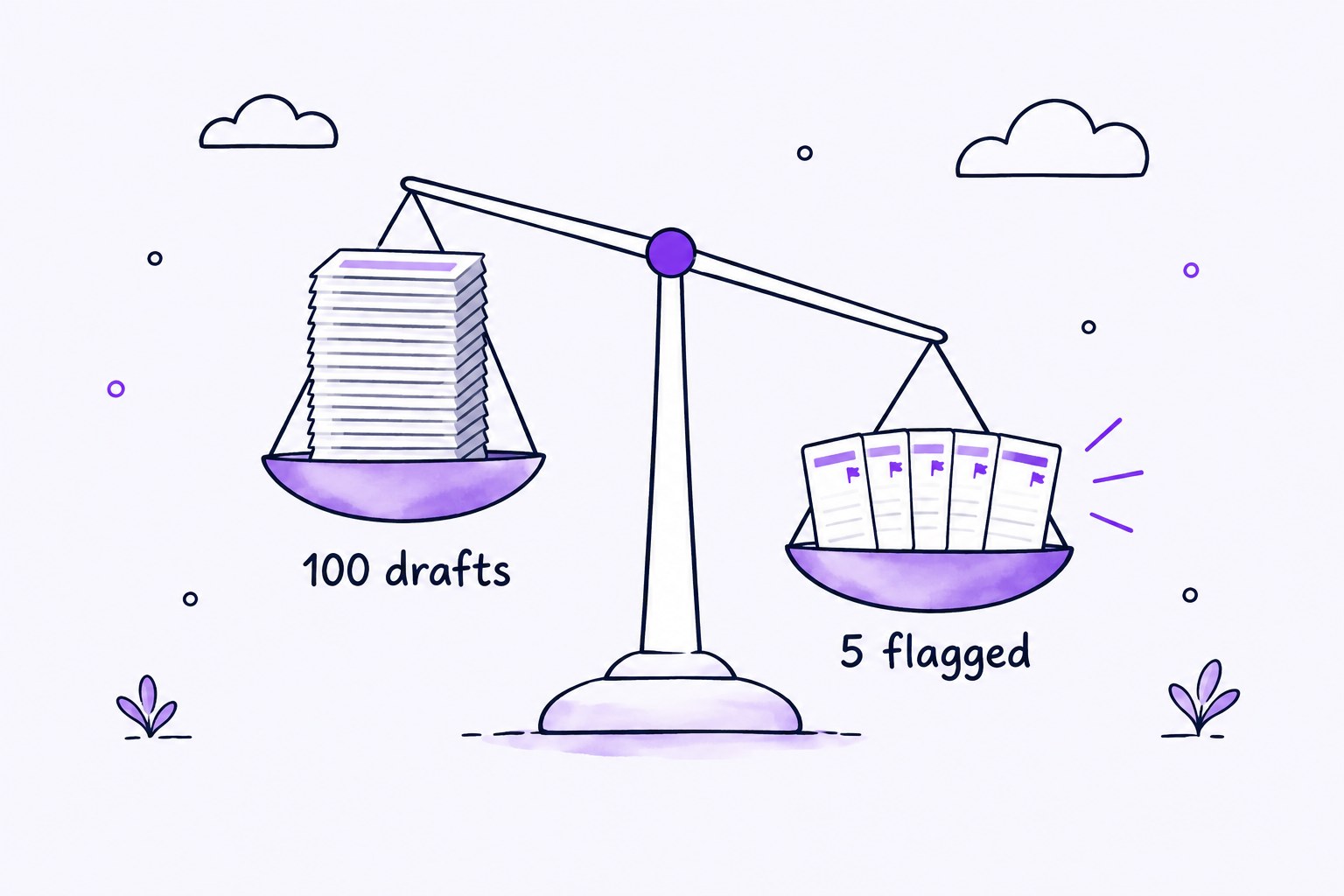
Compute can be added on demand. Experienced editors can’t be added that way. Every hour an expert spends on repeatable checking is an hour not spent on strategy or the hard calls. Attention also degrades. Someone skimming a hundred mostly correct drafts catches less than someone reviewing five that were flagged for a reason.
Why “Human Everywhere” Is Bad HITL Design
Reviewing everything creates bottlenecks and slows delivery. When everything needs a person, nothing gets real scrutiny. Good design is selective: it routes the right questions to people and lets the automation handle the rest.
Human Input vs. Human Intervention
Two different jobs get lumped together as “the human part.” Input is what people contribute before and around the work, and intervention happens later, when the work hits a limit. Teams that mix them up end up with reviewers doing rework instead of steering.
Upstream Input
Upstream, humans supply what the model can’t magically know. That means business strategy, customer understanding, SME knowledge, proprietary data, POV, examples, brand context and, most of all, the definition of quality. No model infers your standards from thin air. If the input is weak, no amount of review downstream fixes it cheaply.
Downstream Intervention
Downstream, humans step in when the workflow reaches the boundary of what it can reliably evaluate. The triggers are specific:
-
Conflicting evidence that the workflow can’t resolve on its own.
-
Strategic ambiguity where the right answer depends on business context.
-
Unusual risk that falls outside normal patterns.
-
Irreversible consequences if the action is wrong.
-
Signs the workflow is optimizing in the wrong direction.
Keep the Human on the Redirect, Off the Iteration
This is our Evidence-First principle. AI can run repeated experiments and evaluations all day. The valuable human move is often noticing that the whole direction is wrong and deciding to stop or change course. That takes judgment. Nudging draft nine into draft ten doesn’t.
Who Owns What: Humans, AI, and Systems
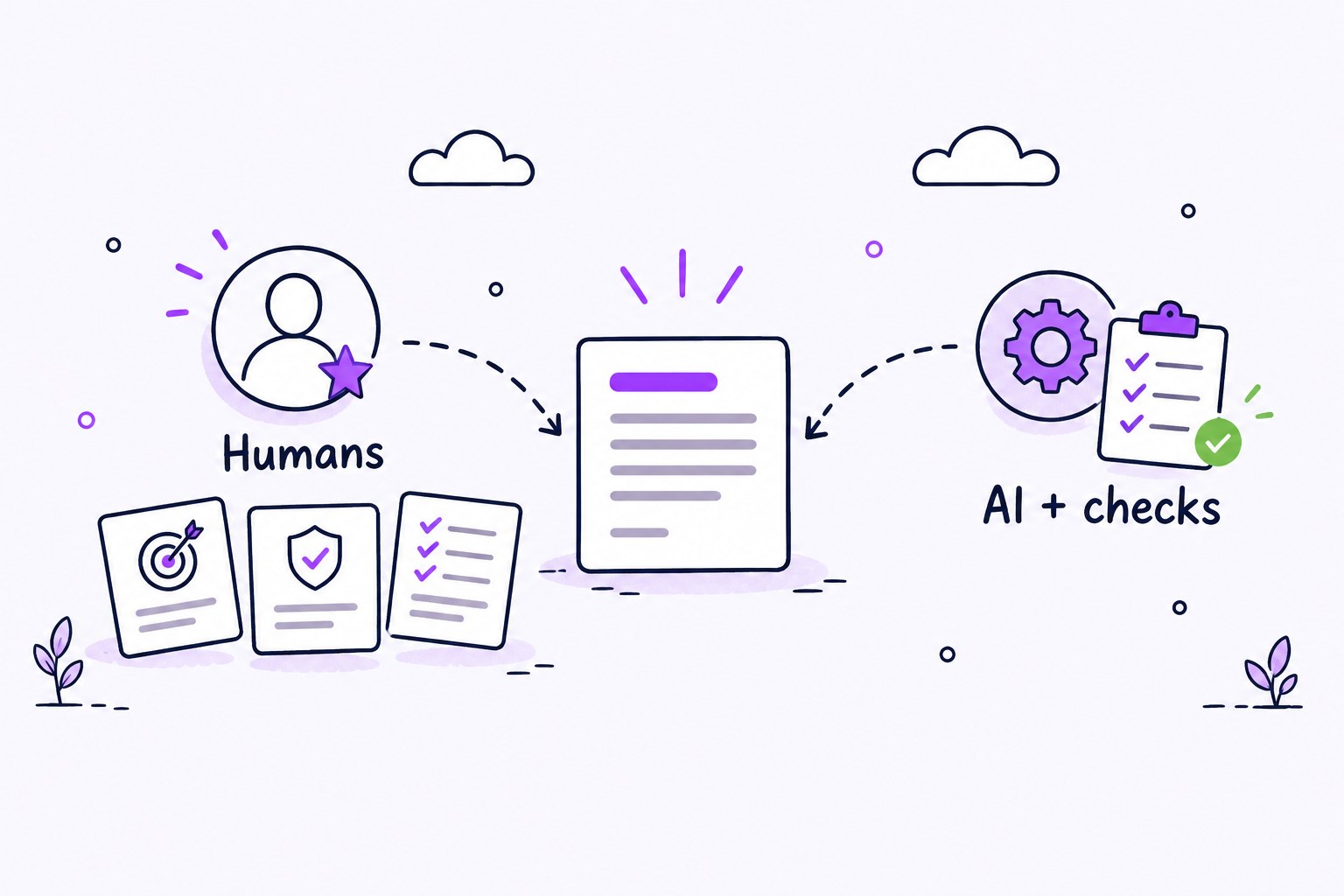
A workable human in the loop approach starts with an explicit ownership split. Without one, responsibilities blur, and blurred responsibility means either everything gets reviewed or nothing does.
What Humans Own
Humans define the outcome, what “good” looks like, and the constraints that cannot be violated. They provide the context and proprietary knowledge the workflow needs, and they decide how success will be evaluated. Accountability stays with them too. It never moves to the machine. If something goes wrong, a named person owns it.
What AI and Deterministic Checks Own
AI and automated systems own repetitive execution: research, synthesis, drafting, comparison, scoring, checking, routing and iteration. If a rule can be tested with code, a person should never be the one testing it. Checks that need judgment need evidence too: a second model grading the first without retrieved sources is one probabilistic system grading another.
Define the Destination, Not Every Route
Many teams try to make automation safe by documenting every SOP branch and edge case. We’ve moved away from that. You will never predict every failure, and the document turns into a maze nobody trusts.
Goal, Context, Constraints, Tools, and Evaluator
We define the bar and let the workflow try different architectures to reach it. A short checklist for any workflow:
-
Goal: What outcome are we after, and for whom.
-
Context: Brand voice, examples, proprietary knowledge and audience.
-
Constraints: What must never be violated.
-
Tools: What the workflow can search, retrieve and check.
-
Evaluator: How success is measured and who resolves what it can’t judge.
Turning Edge Cases into Rules Only When Evidence Shows They Matter
Edge cases still matter. They become explicit rules or guards when real evidence shows they occur, and imagining every failure in advance doesn’t count as evidence. The rulebook stays small and current, and every rule in it has earned its place. People also avoid spending weeks writing rules for problems that never show up.
Production Example: Fact-Checking 2,500 Articles per Month
Fact-checking is where human everywhere breaks down fastest. Our own operations offer an example, though these are our operational figures and not an external benchmark.
Three Minutes vs. Two to Three Hours per Article
We process roughly 2,500 articles per month. Our workflow identifies claims, retrieves and cross-checks evidence, and checks downstream dependencies in about three minutes per article. Doing the same process properly by hand could take two to three hours per article.
Spending thousands of human hours on repeatable verification is a poor use of scarce judgment. Our production workflow combines multi-agent AI, RAG grounding, an EEAT scoring engine, automated quality gates and human-in-the-loop control.
The sequence runs like this: identify checkable claims, define scope, retrieve evidence, apply a source hierarchy, check whether sources support the claims, and trace dependencies affected by corrections. It also distinguishes false claims from unverified ones, which matter differently. For automotive clients, for instance, content is checked against manufacturer spec pages.
Where Humans Stay
Humans define and calibrate the quality system and audit its behavior. They also own the exceptions and the consequential decisions. When authoritative sources conflict, the case escalates to an editor, who weighs which source is more recent, better sourced or more rigorously produced. Editors also handle ambiguous scope and high-consequence claims.
We don’t claim every output needs a final human review forever. How much a step needs depends on its risk profile, covered next.
Findings as Proposals
In our production architecture, findings can remain proposals rather than direct edits. The automated judgment is separated from the consequential action, which gives an editor a clean decision point where it counts. This fits our setup, and plenty of low-risk fixes don’t need it.
How Much Human Oversight Does a Workflow Need?
There’s no single right amount. Oversight should follow the risk profile of each step, judged on four factors:
-
ambiguity (how many defensible answers exist),
-
blast radius (how far a mistake spreads),
-
irreversibility (whether you can undo the damage) and
-
difficulty of evaluation (how hard it is to know whether the output is right).
Where these are low, automation with audits is usually enough. Where they’re high, people belong closer to the decision. We deliberately avoid numeric thresholds, because the right cutoffs depend on your industry, your clients and your tolerance for error.
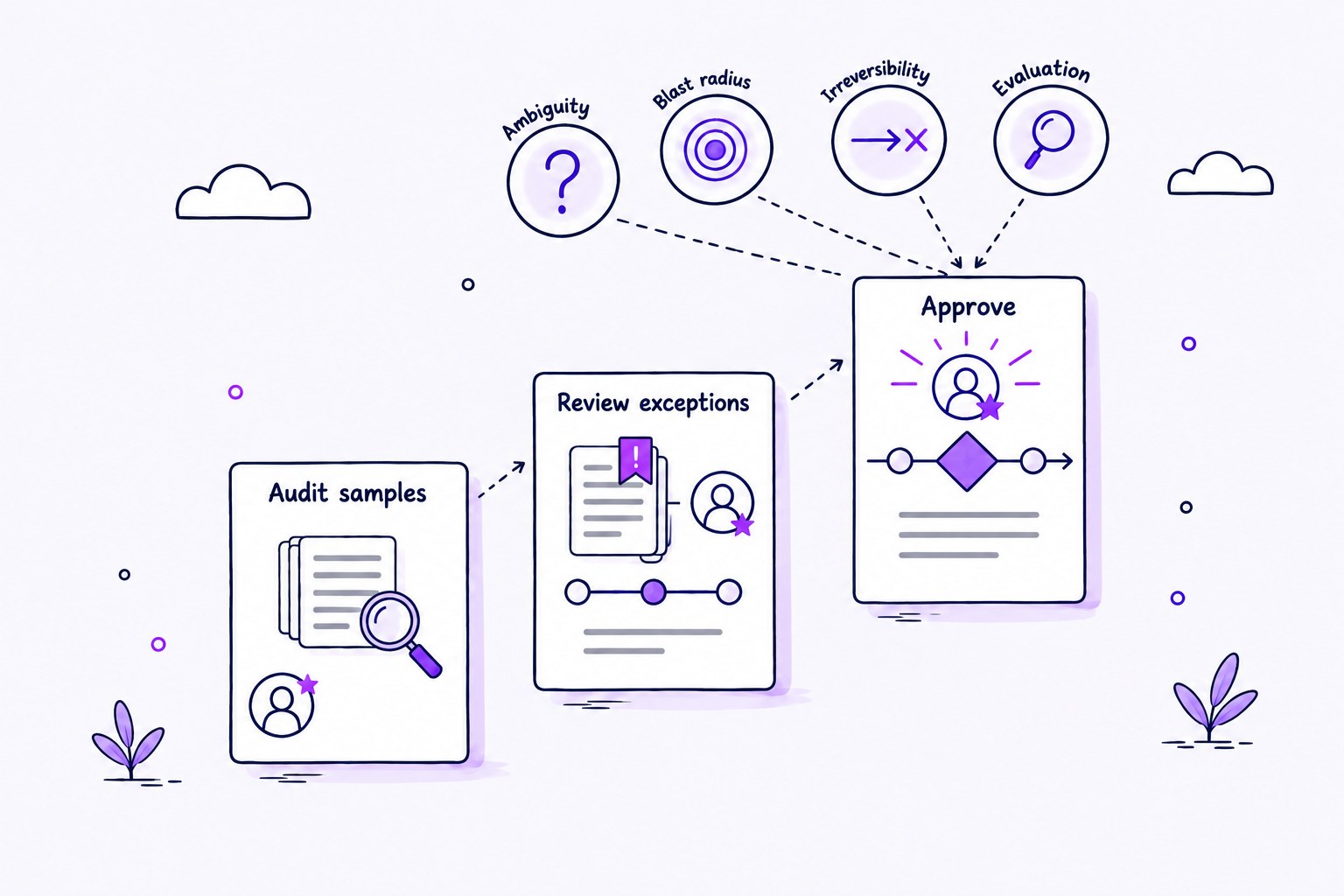
Checkpoint Patterns: Approve, Review Exceptions, Audit Samples
| Factor | Approve | Review exceptions | Audit samples |
|---|---|---|---|
| Ambiguity | High: several defensible answers | Moderate: most cases are clear, some are not | Low: answers are well defined |
| Blast radius | Wide: errors reach many readers or clients | Contained: errors affect a limited set | Narrow: errors stay local |
| Irreversibility | Hard to undo once published or sent | Fixable with some effort | Easily reversed |
| Difficulty of evaluation | Only an expert can judge correctness | Checks work for most cases but miss some | Machines can verify the result |
Treat this as a starting point. The same workflow will often use all three patterns at different steps.
A HITL design checklist helps pull it together:
-
Where to add input: Strategy, brand context, proprietary data and the definition of quality.
-
Where to add intervention: Conflicting evidence, strategic ambiguity, unusual risk and irreversible actions.
-
What to automate: Research, drafting, scoring, comparison, routing and anything mechanically verifiable.
-
What to audit: Samples of routine output and the behavior of the evaluators themselves.
Make Every Human Correction Improve the System
A human correction should fix the cause as well as the artifact. Fixing one article is a repair, while changing why it was wrong moves the workflow forward.
Why Repeated Fixes Signal HITL Failure
If a person keeps fixing the same issue, that isn’t successful HITL. The workflow has failed to capture the lesson, and you’re paying expert rates for the same correction over and over.
Feeding Escalations Back into Context, Evaluators, Rules, Tools, and Permissions
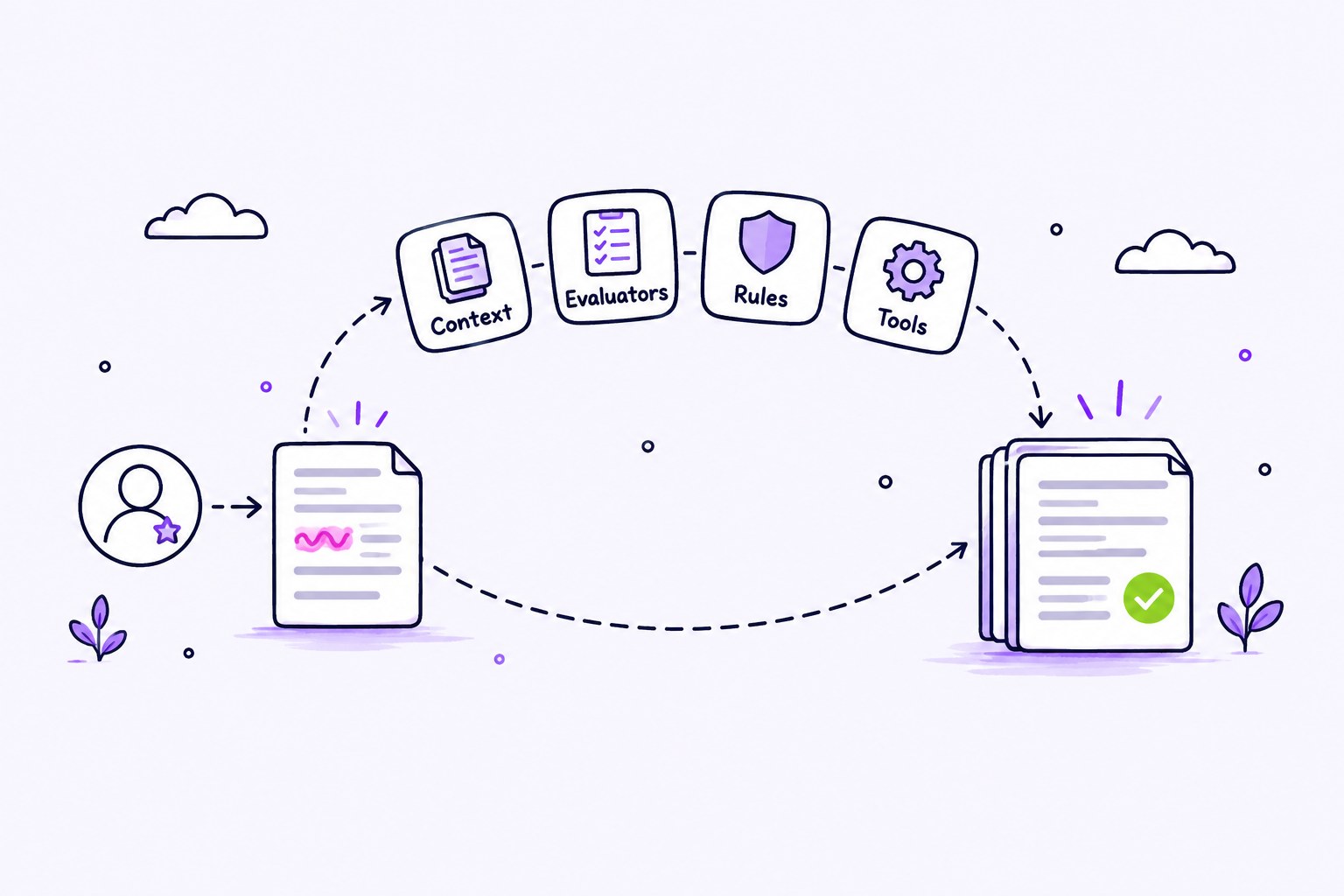
Escalations should feed back into context, evaluators, rules, tools or permissions, so the same class of issue needs less human attention next time. Two cases show how this works in our operations. When an editor resolves a conflict between authoritative sources, the reasoning informs the source hierarchy, and similar conflicts get handled consistently. When a tone or brand issue recurs, it moves into the brand context and the checks that score drafts. You want a shrinking pile of repeat escalations, with human time going to new problems.
Case Study: Rebuilding a 450+ Article Agency Workflow
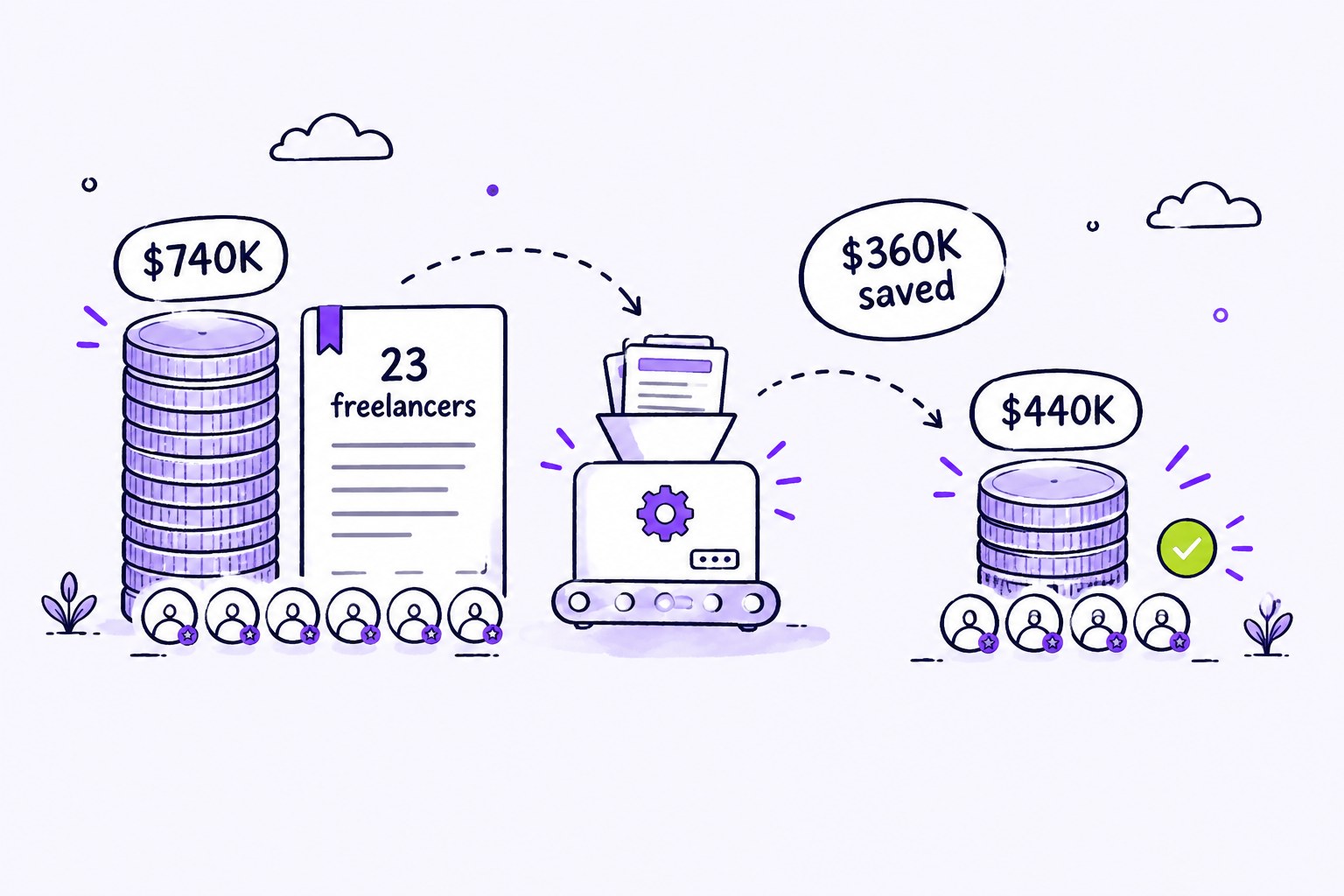
We rebuilt the workflow for an agency producing 450+ articles monthly. We keep the agency unnamed.
| Before | After | |
|---|---|---|
| Articles per month | 450+ | Same volume |
| Clients | 130 | Same |
| Freelancers | 23 | 23 freelancer roles displaced |
| Internal team | Six members | Lean team of four |
| Writing costs | About $740K per year | About $440K per year |
That’s roughly $360K per year saved. More broadly, typical gains can range from 25-50% lower writing costs and 5-10 hours per week saved per freelancer managed. Results vary by industry, competition and execution.
What Moved into the System and What Humans Now Own
Repetitive drafting moved into the workflow. Humans didn’t disappear, but their value moved to what stayed scarce: defining standards, expert input, QA, judgment, strategic direction and accountability. Quality and consistency also improved, though that’s our observation rather than a tracked metric. And the shift wasn’t free: 23 freelancer roles went away.
What Research Says About Human in the Loop AI
The research backs a selective design. A systematic review in Entropy on PubMed Central separates in-the-loop, where a person authorizes an action before the workflow proceeds, from on-the-loop, where the system operates while a person monitors and may intervene. It also names scalability of oversight and cognitive limits such as fatigue and attention lapses as ongoing challenges, with tiered oversight and sampling-based audits as responses.
Databricks points out that HITL does not necessarily mean a person approves every output, and warns that poorly designed HITL creates bottlenecks and the appearance of oversight without meaningful control. It describes three patterns: approval before high-impact actions, exception-based review, and periodic audits.
The NIST AI Risk Management Framework says human-AI arrangements sit on a spectrum with fully autonomous at one end and fully manual at the other, and that some systems may not require oversight while others do. It calls for defined roles, assigned accountability and processes for override and incident response.
A 2026 arXiv study of oversight for computer-use agents compared action confirmation with risk-gated oversight. Repeated confirmations can feel tiring and inefficient, no single strategy was uniformly best on subjective measures, and tighter control doesn’t automatically yield better oversight.
Common Human in the Loop Mistakes to Avoid
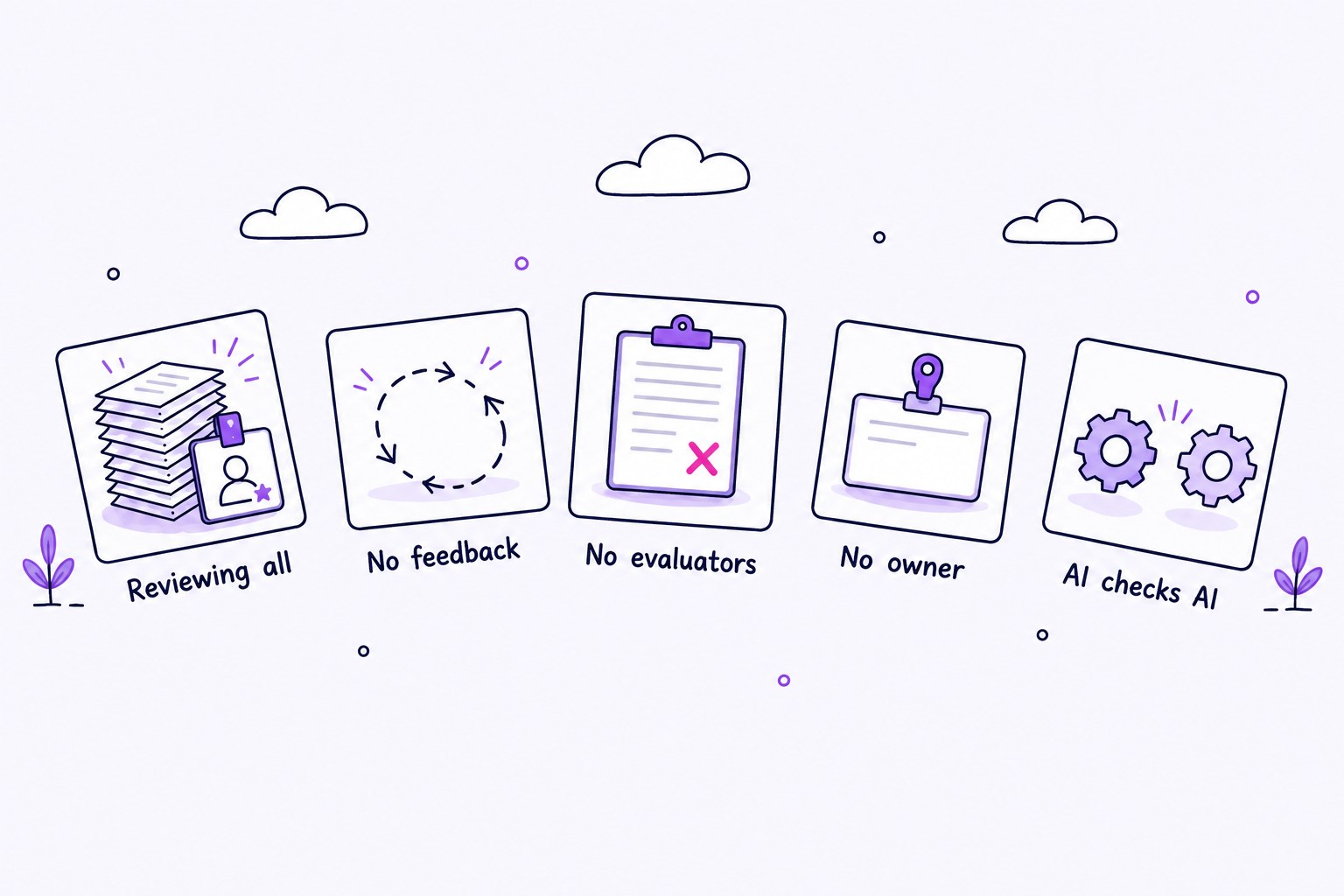
Most HITL failures come from a few repeat patterns:
-
Reviewing every output. Route by risk and audit the rest.
-
No feedback loop. Each escalation should change the context, evaluators, rules or tools, not just the article that triggered it.
-
Approving without evaluators. A reviewer with no defined standard is guessing.
-
Unclear ownership. Name who owns the outcome and who resolves each type of exception.
-
AI verifying AI without evidence. Require retrieved sources before one model signs off on another’s work.
Applying Human in the Loop AI to Your Own Workflow with SEOwind
Start with the ownership split. Decide what your people define, what the workflow executes, and what deterministic checks verify. Then place input upstream, intervention at the real boundaries, and audits everywhere else.
How SEOwind Applies HITL
SEOwind is a white-label content production partner for marketing agencies. Our CyborgMethod is a structured AI system plus humans, where AI handles structure and speed while humans step in for tone and accuracy. Our AI article writing workflow runs brief, draft, score, refine, with research agents, RAG grounding and automated quality gates that auto-refine or flag failing content. Human QA steps in where subtlety, tone or risk matters. Delivery is CMS-ready and white-label.
Agency onboarding starts with a five-article pilot. The client approves the first batch, we fine-tune the workflow, then we scale. You supply keywords, topics, published examples, a point of contact and brand guidelines or samples. We handle research, briefs, drafting, EEAT and brand checks, and final QA.
Next Step
If you want human in the loop AI that protects your team’s judgment instead of spending it, see how we work For Agencies.