
Your brand shows up in ChatGPT through two separate channels, what the model learned in training and what ChatGPT retrieves at answer time, and each rewards different work. Most ChatGPT SEO advice treats ChatGPT as one black box and hands you one list of tactics. We produce 2,500+ articles monthly for 500+ clients across 100+ countries, so we see what holds up at scale and what doesn’t.
What Is ChatGPT SEO? A Clear Definition
ChatGPT SEO is the practice of improving how often and how accurately a brand appears in ChatGPT answers, through both what the model has learned from the public web and what ChatGPT retrieves and cites at answer time. It treats training-data presence and retrieval as two distinct channels, and it is one part of generative engine optimization (GEO). No tactic guarantees a mention, a recommendation, or a citation.
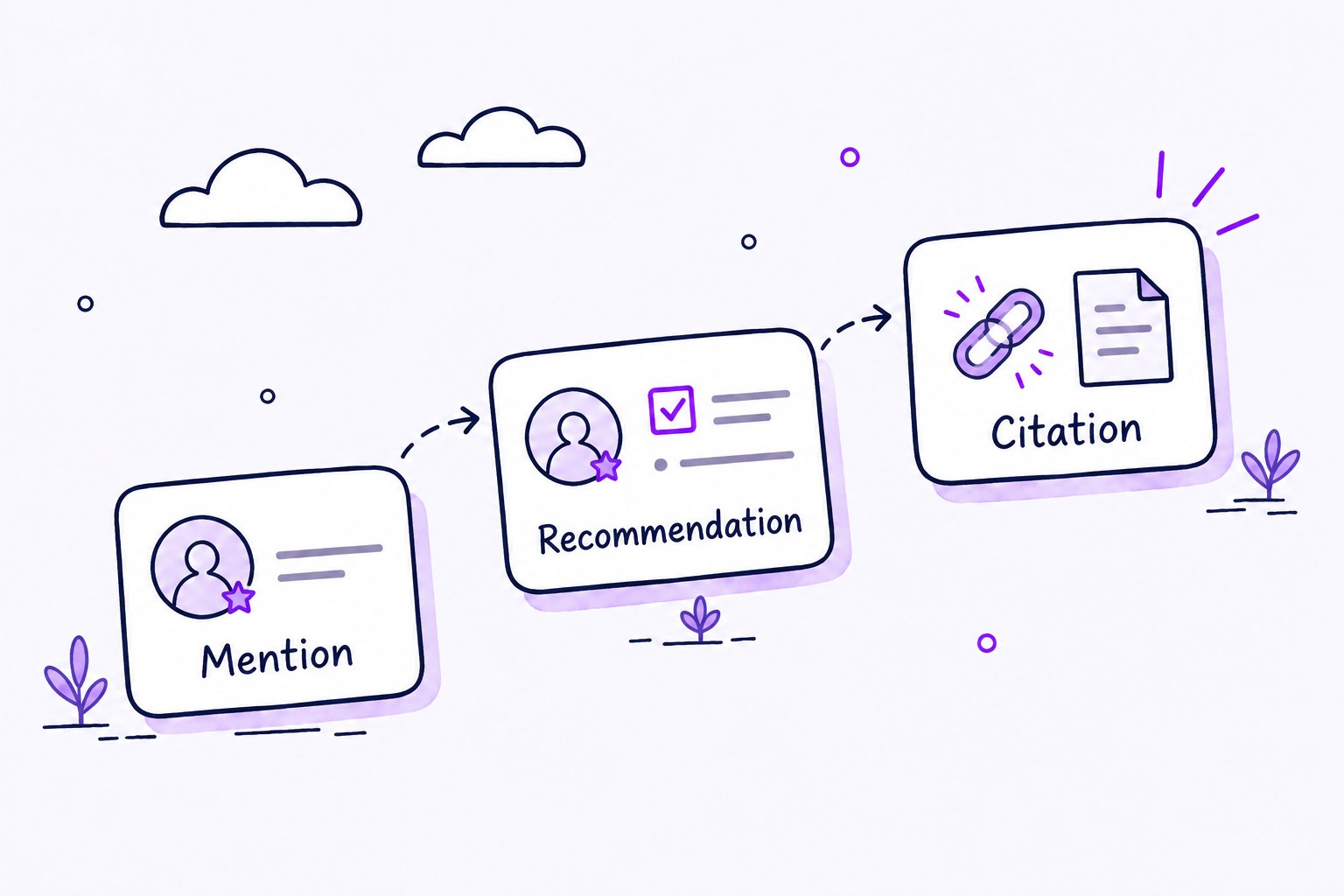
A mention names your business. A recommendation presents it as suited to a particular need, and a citation links out to a source that backs up the answer. The goal is relevant buyer visibility and accurate descriptions, and piling up more content doesn’t get you there by itself.
ChatGPT SEO vs. Using ChatGPT for SEO
ChatGPT SEO improves your brand’s visibility inside ChatGPT answers, while using ChatGPT for SEO means treating it as a tool for tasks like drafting metadata, organizing keywords, summarizing analytics, or outlining articles. People searching “can ChatGPT do SEO optimization” often blur the two. The tool can speed up the second job, but on its own it does nothing for the first, and a page written with ChatGPT is no more likely to be cited because of it.
How ChatGPT SEO Differs From Google SEO
ChatGPT SEO differs from Google SEO because Google returns a ranked list of pages, while ChatGPT synthesizes one answer that may combine several sources and may never send a click. Useful content, clear positioning, technical access and accuracy matter in both. The mechanics and measurement differ.
| Criteria | ChatGPT Search | |
|---|---|---|
| How it works | Crawling, indexing, serving (Google) | Turns a question into queries, retrieves results, answers with source links (OpenAI) |
| Ranking vs. citation | Automated ranking systems weigh many signals to order pages by relevance and usefulness (Google) | Synthesizes one answer with cited sources; selection weighs multiple factors and placement is not guaranteed (OpenAI) |
| Technical prerequisites | Googlebot can crawl and index the page; structured data gives explicit clues about page meaning (Google) | OAI-SearchBot allowed in robots.txt, and OpenAI’s published searchbot IPs permitted by your host or CDN (OpenAI) |
| Measurement | Impressions, clicks, CTR and average position in Search Console’s Performance report (Google), plus organic sessions in analytics | Visible citations and a Sources control (OpenAI). In our own tracking we also look at analytics referrals, citation frequency, sentiment and share of voice. |
| Update speed | Recrawling a changed page can take a few days to a few weeks (Google); robots.txt is generally cached for up to 24 hours (Google) | A robots.txt change can take about 24 hours to affect Search systems (OpenAI) |
How ChatGPT Sources Answers: Training Data vs. Retrieval and Browsing
ChatGPT can answer from what the model learned, from retrieved web results, or from both. The tactics for each are different, so mixing them wastes budget.
Channel 1: Training Data and Long-Term Brand Mentions
Training data is the first channel: what ChatGPT’s models learned before anyone asks a question. OpenAI says its models are developed from publicly available internet information from third-party partnerships, and information that users, human trainers and researchers provide or generate (OpenAI). Training means learning patterns and adjusting parameters. Models do not retain copies of the material, and they may learn to recognize public figures and well-known entities (same source).
Publishing a page does not instantly change what a model knows. Nobody can trace a brand mention to a specific training document. Brand-mention building is a long-term visibility approach with no documented mechanism behind it, and we won’t pretend otherwise.
Channel 2: Retrieval, Search, and Citable Content
Retrieval is the second channel: ChatGPT searches the web at answer time and can cite the pages it uses. It may search automatically when a question would benefit from current information, or users can choose Search manually. It may rewrite a prompt into targeted queries and send follow-up queries after reviewing initial results (OpenAI). Retrieval reaches fresh information without retraining. Accessible, relevant pages can contribute when the system finds and selects them.
Citations can be incomplete, outdated or incorrect, so OpenAI advises opening cited sources to check them (same source). A citation shows a page supported a retrieved answer. It does not show the page was in training data.
Why Most ChatGPT SEO Advice Conflates the Two Channels
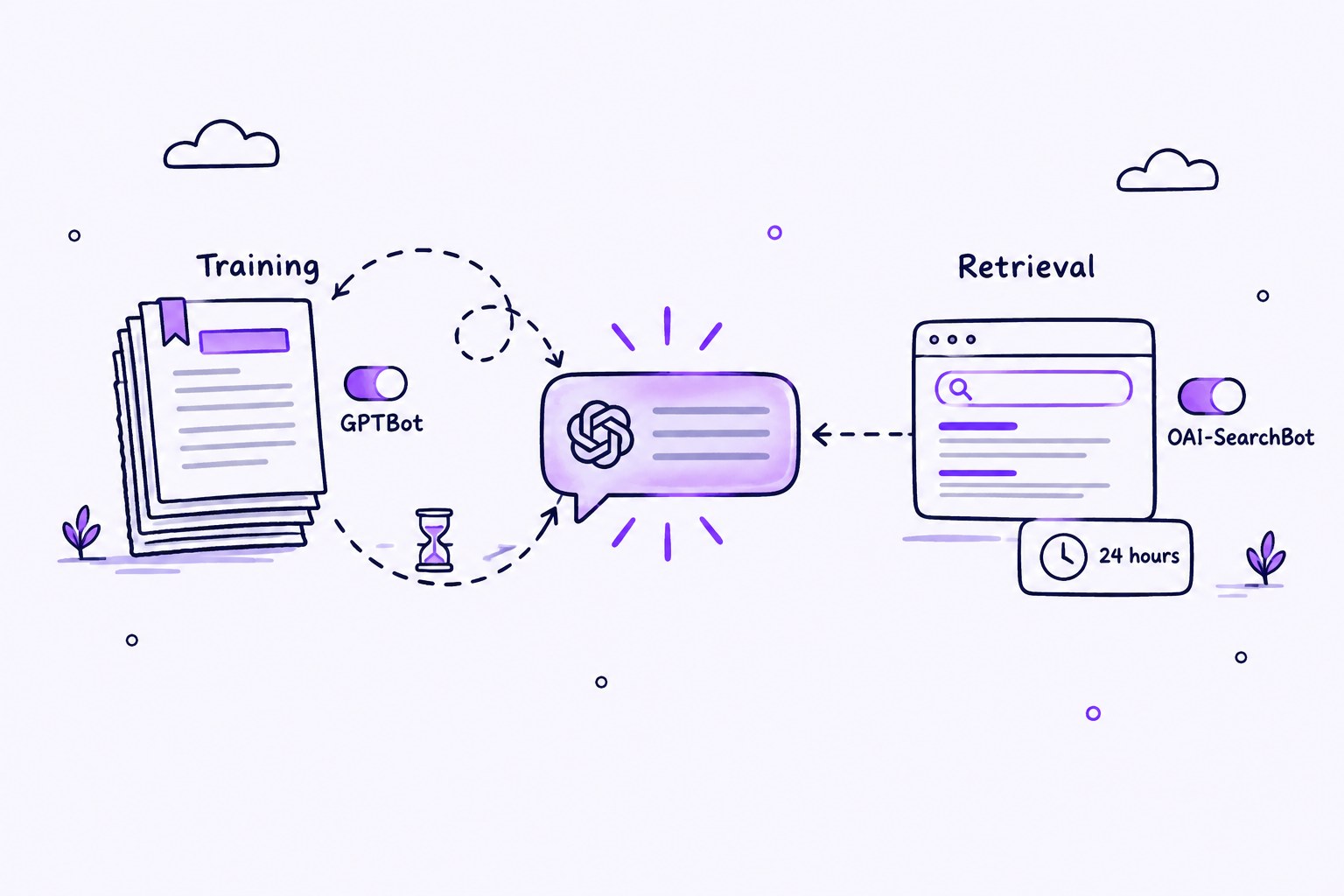
Most ChatGPT SEO advice conflates the two channels because it bundles brand mentions and crawler access into one checklist, as in “get mentioned everywhere and fix your robots.txt.” Those are two jobs, and they differ in levers, timelines and controls.
| Factor | Training | Retrieval |
|---|---|---|
| Lever | Public web presence and brand mentions | Crawlable, citable pages |
| Time horizon | Long term | Robots.txt changes take about 24 hours to affect Search (OpenAI) |
| Control | GPTBot can be allowed or disallowed in robots.txt (OpenAI). What a model learns cannot be directly controlled. | The OAI-SearchBot setting, independent of GPTBot (OpenAI). Placement is not guaranteed. |
How ChatGPT Decides Which Brands to Recommend
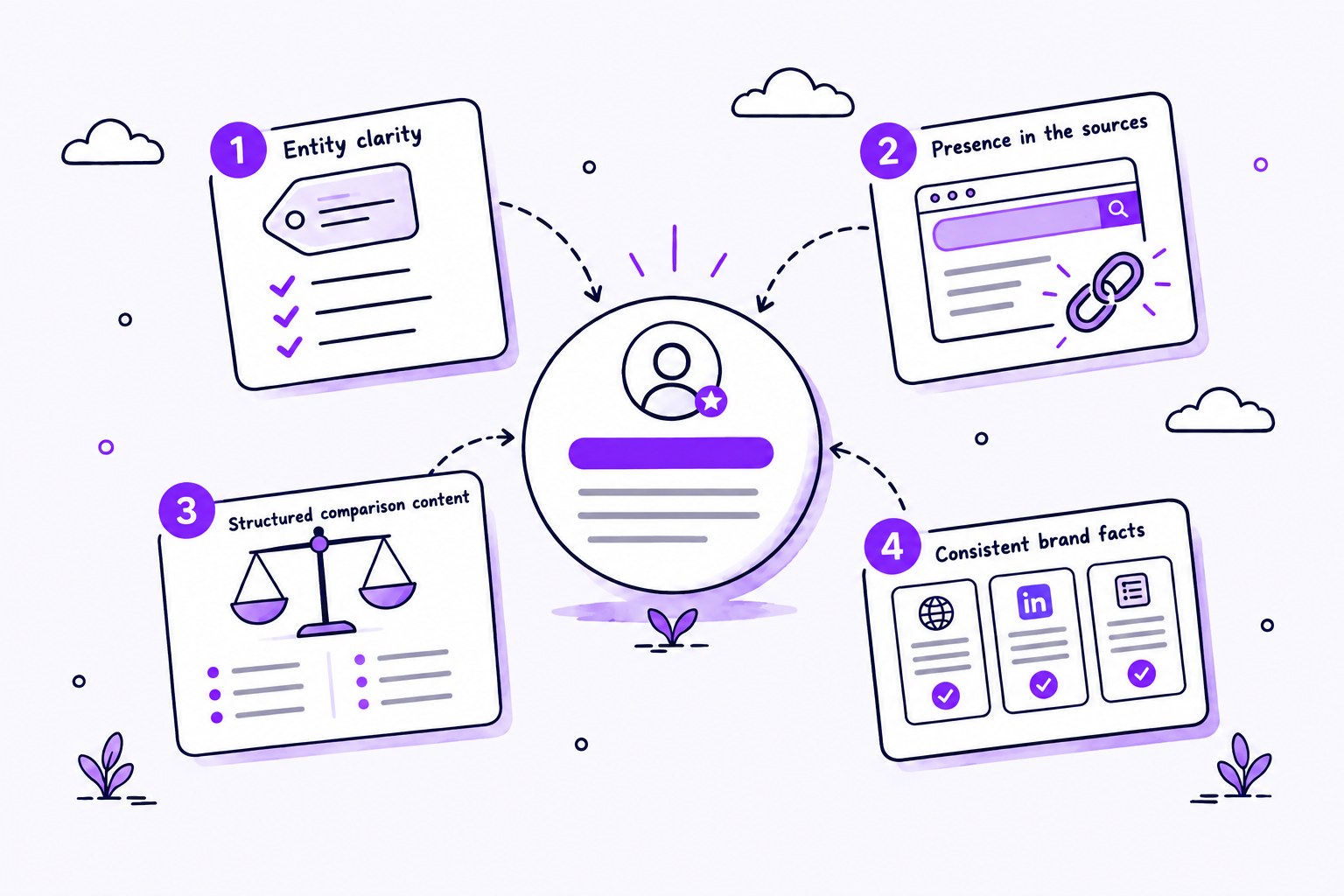
ChatGPT decides which brands to recommend through a selection process OpenAI doesn’t publish, so no single format or authority metric guarantees inclusion. In our client work, four practices come up again and again: entity clarity, presence in the sources ChatGPT retrieves from, structured comparison content, and consistent brand facts across the web. Treat them as practical content habits. They are not confirmed ranking factors.
Entity Clarity
Entity clarity means a reader or a machine can tell what you are and who you serve. A clearly described niche offering can beat a broadly positioned brand for a specific need. Say plainly what your category is, who your customers are, and where you operate, then add the use cases and differentiators that set you apart.
Presence in the Sources ChatGPT Retrieves From
Presence in retrieved sources means your brand appears on the pages ChatGPT finds and selects, both your own and third-party pages that discuss you. Expert contributions and credible coverage can become retrieval sources, and guest posts can too. Back claims with verifiable evidence instead of promotional language.
Structured Comparison Content That Gets Cited
Structured comparison content answers the “X vs. Y” and “best X for Y” questions buyers ask, so comparison pages deserve real investment. A citable page has:
-
A descriptive heading structure and a short answer up top.
-
Buyer-relevant criteria such as capabilities, limitations, integrations and public pricing.
-
Honest pros and cons, including when another option fits better.
-
A genuine update date.
Formatting helps readers use the page. Don’t expect it to work as a citation shortcut.
Consistent Brand Facts Across the Web
Consistent brand facts mean your site, LinkedIn, directories and review platforms all describe you the same way, because contradictions make your brand harder to describe accurately. Keep one verified reference sheet covering your name, one-sentence description, category, target customers, founders and pricing model, then audit every profile against it.
How to Optimize for ChatGPT Retrieval
You optimize for ChatGPT retrieval through three decisions: which OpenAI crawlers to allow, which buyer prompts to track, and which pages to make citable. It’s the channel you can influence on a short timeline.
Decide Which OpenAI Crawlers to Allow
Allow OAI-SearchBot if you want to appear in ChatGPT Search, and decide on GPTBot separately, since it governs training rather than Search. OpenAI runs three user agents, and each needs its own decision.
-
OAI-SearchBot controls ChatGPT Search eligibility: a site must allow it, and its host or CDN must allow OpenAI’s published searchbot IP addresses (OpenAI).
-
ChatGPT-User may visit a page in response to a user action. It isn’t an automatic crawler, it has no say in Search inclusion, and robots.txt rules may not apply to those visits (same source).
-
GPTBot is about training: publicly available pages may be used to train models, and site owners can disallow it in robots.txt (OpenAI).
The GPTBot and OAI-SearchBot settings are independent, so blocking training doesn’t remove you from Search (OpenAI).
Baseline the Buyer Prompts That Matter
The buyer prompts that matter come from sales calls and support tickets, written in the words customers actually use. Avoid prompts designed to force a mention. Keyword tools can inform topics, but search volume does not measure ChatGPT prompt demand. Cover four prompt types: “best X for Y,” “X vs. Y,” “alternatives to X,” and “how do I…”. For each, log mentions, citations, sentiment and which competitors get named. Answers are non-deterministic, so repeat each prompt and sample. That dated baseline is what you report against later.
Make Priority Pages Citable
Citable pages lead each section with the answer, back every number with a linked source, describe the brand consistently, and carry an honest update date. Schema helps machines read page meaning, but Google’s structured data guidance describes Google Search (Google), so don’t expect schema alone to earn ChatGPT citations. Padding doesn’t help either, since content length alone does not determine ranking (Google).
At scale, this is where AI article writing with human review pays off. Our CyborgMethod runs a brief, draft, score and refine loop, with RAG grounding facts in real sources and EEAT scoring before a person signs off.
How to Build Training Data Presence Through Brand Mentions
You build training-data presence by earning credible brand mentions across the public web, through expert contributions, guest posts, and real activity on LinkedIn, Quora and Reddit. This channel is slow and uncontrollable, so treat it as public brand development. In our experience, unlinked brand mentions count toward LLM visibility. Describe the problem you solve and who it’s for, then explain why your approach differs, because context beats repeated names.
Favor credible coverage over bulk mention campaigns, and keep product names and capabilities consistent with your own pages. Use AI for outreach prep and editing, but keep expert voices authentic. The same coverage may also become a retrieval source. Nobody can promise dataset inclusion or retraining schedules, and mention growth does not prove training influence.
How to Track and Measure ChatGPT SEO Performance
You track ChatGPT SEO performance by sampling a fixed set of buyer prompts and logging mentions, citations, sentiment and referral traffic, since no official ChatGPT SEO score or standard reporting exists. Answers vary by prompt, user and time, so track these separately:
-
Brand mentions, recommendations and linked citations.
-
Citation accuracy and the pages being cited.
-
Sentiment and share of voice within your tested sample.
-
Direct LLM referral traffic, with analytics (GA4, for example) configured to identify it.
Monitor which queries trigger brand mentions and in what context. Record test date, mode and whether ChatGPT searched. Your visibility figure describes a share of your sample only, and says nothing about exposure across all users. Attribution is leaky, since unclicked recommendations and later branded searches won’t show as ChatGPT traffic. Pair this with Search Console and web analytics, and judge qualified leads above raw mention counts. Faster, cheaper drafting is a production gain. It doesn’t prove better visibility.
Common ChatGPT SEO Mistakes to Avoid
The most common ChatGPT SEO mistake is confusing AI-assisted production with optimizing for AI answers. Avoid these too:
-
Treating training and retrieval as one channel with one budget.
-
Assuming every answer browses, or that a mention traces to one training source.
-
Declaring victory from one favorable answer.
-
Selling “AI visibility” without a dated baseline to report against.
-
Accepting invented keyword volumes or unverified citations.
-
Shipping high volumes of generic content with no editorial review.
-
Deploying AI-written robots.txt or schema untested.
-
Handing strategy and accountability entirely to AI.
Frequently Asked Questions About ChatGPT SEO
What is the difference between GPTBot and OAI-SearchBot?
GPTBot relates to model training, and OAI-SearchBot to ChatGPT Search eligibility. The settings are independent, so you can allow one and block the other (OpenAI).
Can ChatGPT do SEO for me?
ChatGPT can speed up SEO tasks like drafting metadata, grouping keywords and outlining articles. It can’t make your brand visible in ChatGPT answers, and a page written with ChatGPT is no more likely to be cited because of it.
Does ChatGPT always browse the web?
No, ChatGPT doesn’t always browse the web. It searches automatically when current information would help, or when users choose Search manually (OpenAI). Otherwise it answers from learned knowledge.
How long does ChatGPT SEO take?
ChatGPT SEO shows results fastest in retrieval: a robots.txt change can take about 24 hours to affect OpenAI’s search systems (OpenAI). Training-data presence has no published schedule, so judge it in quarters, not weeks.
Next Steps: Build Your ChatGPT SEO Plan With SEOwind
A ChatGPT SEO plan for clients starts with an initial audit, then monthly refreshes of priority pages, brand facts and prompt samples. In SEOwind partner engagements, agencies have seen 25-50% lower content costs and 5-10 hours saved per freelancer per week. These are ranges from past work, not promises.
SEOwind is a white-label content production partner for marketing agencies, and For Agencies shows how it fits. A few points worth knowing:
-
A structured workflow of brief, draft, score and refine, with human-in-the-loop review at every step.
-
RAG grounding in real sources, plus an EEAT scoring engine that triggers refinement.
-
CMS-ready, fully white-labeled delivery, starting with a sample test and pilot, then a feedback loop, then gradual scaling.
Go Deeper: GEO Pillar Guide and the Get Cited by ChatGPT Checklist
Read our LLM SEO guide for the wider picture. The Get Cited by ChatGPT checklist can help with implementation, but it doesn’t promise placement.