YMYL stands for “Your Money or Your Life,” and YMYL content is any content that could significantly affect a reader’s health, financial stability, safety, or society’s welfare. If you run an agency, that definition matters because one wrong claim can cost a client’s trust and eat your margin through endless revisions. Below, we cover how we decide what qualifies and how we handle YMYL content in production.
What Is YMYL Content? Definition and Why Google Holds It to a Higher Standard
In practice, YMYL content is information where an error can hurt someone. Consequences define it, and a subject label on its own settles nothing. A page that mentions money or health is not automatically in scope. Google’s standards track the potential for real harm.
What YMYL Stands For in the Quality Rater Guidelines
The term comes from Google’s Search Quality Rater Guidelines (QRG), which describe topics that could significantly affect health, financial stability, safety, or the welfare of society (Google). It is a spectrum: clearly YMYL, possibly YMYL, or unlikely YMYL. Clear cases get the most scrutiny when raters assess page quality.
Why Potential for Real-World Harm Raises the Bar
Readers often act on this kind of advice without the knowledge to spot a mistake. The guidelines note that even mild inaccuracies or less reliable sources can have significant consequences in areas like heart-attack symptoms, investing, earthquake response, voting eligibility, and driver’s-license qualifications. Google says this information must be highly accurate and consistent with established expert consensus, and its systems give more weight to strong E-E-A-T for these topics (Google Search Central).
We treat this as an editorial responsibility. Raters help Google assess its systems, and their ratings do not directly move individual pages up or down in Search.
Which Topics Qualify as YMYL
Topic labels are a starting point. The page’s actual claims, purpose, audience, and likely consequences set the level of rigor. Imagining a harmful use for an ordinary topic does not make it YMYL. The topic itself must have the potential to affect health, financial stability, safety, or society’s welfare.
Health, Safety, and Financial Security
Health covers mental, physical, and emotional well-being. Safety means physical and online risk. Financial security takes in anything that could damage someone’s ability to support themselves and their family, and investing is one example. The guidelines treat emergency-room guidance and buying prescription drugs as clear YMYL, along with tsunami evacuation routes. A car review or a weather forecast may be YMYL, and so might advice on how often to replace a toothbrush. Pencils are unlikely to be.
Government, Civics, Law, News, and Sensitive Groups
This bucket covers public-interest issues, trust in public institutions, and election information. The guidelines cite “who can vote” and driver’s-license qualifications as topics where inaccuracies could significantly harm people or society, and news on ongoing violence is a clear YMYL example (Google).
Don’t stretch this into a blanket rule. Not every legal or civic page is YMYL, and news isn’t automatically YMYL. Content about groups of people needs close scrutiny when it could encourage discrimination or hostility. Education, employment, and major purchases call for judgment case by case.
Decision Tree: Is Your Topic YMYL, and What Changes If It Is?
Run each brief through these questions before drafting. Answer for the page, not the website.
Questions to Ask About Harm and User Decisions
-
What will a reader believe or do differently after reading this page?
-
Could inaccurate information or missing context plausibly cause significant harm to a person or to society?
-
Does the page touch money, such as costs, obligations, or the ability to support a household?
-
Does it touch health, either physical or mental?
-
Does it touch safety, either physical or online?
-
Does it touch legal rights, responsibilities, or access to public services?
-
Would a reasonable reader consult a qualified professional or authoritative source before acting?
-
Is the consequence serious, rather than a mere inconvenience?
If the answer is yes to question 2 or 8, and to any of 3 through 7, treat the page as YMYL. A yes on question 7 carries a lot of weight. Treat the whole thing as a spectrum, and when you’re torn, move toward more rigor.

What changes if yes:
| Area | Standard page | If it’s YMYL |
|---|---|---|
| Sourcing | Credible sources | Primary or authoritative sources, with corroboration for consequential claims |
| Author credentials | Knowledgeable writer | Accurate byline and qualifications matched to the topic |
| Review steps | Editorial QA | Added verification plus qualified human review where judgment is needed |
| Update cadence | Periodic refresh | Owned review schedule, triggered when rules or guidance change |
Gray Areas and Page-Level Classification
Classify the page and its claims separately. Google’s ranking systems work at the page level using a variety of signals, and they also use site-wide signals and classifiers (Google Search Central). Page type alone doesn’t determine quality either. Purpose and content do.
Picture a recipe blog with a single medication-advice page. The blog isn’t a YMYL site, but that page needs YMYL handling. Reassess whenever a draft slides from general explanation into recommendations or instructions. Publishers most often get burned right there.
The Elevated E-E-A-T Bar for YMYL Content
E-E-A-T means experience, expertise, authoritativeness, and trustworthiness. It is not a specific ranking factor (Google Search Central). Think of it as a lens for judging whether a page deserves trust, and for YMYL content the lens gets tighter.
Why Trust Outweighs the Other E-E-A-T Factors
Google states that trust is the most important member of the family, and the others contribute to it. Credentials cannot rescue a page that is deceptive or unreliable. The practical signals are clear sourcing and visible expertise, plus an absence of easily verified factual errors. Accurate bylines are encouraged, and fabricated author identities or credentials make a page untrustworthy.
How Quality Raters Separate Low from High E-E-A-T on YMYL Pages
Low E-E-A-T shows up as unsupported claims or unclear accountability, and sometimes as contributors whose qualifications don’t match the page’s purpose. Stronger pages combine reliable main content, appropriate contributors, transparent sourcing, and clear responsibility. Safe, clearly framed personal experience has value, but it can’t replace professional expertise when a page gives specialized advice. Author bios and editorial policies help readers judge credibility. They aren’t shortcuts, and structured data can’t manufacture trust.
How SEOwind Runs YMYL Checks: Stricter Gates on the Same Pipeline
We don’t run YMYL as a separate, riskier product. We apply stricter gates to the same pipeline. At SEOwind, a white-label content production partner for agencies, we run the CyborgMethod: a structured AI system plus humans, where AI handles structure and speed and humans handle judgment and accuracy. The workflow is brief, draft, score, refine, with a human in the loop (HITL) at each step. It uses a multi-agent AI system, RAG grounding in real sources, an EEAT scoring engine, and automated quality gates that trigger refinement.
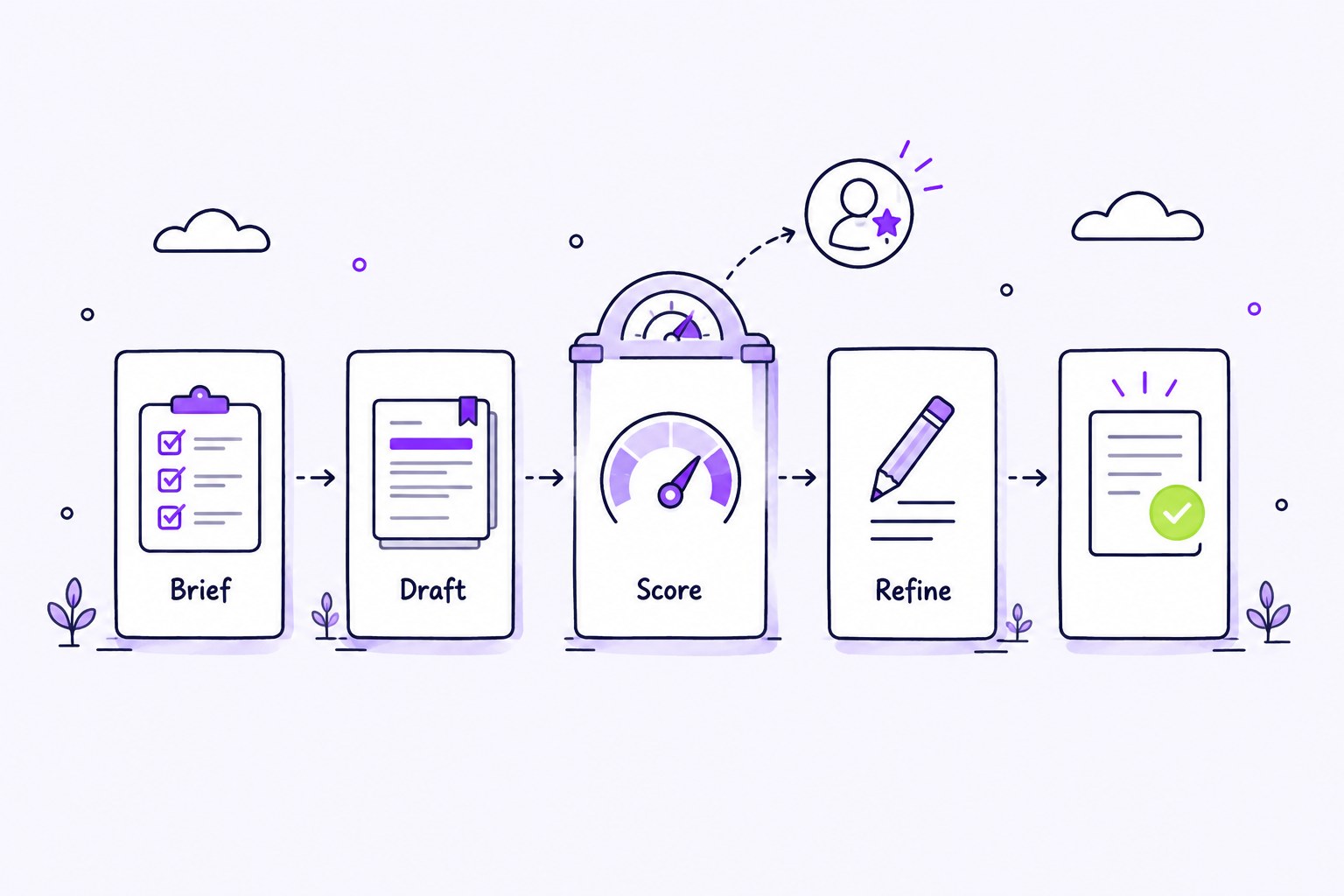
Our standard fact-check gate runs 50+ checks per article. For YMYL work, we run the same gate with tightened thresholds and mandatory human escalation. In client production it exists as a distinct workflow step, so we’re committed to it operationally. The process is our own, and Google doesn’t require it. Verification applies to every article, and higher-risk categories like health, financial stability, and safety get more editorial depth and human scrutiny.
Claim Verification Against Source Quality Thresholds
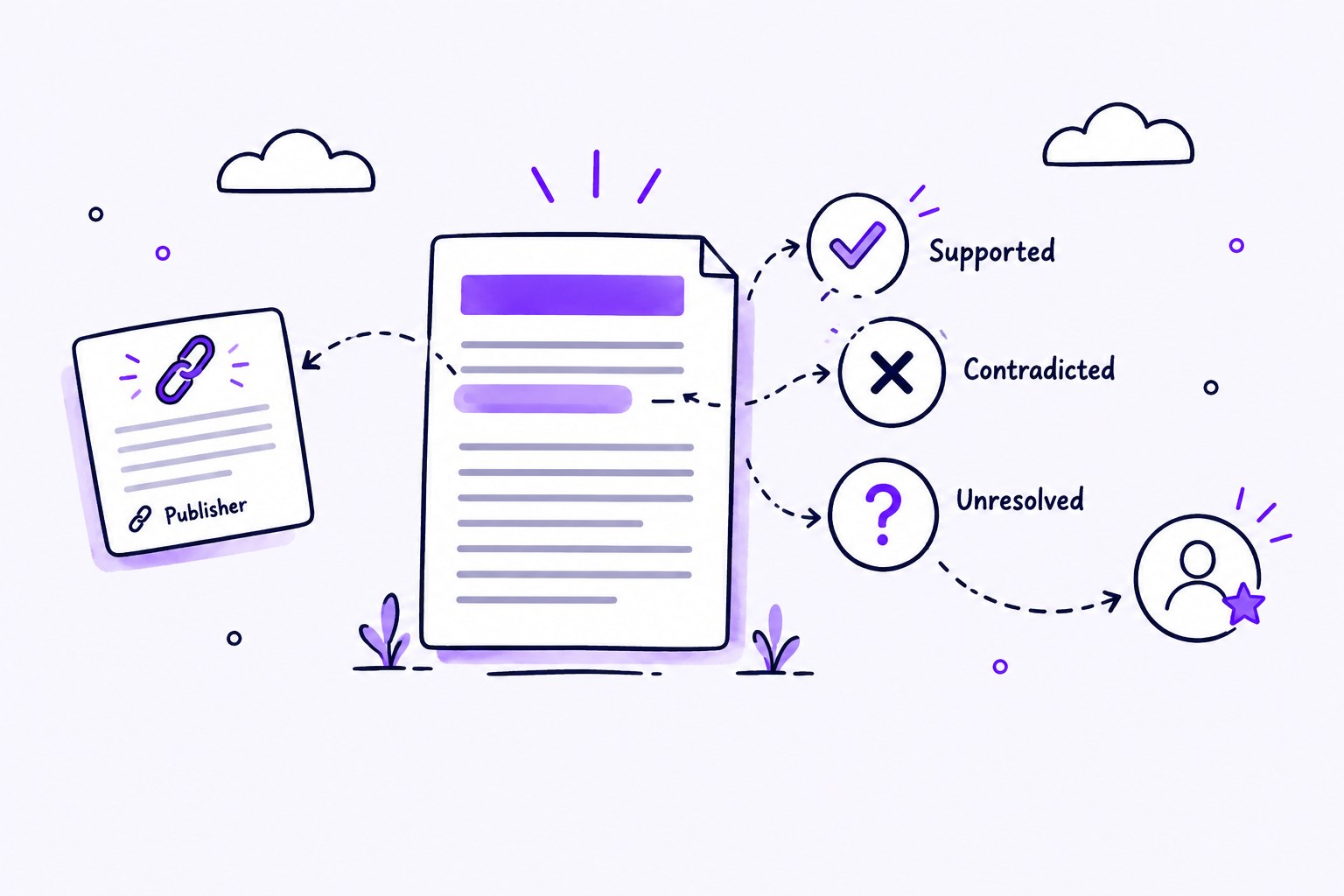
Every checkable claim is verified against evidence and marked supported, contradicted, or unresolved. A source-quality check asks whether a source meets a credible bar and actually supports the claim, instead of just covering a related topic. A citation existing proves nothing. When a claim is corrected, we recheck the conclusions and tables built on it, along with any comparisons or recommendations. One fixed number can quietly break a table three sections later.
Strict Attribution: Every Claim With a Link and Publisher Name
Every claim carries a link and the publisher name. That lets reviewers and readers separate substantiated facts from interpretation or opinion. Vague claims get cut, so clients send back fewer revision rounds, and your margin stays intact.
Expert Review Triggers and Mandatory Human Escalation
Simple defects trigger revision, while anything that needs judgment goes to a human. Escalation happens when:
-
Source evidence conflicts
-
Expert input is missing
-
Evidence is weak or unavailable
-
YMYL or compliance risk is high
-
Domain expertise is needed
-
Evaluation remains uncertain
AI doesn’t replace expert sign-off in this model. Google says AI output should be manually fact-checked and reviewed for accuracy before publication, and mass-produced pages without added value may violate its scaled content abuse policy (Google Search Central). Appropriate AI use isn’t against its guidelines, though (Google Search Central). The approaches compare like this:
| Generic AI one-prompt output | Freelancer-only workflow | SEOwind CyborgMethod | |
|---|---|---|---|
| Claim verification | Left to the editor | Depends on the writer | Built-in gate with supported, contradicted, or unresolved marking |
| Attribution | Often missing or unchecked | Varies by writer | Link and publisher name on every claim |
| Expert review | None by default | Arranged ad hoc | Defined escalation triggers |
| Scalability | High | Limited by headcount | High, with gates intact |
| Turnaround | Fast, then slowed by rework | Varies with availability | Structured, repeatable workflow |
| Human oversight level | Low | High but inconsistent | HITL at each step |
What YMYL Rigor Looks Like in Health Insurance and Automotive Content
In the QRG framing, a car review is a possible-YMYL example, while health and financial-security content is judged by potential harm. Our automotive clients cover a wide range. A general model comparison sits low on the spectrum. A page with wrong financing language or a misstated safety spec sits much higher. In health insurance, a wrong dosage-adjacent claim or a misdescribed coverage term has real consequences for access to care and household costs. Verification therefore sits before publishing, well ahead of any complaints.
The kinds of checks differ by vertical.
-
For health insurance, we check coverage details and plan terms against insurer or regulator pages. We also state eligibility conditions, dates, and geographic limits so a general explanation isn’t mistaken for universal guidance.
-
For automotive, we check specs against manufacturer spec pages and avoid presenting instructions as universal when they depend on vehicle configuration.
In both, we separate firsthand observation from documented fact, disclose commercial relationships, and review pages when policies or technical guidance change. We don’t offer medical, legal, or financial advice, and neither should your content.
Results vary by niche, competition, and execution. Rigor positions content to earn trust, but it can’t guarantee rankings.
YMYL Content Checklist and Common Mistakes Before You Publish
Copy this into your CMS or QA doc:
-
Page purpose and audience confirmed, risk level assessed
-
Every consequential claim verified against a credible source
-
Each citation supports the exact claim, not just the topic
-
Link and publisher name attached to every claim
-
Statistics carry a current date and jurisdiction
-
Author named, with accurate credentials
-
Reviewer qualified for the subject, with an accurate role description
-
Limits and assumptions stated, along with any exclusions
-
Downstream tables and recommendations rechecked after corrections
-
Title and headings do not overstate certainty
-
Sponsorships and affiliate ties disclosed
-
Publisher identity and contact details easy to find
-
Unresolved or conflicting evidence escalated to a human
-
Owner assigned for future reviews and corrections
Common mistakes and fixes

-
Unsourced statistics. Attach a source or cut the number.
-
Anonymous authors. Add an accurate byline. Never invent credentials.
-
Outdated figures. Recheck against the current source before publishing.
-
Generic disclaimers used instead of accuracy. Fix the claim first. A disclaimer is context, not protection.
-
Decorative citations. Confirm the source says what you claim.
-
Date refresh without a review. Update the date only after checking the substance.
If you want this gate running inside your production, see our services For Agencies. To see how the drafting side works, read about our AI article writing.
FAQ
Does YMYL Apply to Every Page on a Site?
No. Assess each page’s topic, claims, and potential consequences. Site-wide accountability and reputation still matter, and Google’s systems use both page-level and site-wide signals. Mixing YMYL and non-YMYL pages does not force you to split the site, but editorial standards should stay consistent.
Is YMYL a Ranking Factor?
No. YMYL is a concept in Google’s Search Quality Rater Guidelines used to evaluate search quality. It is not a direct ranking factor or score. E-E-A-T is not a specific ranking factor either, and raters do not directly affect rankings.
Can AI-Assisted or Small-Site Content Rank for YMYL Topics?
It depends on whether the content meets Google’s quality criteria, and nothing here promises a small site will rank. Appropriate AI use is not against Google’s guidelines, but AI gives no special ranking advantage. Useful, original content that demonstrates E-E-A-T may do well. Publishers stay responsible for accuracy, and AI cannot supply firsthand experience or professional accountability. Relevance and competition still shape results, as does how well the work is executed.
Conclusion
Strong YMYL content comes from judgment applied at the page level, then enforced through verification, attribution, and human escalation. Stricter gates on the same pipeline keep revision cycles short and client risk low.