
Most conversations about AI content creation workflow start with a tool comparison. Ours doesn’t. We built something at SEOwind by asking a different question: what does a skilled human content team actually do when nobody’s watching the clock, and how do you make that process run at scale without falling apart at high volume?
We didn’t need a faster writer. We needed a system that could execute the entire content creation process without quietly skipping the difficult parts.
Rebuilding the Human Content Process, Not Compressing It
A lot of content automation software tries to shrink the writing process down to a single prompt. Type in a keyword, get a draft. Skip enough steps and you end up with generic structure and claims nobody bothered to check.
The Core Thesis: What Good AI Systems Do Differently
Good AI systems do what good humans should do: understand the assignment, research, plan, write, notice what’s missing, research again, evaluate, verify, and revise. No skipped steps, no fatigue, no deciding three sources are enough because it’s late. We didn’t set out to build an AI writer. Writing is one capability inside a much larger system, and treating it as the whole system is where most content automation platforms go wrong.
The LLM as Reasoning Engine, Not Database
An LLM reasons. It doesn’t remember. It doesn’t “know” your product roadmap or last quarter’s case study. What it does well is reason over context you feed it, evidence you retrieve, and knowledge you connect through tools like RAG. Our Research Agent uses RAG specifically to prevent hallucinations, so claims get grounded in retrieved sources instead of whatever the model happens to guess. Expecting a model to recall facts is a design mistake. Feeding it the right evidence and letting it reason is the actual job.
Workflow vs. Agent: Two Different Jobs
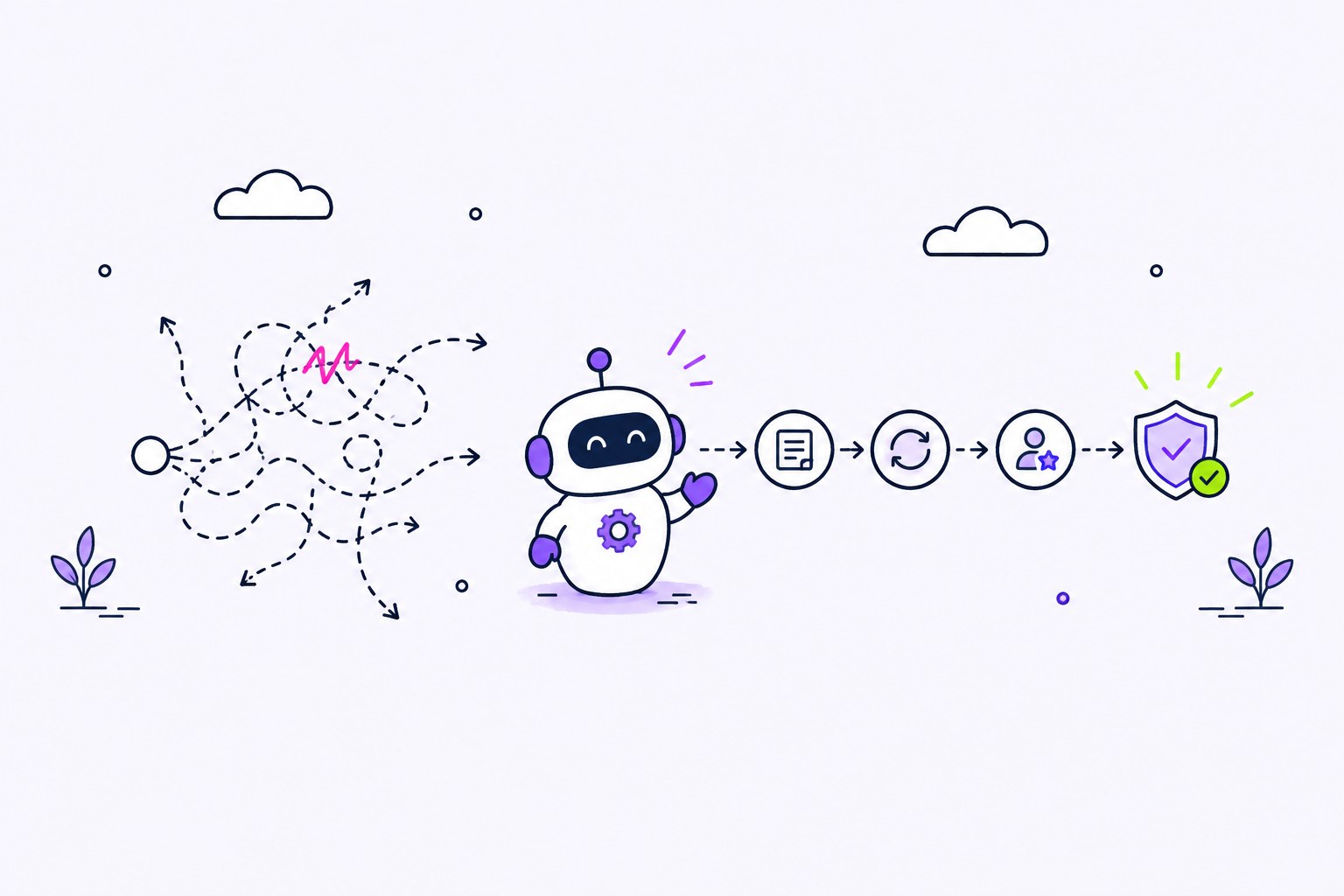
People use “workflow” and “agent” interchangeably when talking about AI content workflows, and that causes real confusion, because the two do different jobs.
Anthropic frames it well: workflows are systems where LLMs and tools get orchestrated through predefined code paths, while agents dynamically direct their own processes and tool usage. Anthropic also recommends finding the simplest solution possible and only adding complexity when needed. We agree, and we’ve felt the cost of ignoring that advice firsthand. A fully autonomous agent deciding its own next steps sounds exciting on paper. In practice it’s unpredictable, harder to debug, and often no better than a well-designed sequence.
Agents Handle Jobs, the Workflow Handles the Process
An agent might research, retrieve, or write. The workflow decides the sequence: it tracks state, manages context handoffs, sets retry logic and budgets, defines stopping conditions, enforces quality gates, and knows when to escalate to a human. Predictable workflows with agentic capability at specific stages consistently beat fully autonomous agents left to negotiate among themselves.
The AI Content Creation Workflow From Input to Finished Article
Before getting into the architecture underneath it, let’s zoom out and look at what actually happens to an article.
At a high level, our AI content creation workflow looks like this:
Validate → Research → Brief → Outline → Research → Write → Evaluate → Research or Revise → Fact-Check → Final QA
That looks linear on paper. It isn’t. When the evidence or output isn’t good enough, the system moves backward, the same way a good writer goes back to research when a draft exposes a gap.
1. Validate the Assignment
That looks linear on paper. It isn’t. When the evidence or output isn’t good enough, the system moves backward, the same way a good writer goes back to research when a draft exposes a gap.
2. Research Before Deciding What to Write
Research starts with the search landscape and expands to trusted external sources, statistics, and the client’s own knowledge. It doesn’t decorate the article later. It decides the angle, the coverage, where competitors are weak, and what the article can credibly say.
3. Turn the Research Into an Executable Brief
The brief turns that evidence into instructions the rest of the system can execute: intent, structure, questions to cover, keywords, company and expert context, supporting facts, and constraints. The outline comes out of research, not out of an LLM guessing which headings usually appear for a keyword.
4. Research Again at the Section Level
This is where the workflow stops looking like the classic research → outline → write pipeline. Before writing each section, the system checks whether it has the evidence that section needs. If not, it researches again. Research isn’t one box at the start of the workflow. It’s a capability the system calls whenever the article needs more context.
5. Write From Evidence, Not Model Memory
The writer gets the brief, the section objective, the evidence, company knowledge, brand voice, SME material, and guidelines. Its job is to synthesize that material, not to fill gaps from training data.
6. Evaluate, Refine, and Loop Back
A finished section isn’t automatically a good one. The system checks whether it answered the question, whether the evidence holds up, and whether anything is generic, unsupported, or off-brief. What failed decides what happens next: rewrite, find better evidence, add company or expert context, or research again.
7. Fact-Check the Finished Article
Once the article is assembled, every checkable claim is verified against evidence and marked as supported, contradicted, or unresolved. Corrections can ripple through the rest of the article, which we cover in Pass 4.
8. Route the Finished Piece Through Final Quality Control
The article is evaluated as a whole. Simple problems trigger another revision. Anything that needs a judgment call goes to a human.
That’s the content creation workflow from the article’s perspective. Underneath it, we organize the work into four major passes that control how research, writing, verification, and state move through the system.
Under the Hood: The Four-Pass Architecture
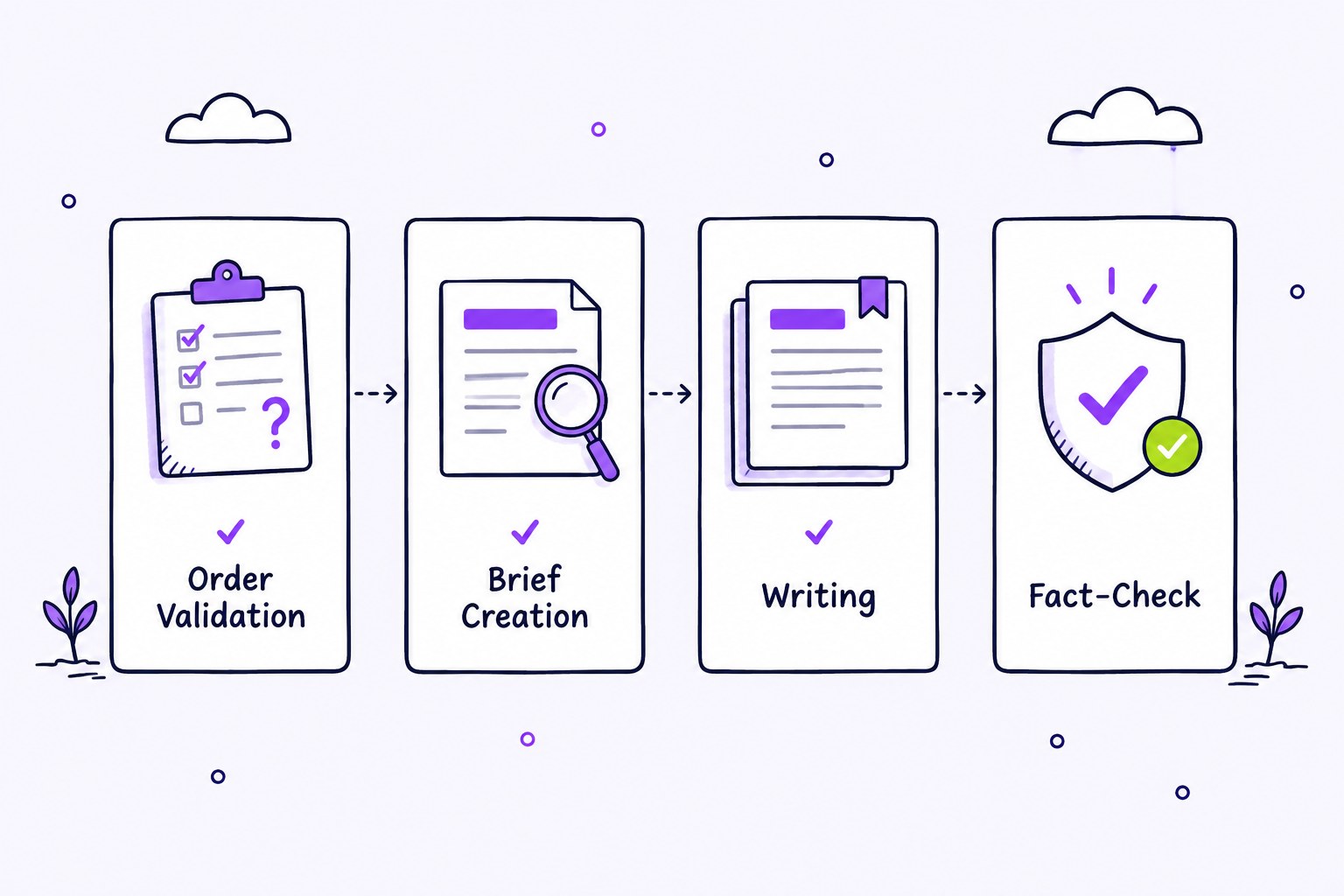
The workflow above describes what happens to an article. Underneath it, our system organizes that work into four major passes: order validation, brief creation, writing, and fact-checking.
Think of these as orchestration boundaries, not four simple steps. Each pass contains its own mix of specialist agents, retrieval steps, deterministic checks, evaluator calls, quality gates, and state updates, with clear rules for when work progresses, retries, loops back, or escalates.
Pass 1: Order Validation Before Research Begins
Validation gets its own pass because it’s the cheapest place to catch a mistake. The system checks whether the angle matches search intent, whether the audience, geography, and business goal are clear, and whether there’s a content type mismatch, conflicting instructions, missing company context, or a gap where SME input is needed but absent. YMYL and other high-risk topics get flagged here, not discovered mid-draft.
The cheapest content error to fix is the one that never reaches the writer. Every hour spent writing against a vague or contradictory brief is an hour you can’t get back.
Pass 2: Turning Research Into an Evidence Package
Gathering research isn’t the hard part. Our system pulls from SERP analysis, competitor structure, keyword and topic clusters, secondary intent, common questions, trusted primary sources, statistics, internal company knowledge, SME material, previous content, product information, brand positioning, and terminology. The hard part is turning all of that into context later stages can use without losing track of where each fact came from. Good briefs are analytical before they’re generative, and dumping everything into one giant prompt doesn’t work.
Why State Management Turns Prompt Chaining into a Workflow
None of this works without state. The system needs to track what’s been researched, which evidence supports which claim, what passed or failed evaluation, what’s already been retried, and what still needs resolution before the next stage can start. Without state, you have a sequence of prompts. With state, you have a workflow that holds together instead of just guessing well.
Pass 3: Writing as a Research-and-Synthesis Loop
The writing pass isn’t a single generation call. It’s a loop that runs independently for each section, and the key detail is that the writer doesn’t control it. The workflow decides what context the section gets, whether more evidence is needed, when writing can start, and whether the result passes. Writing consumes research, but it also reveals what needs researching next.
The Heading-Level Research Loop
At the heading level, a planning step figures out what that specific section actually needs to prove or explain. From there, the system runs targeted queries, pulling from both external sources and internal company knowledge through RAG, then evaluates whether what came back actually satisfies the section’s intent. If it doesn’t, the query gets refined and run again, mid-draft, without waiting for a whole new pass.
Where the Research-Scale Advantage Comes From
A human writer researching one section properly checks the SERPs, reads competitor articles, tracks down primary sources, digs through company docs, pulls from SME interviews, and checks first-party data before drafting starts. Every one of those is a context switch, and every context switch costs real time and focus. The system runs that loop for every section, across hundreds of articles, without paying that cost.
Pass 4: Fact-Checking and the Ripple Effect
Fact-checking isn’t a spellcheck pass at the end. It runs its own structure: a census of every claim in the piece, evidence retrieval and routing for each one, source validation, a judgment call on whether the claim holds, a proposed correction where needed, a downstream consistency check, and escalation if something still can’t be resolved.
Why Correcting a Claim Isn’t the End of the Correction
Say a section claims “Plan A costs $50, making it cheaper than Plan B.” If fact-checking finds the real number is $75, you haven’t just fixed a number, you may have broken the conclusion built on top of it. A correction isn’t complete until you know what else depended on the thing you corrected. That ripple-effect check is what separates real fact-checking from a find-and-replace exercise, and it’s a step most automated content creation tools skip entirely.
Designing the Multi-Agent System by Responsibility
We assign responsibility by role, not by trying to look sophisticated. In our production system that means a Research Agent that retrieves data, quotes, and stats; a Writing Agent that weaves structure and substance together while avoiding keyword stuffing and staying aligned with E-E-A-T; and an Eval & Refine Agent that does QA for gaps, phrasing, accuracy, and credibility. Alongside them, an evidence critic checks whether a source actually supports the point being made, not just whether it’s on topic. An orchestrator sits above all of it and runs the workflow described earlier..
Why More Agents Doesn’t Mean More Quality
Stacking on agents doesn’t automatically buy you quality, and it’s worth saying plainly since a lot of vendors won’t. Every additional agent adds another handoff, and every handoff is a chance to lose context. We add a specialist only when it genuinely improves specialization, observability, risk control, cost control, evaluation, or reliability, never because a longer agent roster sounds more advanced. Sometimes one model with richer context outperforms three narrow specialists. Sometimes deterministic code beats an agent outright. Architecture should follow observed quality, not fashion, and agent count isn’t a sophistication metric worth chasing.
Judgment vs. Determinism: Knowing What to Automate
A lot of wasted complexity in AI content automation comes from using a model for something code could handle perfectly well, or vice versa.
Reserve Judgment Calls for AI, Reserve Known Facts for Code
Whether a page scraped successfully, whether a quote actually appears on the source page, whether a year or version number matches, whether a domain meets your acceptability bar, whether a schema is valid, whether a number is malformed, whether a budget got exceeded, whether a required field is missing: none of that needs a model’s judgment. It needs a deterministic check. Save model reasoning for genuine ambiguity, interpretation, and synthesis, and give each agent only the tools its job requires. An evaluator with scraping, rewriting, and execution powers doesn’t get smarter. It just gets more ways to drift off task.
Quality as a System of Gates
Quality control shouldn’t be something you check once at the end and hope for the best.
The 7-Dimension Evaluation Model
You can’t automate what you can’t evaluate, which is why quality gets checked at multiple levels rather than once at the finish line.
Each pass has its own readiness gate: is the brief complete, is the research sufficient, are the sources credible, are the claims grounded? Content evaluation asks a different question: is the finished article actually good?
For that second problem, an illustrative 7-dimension model can evaluate Experience, Expertise, Authoritativeness, Trustworthiness, Search Intent Coverage, Claim Verification, and Guideline & Brief Compliance. Each dimension defines what’s being evaluated, what evidence supports the judgment, what passing looks like, what can be revised automatically, and what needs human intervention.
Turning Evaluation into a Routing Signal
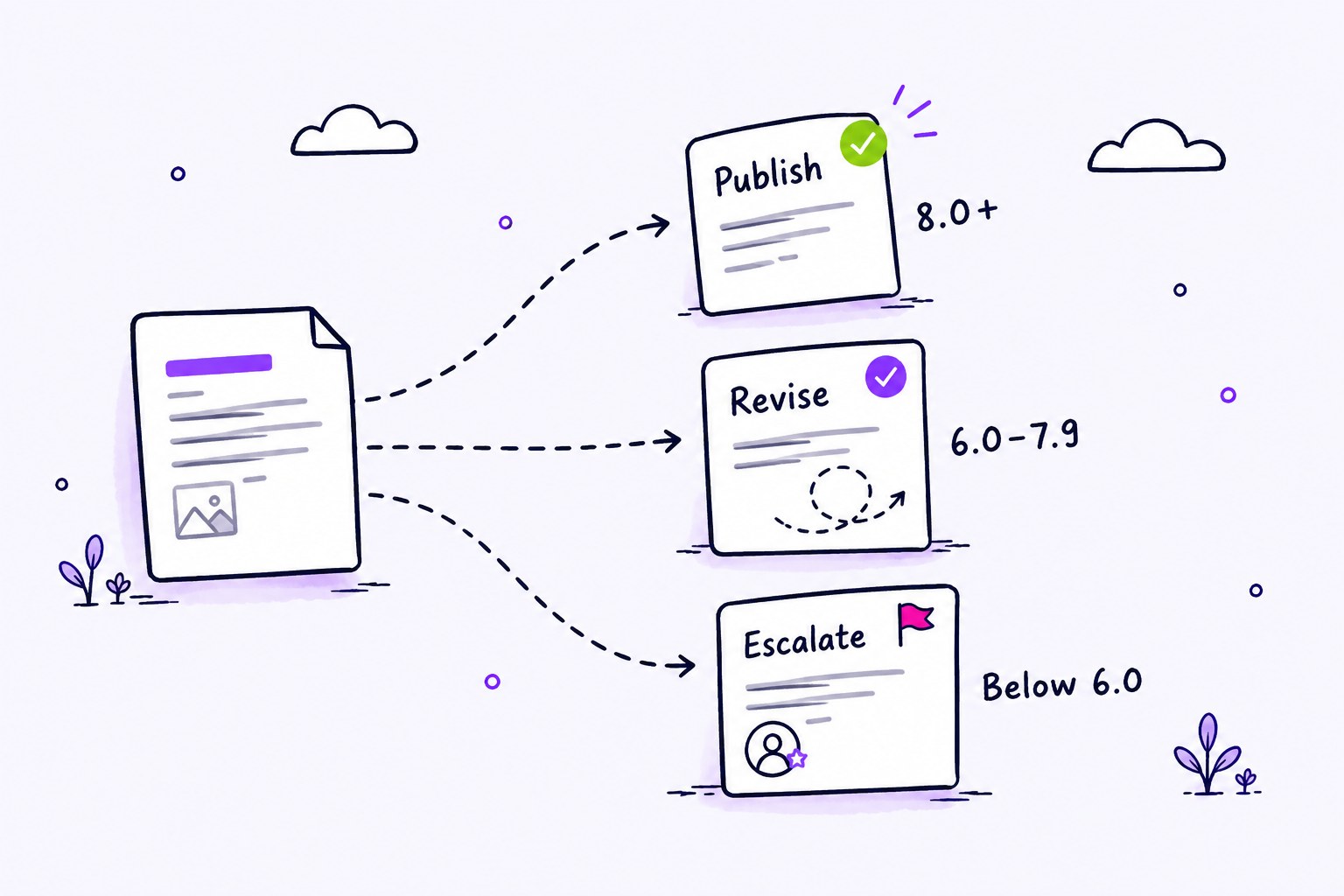
Evaluation only matters if it drives a decision. As example routing logic, not a fixed threshold, a score of 8.0 or above might mean publish, 6.0 to 7.9 triggers revision, and anything below 6.0 gets rejected or escalated. Evaluation works as a routing mechanism, not commentary, which means the evaluator needs to return structured output: dimension scores, an overall status, which criteria failed, the reasoning behind that, and actionable revision instructions, so the orchestrator can route the piece to publish, revise, re-evaluate, or escalate. Anthropic’s evaluator-optimizer pattern captures this well: one LLM generates, another evaluates and feeds back in a loop, and it works when there are clear criteria and real value in iterating.
Where Human Judgment Still Belongs
None of this replaces human judgment. It routes human attention to where it actually matters, instead of spreading it thin across every single piece.
Exception-Driven Intervention, Not Constant Oversight
Our HITL model is exception-driven, not blanket oversight. Humans step in when trusted sources genuinely conflict, when business intent is ambiguous, when scope can’t be pinned down, when key evidence isn’t available, when YMYL or compliance risk is high, when real domain expertise is needed, when evaluation stays uncertain even after revision, or when a piece keeps missing the quality bar on repeat attempts. Humans also contribute upstream, well before any of that: SME interviews, product expertise, first-hand experience, customer insight, strategic point of view, internal data nobody else has access to.
This is the core of CyborgMethod as a hybrid system. AI handles the heavy lifting, humans add the finer judgment calls, and the entire thing ships white-label. Automation removes repetitive execution but responsibility stays exactly where it belongs. Humans still define what quality means, provide the expertise and business context the system can’t invent, resolve ambiguity, and make consequential calls when the workflow escalates something it shouldn’t decide on its own.
Why This Process Outperforms Manual Content Production
We’re not claiming AI writes better than your best human writer on their best day. Anyone telling you otherwise is selling something.
Repeatability Without Burnout
The real argument is repeatability. A skilled human absolutely could research, plan, write, verify, and revise with this level of rigor. What they can’t do is sustain it across a high volume of articles under deadline pressure without something slipping. Talent isn’t the constraint. Consistency is. The gap between a system and a human team at volume isn’t about who’s smarter. It’s about who can keep doing it correctly at scale.
One agency partner felt this directly. They were producing 450+ articles a month across 130 clients using 23 freelancers, spending around $740,000 a year to keep that machine running. After moving onto our system, that dropped to roughly $440,000 a year, and their internal team shrank from six people to four. That’s an illustrative result from one partnership, not a guarantee, but it’s a real picture of what repeatability without burnout looks like at scale. We also ran an internal AI Writing Challenge that produced 116 articles in 30 days, an average of 3.87 articles a day, using CyborgMethod, which gives you a sense of the throughput this kind of system supports.
| Criteria | Single-prompt AI tools | Multi-agent systems | White-label multi-agent service (CyborgMethod) |
|---|---|---|---|
| Scalability | Low, output degrades at volume | High | High, without internal build cost |
| Quality control | Minimal, no gates | Structured gates and evaluation | Structured gates plus HITL sign-off |
| Turnaround time | Fast but shallow | Moderate, thorough | Moderate, thorough, managed |
| Customization | Limited | High, if built well | High, matched to brand voice |
| Cost structure | Low per unit, high revision cost | Variable, depends on build | Predictable, no build-out needed |
| Human oversight | Minimal | Defined by design | Exception-driven, editorial |
Build vs. Buy: The Real Work Behind AI Content Systems
If you’re considering building something like this in-house, the API call is the easy part. Making its output dependable is the hard part.
Questions to Answer Before You Build
Beyond connecting to a model, you need to map your actual production process, define what quality means in measurable terms, build orchestration and state management, set up RAG and retrieval, establish a source hierarchy, build or license scraping and research tools, track provenance, define structured schemas, write deterministic validation logic, design evaluator architecture and routing rules, handle retries, build observability and cost controls, plan fallbacks, and design human escalation paths, then maintain all of it going forward. As a rough rule of thumb from our own build, expect something like 20-30% of the work to be AI, and the remaining 70-80% to be process and systems engineering. That’s not a scientific benchmark, just what we’ve observed building this.
Before committing to a build, ask yourself: can you describe your current human workflow in detail? Can you define good content in measurable terms? Do you know what context each stage actually needs? Which sources do you trust and why? What state needs to persist between stages? Can you evaluate intermediate outputs, not just the final draft? Which checks should be deterministic, and which genuinely need an LLM? When should a human step in, and who owns this system after launch? If you can’t answer most of those, the problem isn’t which model to pick. You don’t yet understand your own process well enough to automate it.
The White-Label Path
That’s exactly the gap white-label partnerships are built to close. Working with a white-label AI services for agencies partner gets you years of refinement on this architecture without the build-out risk, the maintenance burden, or the trial and error of figuring it out in production. We started this as an in-house AI platform for our own SEO content, and it grew into a white-label offering because agencies kept leaning on it for their own client work. That’s a different origin story than a tool built for a market from day one, and it shows in how the system handles edge cases.
What This Looks Like in SEOwind
The workflow isn’t identical for every article. The core process stays consistent, but the depth changes based on the assignment. A straightforward informational article may move through with relatively little intervention. A YMYL topic, conflicting sources, missing expert input, or weak evidence can trigger deeper research, stricter verification, additional revision, or human escalation.
That’s an important distinction: we standardize the process and the quality bar, not the exact route every article must take.
This is the system underneath SEOwind’s AI article writer. Research, internal company knowledge, SME input, brand voice, writing, evaluation, fact-checking, and human judgment aren’t separate features bolted onto a generator. They’re parts of the same production workflow.
And the workflow continues beyond creating a new article. Content updates can bring published pages back through research and evaluation as the SERP, competitors, or available evidence changes, while internal linking uses Search Console data to connect content based on actual site information.
That’s why we describe our approach as research first, writing second.
A prompt produces an answer. A workflow produces an article. A system makes the outcome repeatable.
Next Step
If you’re evaluating what to use AI for in content creation and weighing whether to build this internally or work with a team that’s already refined it, SEOwind is a reasonable place to start that conversation.
Can AI fully replace human writers in a content workflow?
No, and any system claiming otherwise is skipping the parts that matter most. AI can sustain a rigorous research, writing, and verification process at a scale humans can’t match without burning out, but humans still need to define quality, provide real expertise and business context, resolve ambiguous intent, and take responsibility for decisions the system shouldn’t make autonomously.
What’s the difference between content automation and an AI content management approach?
Content automation software often refers to speeding up a single task, like generating a draft. AI content management, as we build it, covers the entire process, research, briefing, drafting, evaluation, fact-checking, and revision, all tracked through state and routed through quality gates rather than treated as one isolated step.
Is a multi-agent system always better than a single AI model for content creation?
Not necessarily. A specialist agent earns its place when it makes the system easier to control, debug, or evaluate. Sometimes a single model with well-prepared context outperforms a more complex multi-agent setup.