Drop AI into a broken content operation and you get the same operation, only faster, weaknesses included. We see this in most AI rollouts. Drafting speeds up, backlogs grow, and quality slips.
Traditional ContentOps covers people, processes, governance, tooling, briefs, and measurement. Here we focus on what changes when AI does real work inside that system. We run this model for agencies (see For Agencies). AI makes content generation faster. Add operations around it, and end-to-end execution becomes repeatable and observable, which is what makes it dependable.
What Is AI Content Operations? Three Levels of Adoption
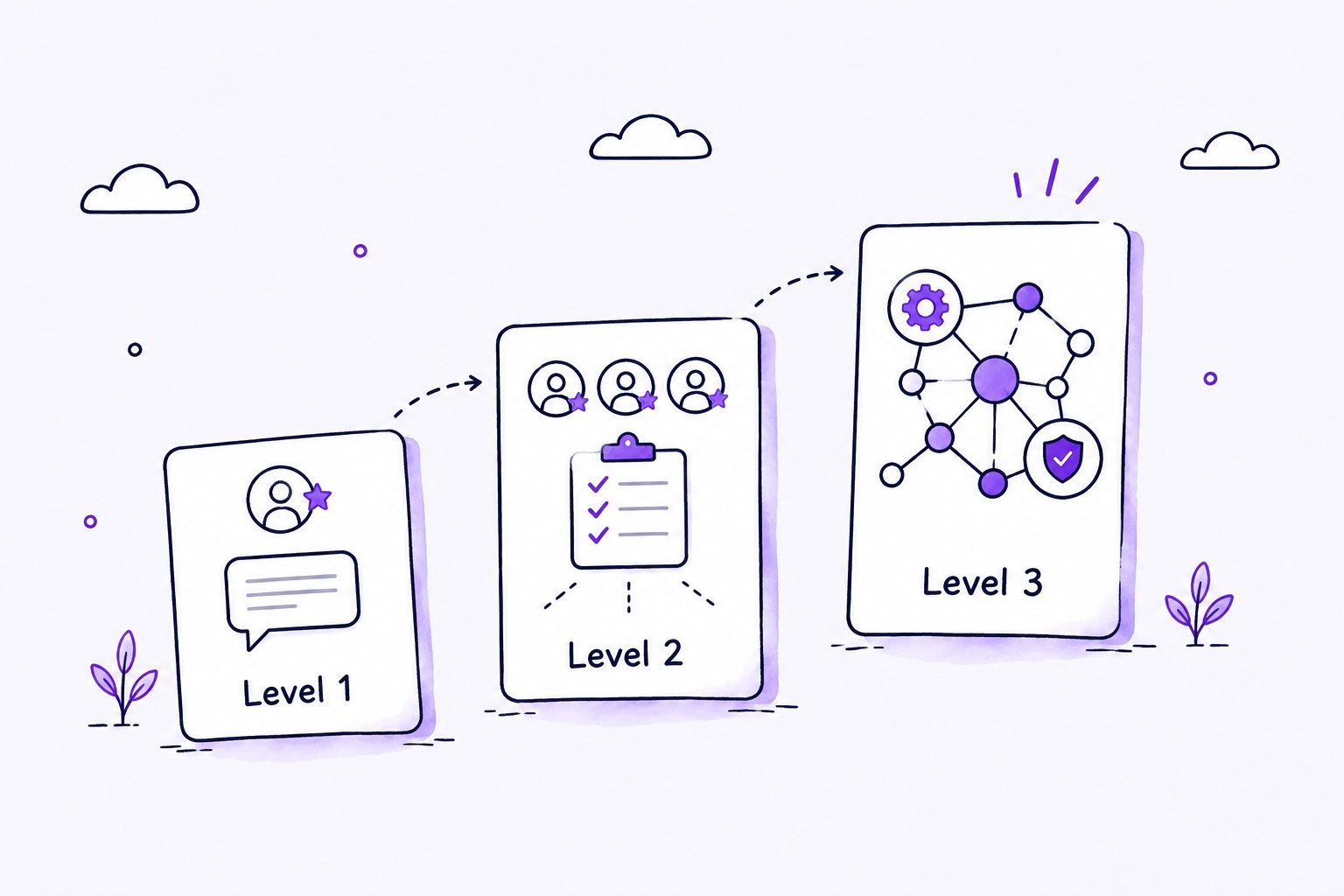
AI Content Operations is the coordinated use of AI, reliable context, defined workflows, quality controls, and human oversight to produce and improve content consistently at scale. It turns disconnected AI tasks into a controlled production process with clear input requirements, measurable acceptance criteria, quality gates, feedback, and ownership.
Most teams sit at one of three levels, and each level fixes one problem while stumbling on the next.
Level 1: Individual AI tools.
A person uses a chatbot to research, outline, draft, or edit. That buys personal speed. Results hinge on that person’s skill and how carefully they check the output by hand.
Level 2: AI-assisted workflows.
Teams share prompts, briefs, brand guidelines, review requirements, and repeatable procedures, which brings consistency between people. Only some steps are connected, though, so coordination stays partly manual.
Level 3: AI content operations.
Workflows manage state, context handoffs, evaluation, refinement, escalations, approvals, measurement, and feedback. Components or agents may specialize in research, briefing, drafting, and QA. You get reliability at this level only if you build it and keep maintaining it.
How AI Content Operations Differs From Traditional Content Operations and AI Writing Tools
Traditional ContentOps organizes people and process, while an AI writing tool just produces text. AI content operations connects the two and makes the behavior of the whole system measurable.
Multiple agents are optional. Anthropic distinguishes workflows, where LLMs and tools follow predefined code paths, from agents, where LLMs dynamically direct their own process and tool use. It also notes that simple LLM calls with retrieval can be enough for many applications, and that complexity should be added only when it demonstrably improves results. We agree. A simple model plus deterministic checks and human reviews can outperform an elaborate but unreliable multi-agent setup.
Tom Winter, who leads our approach, puts it simply: “A prompt isn’t a system.” Even a great prompt gives you no repeatability, governance, monitoring, or accountability.
Why Adding AI to an Existing Workflow Often Fails

Bolting AI onto an old workflow shifts the bottleneck instead of removing it. AI multiplies drafts. Research, factual checks, expert review, brand review, approvals, CMS publishing, and maintenance stay capacity-constrained. More drafts can mean bigger backlogs and higher correction costs rather than more completed output.
It also amplifies flaws. Weak briefs, missing context, vague quality requirements, and inconsistent approvals get copied across hundreds of assets. Fluent wording says nothing about whether a piece is useful, factually correct, or original. AI speed multiplies output but cures nothing.
Tom’s principle is to define “good” first, then automate it hard. Before automating anything, define the audience need, business goal, required sources, acceptable depth, brand viewpoint, unacceptable errors, approval owner, and pass/fail criteria. Skip this and you automate guesswork.
He has another warning: “Your content process is aspirational fiction.” The process on paper breaks under deadline pressure, so automation ends up inheriting the process people really follow rather than the documented one.
Search engines notice scale without value. Google says generating many pages without adding user value may violate its scaled-content-abuse policy. Its helpful content guidance also includes a self-assessment question about using extensive automation to produce content on many topics.
The Eight-Part AI System Stack
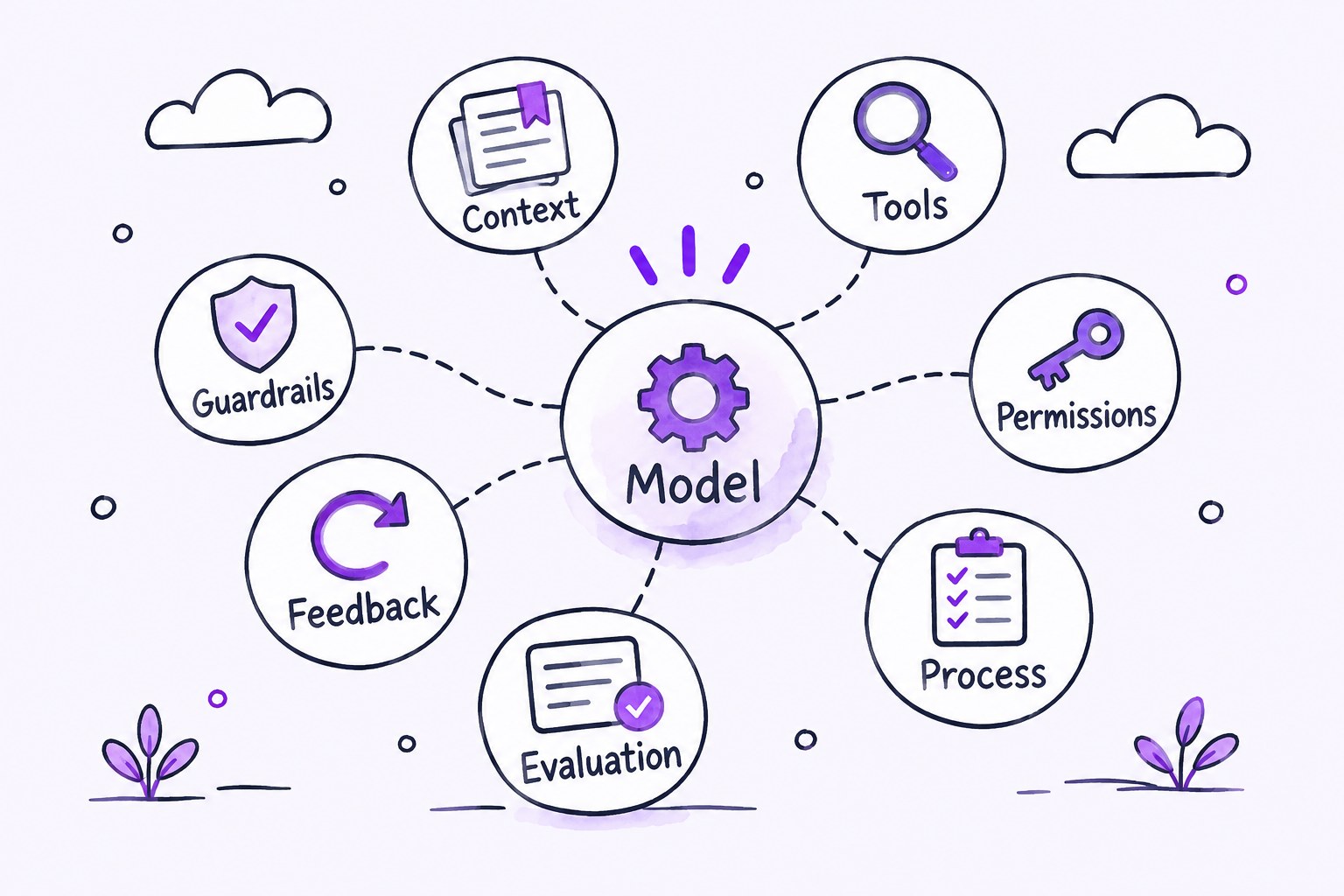
An AI system is more than a model. We describe it as AI System = Model + Context + Tools + Permissions + Process + Evaluation + Feedback + Guardrails. Weakness in any part limits the whole.
-
Model: LLMs handle research synthesis, drafting, review, and targeted refinement. Choice matters, but no model substitutes for the rest.
-
Context: Verified company and product facts, audience needs, brand voice, editorial instructions, SME insights, briefs, search intent, research, existing content, and client constraints. Incomplete context produces generic or incorrect results.
-
Tools: Retrieval and search, analytics, content repositories, SEO platforms, CMS integrations, and verification utilities. Retrieving current evidence is a different job from generating plausible text.
-
Permissions: Access restrictions and approval rights, built on least privilege. A research component should not have unrestricted publishing or data-editing authority.
-
Process: Orchestration of sequence, state, dependencies, retries, context handoffs, exceptions, and approvals. Orchestration is not an individual agent.
-
Evaluation: Rule-based checks, evidence verification, and structured rubrics, plus human editorial assessment that decides pass, revise, escalate, or reject.
-
Feedback: Logged failures, reviewer comments, client corrections, and quality trends that update instructions, context, briefs, rubrics, and workflow design.
-
Guardrails: Protections for privacy, unsupported claims, unauthorized actions, risky subject matter, source quality, and inappropriate publication.
Adopt this incrementally. Complexity for its own sake is how fragile systems get built.
The AI Content Production Workflow From Intake to Monitoring
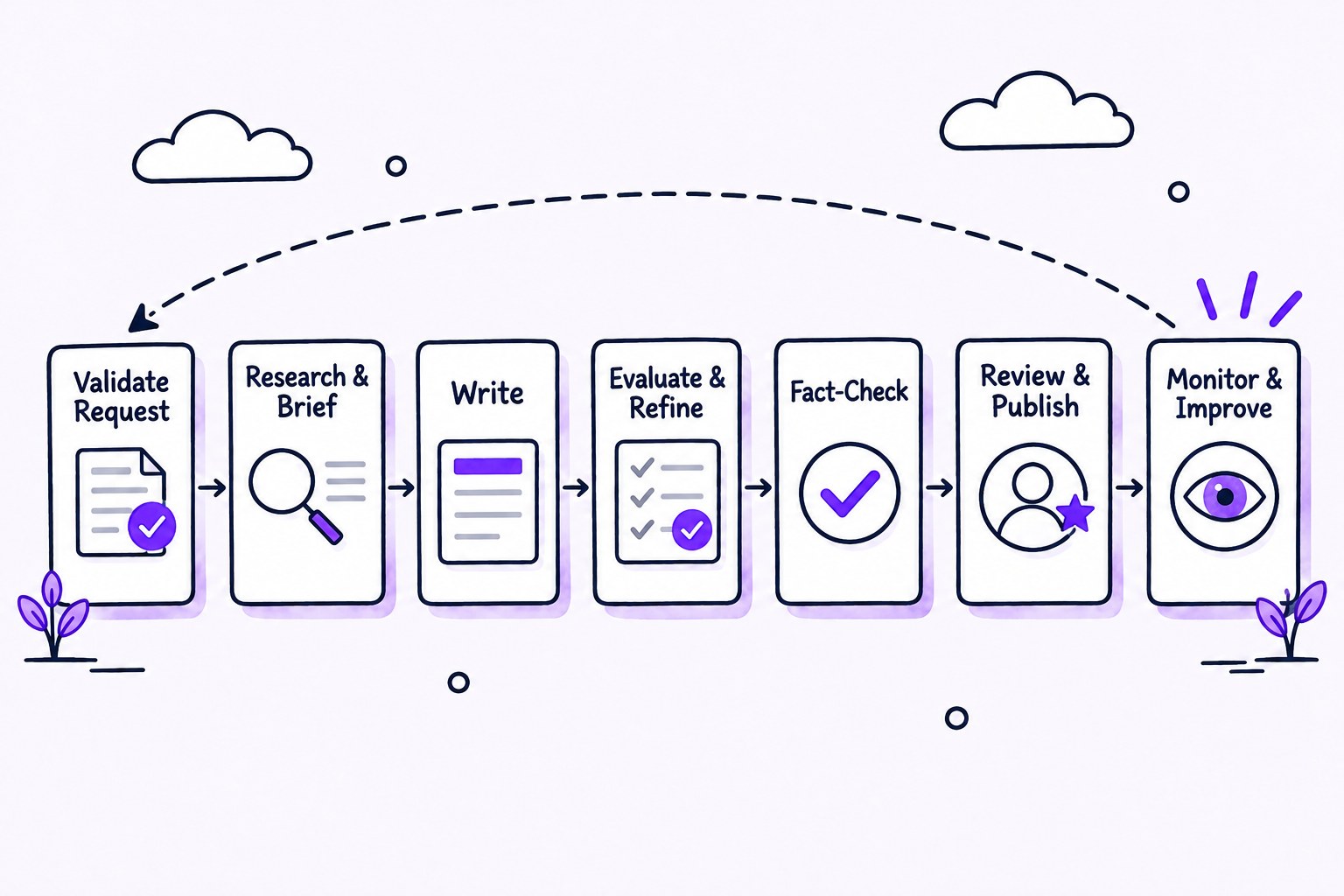
A reliable AI content operation is much more than generating a brief, asking AI to write an article, and checking the result.
At SEOwind, we organize content production into seven stages:
Validate the Content Request → Research and Build the Brief → Write With Context → Evaluate and Refine → Fact-Check → Human Review and Publish → Monitor and Improve.
Each stage has a different purpose and quality requirements. When something fails, the system should identify the problem and route it back to the right stage instead of passing it forward and hoping an editor catches it.
We also conduct research and verification at four points: during order validation, brief creation, writing, and final fact-checking. These are our four research passes, not four separate workflows.
Our familiar Brief → Draft → Score → Refine process sits inside this larger operation. It describes how we create and improve content, while the full workflow also covers everything needed to deliver it consistently.
Stage 1: Validate the Content Request
Nothing enters production unvalidated.
An incomplete or incorrect content request creates problems that follow an article through every subsequent stage. It’s much easier to fix a wrong target market before writing than to discover it during final editorial review.
We validate keywords, product and company names, target market, audience, search intent, content type, scope, and client instructions. We also identify missing business information, conflicting requirements, and topics that may need specialist input, particularly YMYL content.
Some checks are deterministic. A missing required field or an invalid URL doesn’t require sophisticated AI reasoning. Other checks need context and judgment. For example, is the requested topic relevant to the client’s business? Does the search intent match the proposed article? Is the product actually available in the target market?
Ambiguous decisions go to a person rather than being silently resolved through assumptions.
This is also where we need to understand what good content looks like for this particular assignment. Quality requirements should reflect the audience, business goal, content type, and level of expertise required.
The output is a validated content request with clear expectations, ready for research.
Stage 2: Research and Build the Brief
Lock the angle before writing starts.
A good brief isn’t just a list of headings generated from competitor articles. It establishes what the article should achieve, what questions it must answer, and what information supports those answers.
Our research combines SERP analysis, competitor content, search intent, relevant questions, credible external sources, and the client’s internal knowledge. We identify missing information, opportunities for differentiation, useful statistics, and areas where original expertise would make the article stronger.
We use what we call the sandwich method as an editorial heuristic: approximately 60% of the content addresses established search intent, while 40% makes room for original experience, expert perspectives, company insights, and differentiation. It’s a working guideline, not a formula from Google or a rigid ratio for every article.
The research feeds into a structured brief that explains what each section needs to accomplish, not simply what its heading should be.
An important part of our approach is retaining the research for later stages. Relevant facts, sources, scope information, and cautions can be passed forward so the writer and fact-checking system can work from the same underlying material. That material still needs to be verified; appearing in a research brief doesn’t automatically make something true.
Before writing starts, we evaluate whether the brief covers the intent, provides enough relevant context, and has a clear angle. If the brief is weak, we improve it before generating the article.
Stage 3: Write the Article With Context
Research doesn’t stop when writing starts.
This is where the actual article gets written, but we don’t simply hand the AI a brief and ask for 3,000 words.
Our AI writing system works section by section, using the approved brief and relevant context. That includes brand voice, audience information, company and product knowledge, research findings, editorial instructions, and the content already written.
Before writing a section, the system determines what that section needs to establish and retrieves relevant supporting information. If important evidence or information is missing, further research can be performed rather than expecting the language model to fill the gap from its training data.
This is where retrieval-augmented generation (RAG) comes in. RAG means retrieving relevant information and making it available to the model during generation. It helps ground the writing in supplied knowledge, although it doesn’t guarantee that every statement will be correct.
For perspective, we can provide around 7,000 words of supporting context to produce a 3,000-word article. The point isn’t the ratio itself. It’s that the work behind the article can be substantially larger than the finished text.
The writing system also needs to maintain consistency across sections, follow the brief, avoid repetition, and incorporate appropriate internal links and source references.
The output of this stage is a complete first draft. Not a finished article.
Stage 4: Evaluate and Refine the Draft
If you can’t define what good looks like, you can’t systematically improve it.
Generating a draft is relatively easy. Determining whether it’s genuinely good is where much of the work begins.
We evaluate content against defined criteria, including search intent, brief compliance, usefulness, depth, originality, evidence, readability, redundancy, brand voice, and E-E-A-T indicators.
The evaluation needs to explain what’s working, what’s missing, and what specifically should change. An instruction like “make this article better” isn’t useful because it doesn’t define better.
For example, the evaluation might identify that a section repeats information already covered, makes a comparison without sufficient evidence, or discusses a product without explaining why a particular feature matters to the target audience.
Those findings become targeted refinement instructions.
The system can improve the affected sections, gather more research, request additional business or expert context, or return to the brief if the problem started earlier.
But refinement needs stopping rules. Repeatedly asking AI to improve the same text can introduce errors, increase length unnecessarily, or replace useful content with generic explanations.
The goal isn’t to maximize the number of revisions. It’s to reach the defined quality standard without introducing new problems.
Stage 5: Fact-Check and Verify Downstream Impact
Fix one thing, check everything it affects.
Even a well-researched and carefully evaluated article can contain factual errors. That’s why fact-checking is a dedicated stage, not something we assume happened during research or writing.
Our system identifies checkable claims in the finished article, retrieves relevant evidence, and evaluates whether the sources actually support each statement.
Claims are classified as supported, contradicted, or unverified. The distinction matters: failing to find evidence for something doesn’t automatically mean it’s false. Conflicting sources and consequential unresolved claims need further investigation or human review.
We also validate context around the evidence. A statistic might be correct but refer to the wrong year, market, product version, or measurement. A source discussing a topic isn’t necessarily evidence for the particular claim being made.
Our research-first approach also allows the fact-checking system to reuse sources identified earlier, rather than starting every verification from scratch.
Then comes something we consider particularly important: the Downstream Impact Check.
Imagine an article claims a product has a particular specification, then uses that figure to recommend it over a competitor. If the specification turns out to be wrong, correcting the number alone isn’t enough. The comparison and recommendation may now be wrong too.
Our system checks for these dependencies so that an accepted correction doesn’t leave contradictions elsewhere in the article.
At SEOwind, we apply AI-assisted fact-checking across approximately 2,500 articles per month. Automated verification makes this level of checking feasible, but it doesn’t eliminate uncertainty. Corrections must still be supported by evidence, and unresolved findings need a clear escalation path.
As Google’s guidance on generative AI content explains, AI-generated content requires attention to accuracy and quality, including human review.
Stage 6: Human Editorial Review and Publication
Automation should reduce repetitive work, not remove accountability.
By the time an article reaches editorial review, it should already have passed the relevant research, writing, evaluation, and verification checks.
Human editors can then focus on what matters most: business relevance, the client’s positioning, natural language, originality, nuance, sensitive claims, and whether the article actually delivers value to its intended reader.
They also handle issues the automated system couldn’t resolve confidently, including situations that need subject-matter expertise or a business decision.
An editor shouldn’t need to reconstruct missing research, rewrite an article built around the wrong intent, or discover obvious factual problems that could have been caught earlier.
Once approved, the content moves through formatting, internal-link checks, final approval, and publication or CMS delivery, depending on the client’s workflow.
The goal is to make human review more valuable by giving editors better material to work with, not by treating their time as an unlimited safety net for broken processes.
Stage 7: Monitor Results and Improve the System
A good content operation learns from its failures.
Publishing an article isn’t the end of the process.
We collect editorial corrections, client feedback, revision requests, recurring rejection reasons, and issues discovered after delivery or publication. Where performance data is available, it can also inform future content decisions.
The important part is understanding why something went wrong.
Did the content request lack necessary information? Did the brief miss the actual search intent? Was important company knowledge unavailable? Did the writer misunderstand the evidence? Did the evaluation fail to catch repetition? Or was the verification process too weak?
Different problems require different fixes.
We might update validation rules, improve research instructions, change the context supplied to the writer, strengthen an evaluation criterion, or clarify editorial guidance.
This doesn’t mean every correction automatically retrains a model. It means we use feedback to improve the process that produces the next article.
That’s the difference between repeatedly fixing individual articles and building a content operation that becomes more reliable over time.
The bigger lesson: AI content operations aren’t about replacing a writer with a prompt. They’re about turning the full process that produces good content into a system that can execute consistently, identify failures, and improve over time.
That’s how you scale quality, not just output.
Quality Assurance: Why Generation Is Not Evaluation
Asking a model to write something tells you nothing about whether the result is good. Tom’s position is that most teams ask AI to generate, while smart ones ask it to evaluate. Fluent output can still be unhelpful, repetitive, or inaccurate, and sometimes it’s weakly sourced too. So we separate generation, independent evaluation, refinement, and human acceptance.
Using an E-E-A-T Rubric and Quality Gates
Our proprietary E-E-A-T rubric, run by our EEAT scoring engine, is a quality evaluation tool. It isn’t an official Google score, and it doesn’t predict rankings. Google states that E-E-A-T itself is not a specific ranking factor. The rubric looks at four dimensions:
-
Experience: First-hand insights, implementation details, product usage, original examples, and screenshots when applicable.
-
Expertise: Precision, appropriate depth, specialist understanding, and subtlety.
-
Authoritativeness: Credible original data, recognized expertise, high-quality sources, and meaningful external recognition.
-
Trustworthiness: Verifiable claims, attribution, transparency, balanced statements, and honest limitations.
Our wider evaluation also covers search-intent coverage, claim verification, and brief compliance. A consistent rubric outputs context, scores, strengths, weaknesses, and prioritized actions in machine-readable form. That makes tracking and triggers easier:
{“score”: 7.4, “strengths”: [“…”], “weaknesses”: [“…”], “actions”: [“…”]}
Scores are evaluator judgments. Judgments on tone, relevance, and E-E-A-T signals are non-deterministic, so calibrate them against a stable baseline. Use representative test articles, compare results with qualified editors, inspect false positives and false negatives, track disagreement, and re-test after any model, prompt, or rubric change. Automated graders are not unbiased, and we promise no consistency threshold.
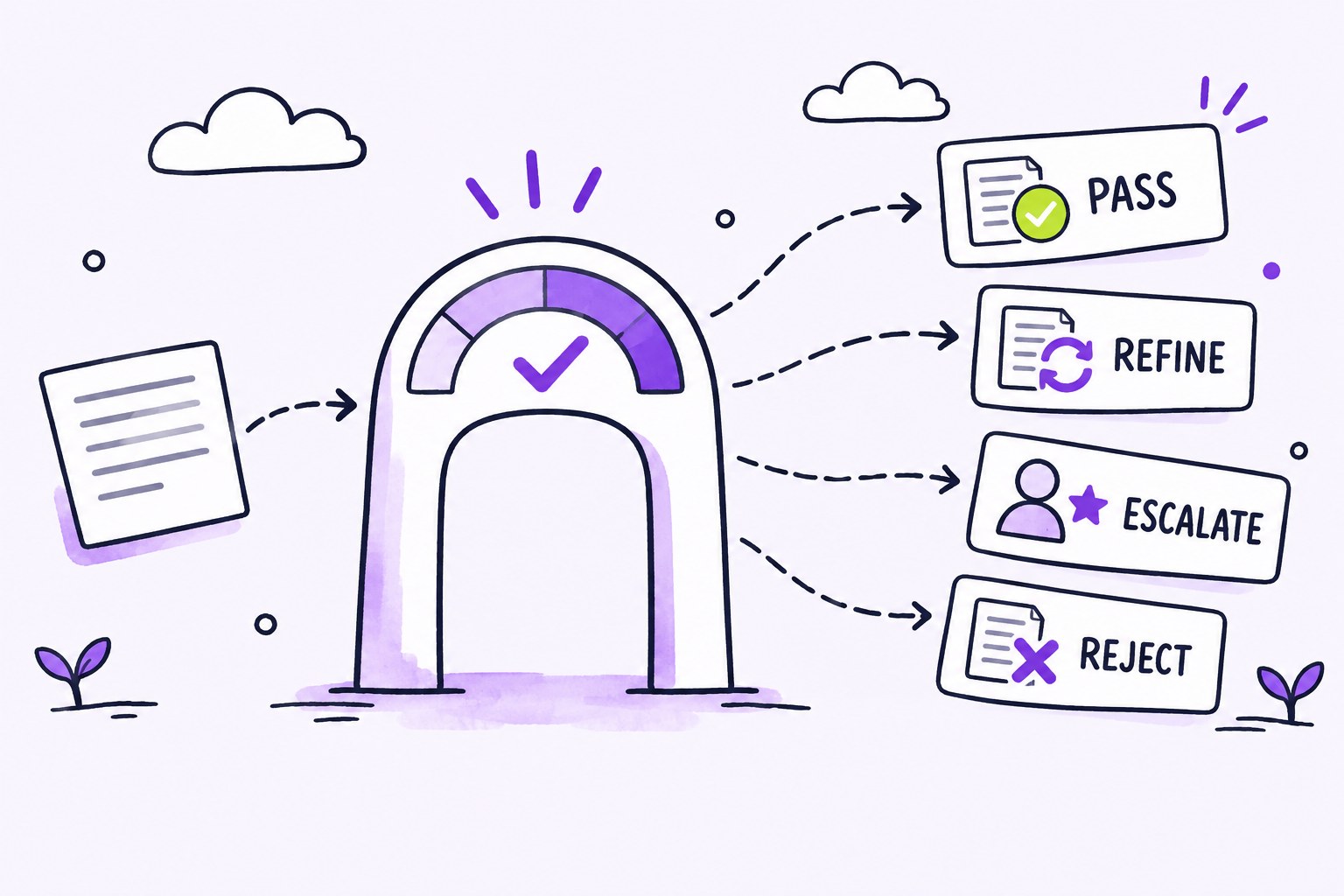
A quality gate has a standard, a verification method, and a failure action. Outcomes are:
-
PASS (meets standards),
-
REFINE (a specific fix is needed),
-
ESCALATE (a human or expert decision is required), and
-
REJECT (substantial rewrite or new brief).
As example routing logic, not fixed thresholds, 8.0 or above might publish, 6.0 to 7.9 revise, and below 6.0 reject or escalate. A score alone should not decide sensitive publication decisions. Track client escape rate, revision-cycle count, and error rate by category, and inspect both false passes and false alarms.
Human-in-the-Loop and CyborgMethod: Where People Stay Responsible
Automate appropriate execution and keep human expertise, accountability, and consequential judgment. Build human involvement in from the start rather than tacking on a final proofread. Our Human in the Loop AI approach distributes people across the lifecycle:
-
Before: Humans define strategy, audience, brand perspective, SMEs, and the quality and risk levels they’ll accept.
-
During: They resolve conflicting evidence, unclear scope, missing context, original arguments, specialist questions, and high-risk decisions.
-
After: They review usefulness, accuracy, subtlety, differentiation, brand alignment, and publication readiness.
Oversight is risk-based. Formatting checks can often be automated, while medical, financial, legal, and other sensitive claims may need specialist review. Humans step in for conflicting evidence, strategic ambiguity, unusual risk, irreversible consequences, and signs the workflow is optimizing in the wrong direction. Those escalations feed back into context, evaluators, rules, tools, or permissions.
Human attention is limited, and blanket review creates bottlenecks. Three patterns help: approval before the workflow proceeds, monitoring with intervention on exceptions, and periodic audits of automated low-consequence work.
The CyborgMethod puts this into practice. Humans bring expertise and strategy and make the editorial calls. AI supports research, structure, drafting, QA, and repeatable execution. Tom’s view is that as execution gets cheaper, judgment gets more valuable. Human value shifts to deciding what is worth saying, supplying real experience, evaluating evidence, and owning quality. We call it “Good Laziness”: remove repetitive work while keeping responsibility and standards. As Tom puts it, “The bottleneck is not talent. It is repeatability without burnout.”
NIST suggests including human-oversight roles and responsibilities in generative AI system inventory entries. Its AI Risk Management Framework organizes risk work into four functions (Govern, Map, Measure, and Manage), with ongoing monitoring and clearly assigned responsibilities.
How Roles Change as Volume Grows
This is the model we propose, and no industry body has standardized it. It defines responsibilities and skips trendy titles:
-
Content Strategist: priorities, audience, differentiation.
-
Content Architect: briefs, context structures, editorial rules.
-
AI Workflow Owner: orchestration, integrations, exception handling, reliability.
-
Quality/Evaluation Owner: rubrics, tests, failure analysis, acceptance criteria.
-
Subject-Matter Experts: supply and validate deep knowledge.
-
Editors: evaluate finished work and make publication decisions.
With around 10 assets per month, people can combine several of these responsibilities. Scale to 100, and shared workflows, reviewer capacity, and quality ownership become more important. Reach 1,000, and observability, context governance, distributed production, and exception handling become critical. These volumes are scenarios, not hiring benchmarks. The broad shift is from writing and coordinating to reviewing, briefing, and quality ownership. For general organizational design, see the foundational “Content Operations: How to Build a Scalable Content Production System.”
Metrics and the Real Economics of AI Content

Count approved, useful assets, since generated drafts say little about output. We define accepted output through the measures below. They come from this article, with no external benchmarks.
Accepted throughput is approved assets per period. First-pass acceptance is the percentage approved without revision, and refinement rate is the average number of revision cycles per accepted asset. Editorial hours per asset gives you human review time. Time to publish runs from request or ideation to publication.
Cost per approved article divides all relevant production and coordination costs by approved articles. Those costs include research, model use, retrieval, evaluation, refinements, SME review, coordination, publishing, and corrections. Factual error rate is verified errors relative to reviewed claims or assets, and you should state the denominator. Error escape rate counts issues found after approval or publication.
A $1 AI draft that needs hours of editing can cost more than a pricier draft that passes quickly. Read throughput together with quality and rework. Speed alone isn’t business value.
Agency Case Study: Scaling Production Across Many Clients
One agency we work with was producing 450+ articles a month for 130 clients through a bench of 23 freelancers. After moving production to our AI-plus-human system, it kept the same volume and the same clients, and cut annual content costs by roughly 40%.
Client anonymized. Results depend on industry, competition, and execution.
Before: Briefs were fragmented, quality was inconsistent, and coordination costs were high. The agency produced about 450+ articles per month across about 130 clients. It used 23 freelancers at about $740,000 per year, plus six internal staff for QA, communications, and CMS uploads.
Changes: We rebuilt the workflow end to end: validated client intake, research, standardized briefs, AI drafting, automated quality gates, human editing, and cleaner handoffs back to the agency.
After: Annual cost dropped to about $440,000, with an internal team of four running the operation. Same volume, same clients.
Lessons: Don’t credit AI for every gain. Process design and staffing changed too, and arguably mattered as much. What remains difficult is the upstream work: capturing client context, keeping briefs accurate, and giving editors enough capacity to make real decisions.
Common Failure Modes and How to Fix Them
Most failures repeat. Tom’s advice: when the same mistake keeps happening, stop fixing the article and start fixing the process. The table maps nine common failures to their causes and fixes.
| Problem | Cause | Fix |
|---|---|---|
| Automating chaos | Unstandardized workflow, higher output | Standardize the workflow before increasing output |
| Prompts as infrastructure | Instructions live in individual heads | Centralize and version instructions, context, review standards |
| Weak business context | Poor information capture | Improve capture, retrieval, validation |
| Generation without evaluation | No acceptance criteria | Add criteria and independent checks |
| Endless refinement loops | No stopping rules | Limit iterations, prioritize fixes, escalate |
| Unreliable graders | Uncalibrated evaluators | Calibrate against human judgments, re-test after changes |
| Editorial bottlenecks | Blanket review, limited capacity | Plan reviewer capacity, use risk-based oversight |
| Missing feedback loops | Errors fixed only in articles | Track recurring errors, fix upstream causes |
| Model or workflow drift | Unversioned changes | Version components, test changes, watch quality trends |
Reliability depends on someone owning it over time. A one-time setup won’t hold.
AI ContentOps Maturity Model and Implementation Roadmap
This is a practical model, and nobody in the industry has standardized it. Maturity has nothing to do with agent count or percentage automated. A simpler reliable system can be more mature than a sophisticated fragile one.
-
Ad hoc: Individuals use AI independently with uneven review. Next, agree on shared instructions.
-
Standardized assistance: Shared instructions, briefs, and quality criteria exist. Next, connect the stages.
-
Integrated workflows: Stages, handoffs, and context are connected. Next, add measured gates and escalation.
-
Evaluated and governed automation: Measured gates, escalation, monitoring, and permissions are in place. Next, use data to improve.
-
Continuously improving operations: Data drives changes to context, workflow, evaluation, and ownership. Next, keep calibrating.
The roadmap has eight steps. The principle is to automate what you understand, measure the outcome, and expand deliberately.
-
Map the current end-to-end process, owners, bottlenecks, costs, and common failures.
-
Define acceptable output per content type: usefulness, accuracy, sources, brand, risk, and approval.
-
Standardize context and briefs using maintained company information and editorial rules.
-
Automate one well-understood stage, such as intake checks, research support, or briefing.
-
Introduce evaluation and compare automated assessments with human judgments.
-
Define human escalation and final approval ownership.
-
Measure accepted output, total costs, quality, rework, and turnaround against the previous process.
-
Expand automation incrementally only when reliability holds.
You are ready to advance when results are stable across several cycles, reviewers agree with the evaluator, and rework is falling.
FAQs About AI Content Operations
Does AI replace writers? No. It shifts human work toward briefing, reviewing, and owning quality.
Do I need multiple agents? Not necessarily. A simple model plus deterministic checks and human review can outperform an elaborate but unreliable setup.
Does RAG prevent hallucination? No. It retrieves relevant information for the model to use, but sources still need evaluation and claims still need checking.
Can a quality score decide publication? Not alone, especially for sensitive topics. Scores are calibrated judgments that don’t amount to facts.
Where should I start? Map your current process, define acceptable output, then automate one well-understood stage.
Build a Reliable System for Accepted Output
The best systems define good, provide trustworthy context, coordinate execution, evaluate outcomes, and keep humans responsible for important decisions. That is what AI content operations means in practice. Agencies that want to apply it without building all the infrastructure can look at our white-label content production for agencies, a structured AI system plus humans (CyborgMethod), delivered CMS-ready and under your own brand. Onboarding starts with a pilot and a feedback loop, then scales gradually.
AI makes whatever strengths and weaknesses your operation already has scale faster, so fix the system first.