
Most advice on AI search optimization is either recycled SEO or confident guesses about proprietary algorithms. We produce thousands of articles monthly for agencies, so we care about what holds up across many clients. Below you’ll find what to do first, what carries over from SEO, and what remains unproven.
What Is AI Search Optimization and How Does It Change Visibility?
AI search optimization is the practice of making content easy to find and clear to read, with enough credibility that search-enabled AI systems can use it when generating answers. People also call it AEO or GEO. It sits on top of SEO, and Google’s guidance focuses on foundational SEO and valuable content.
From Ranked Links to Cited Answers
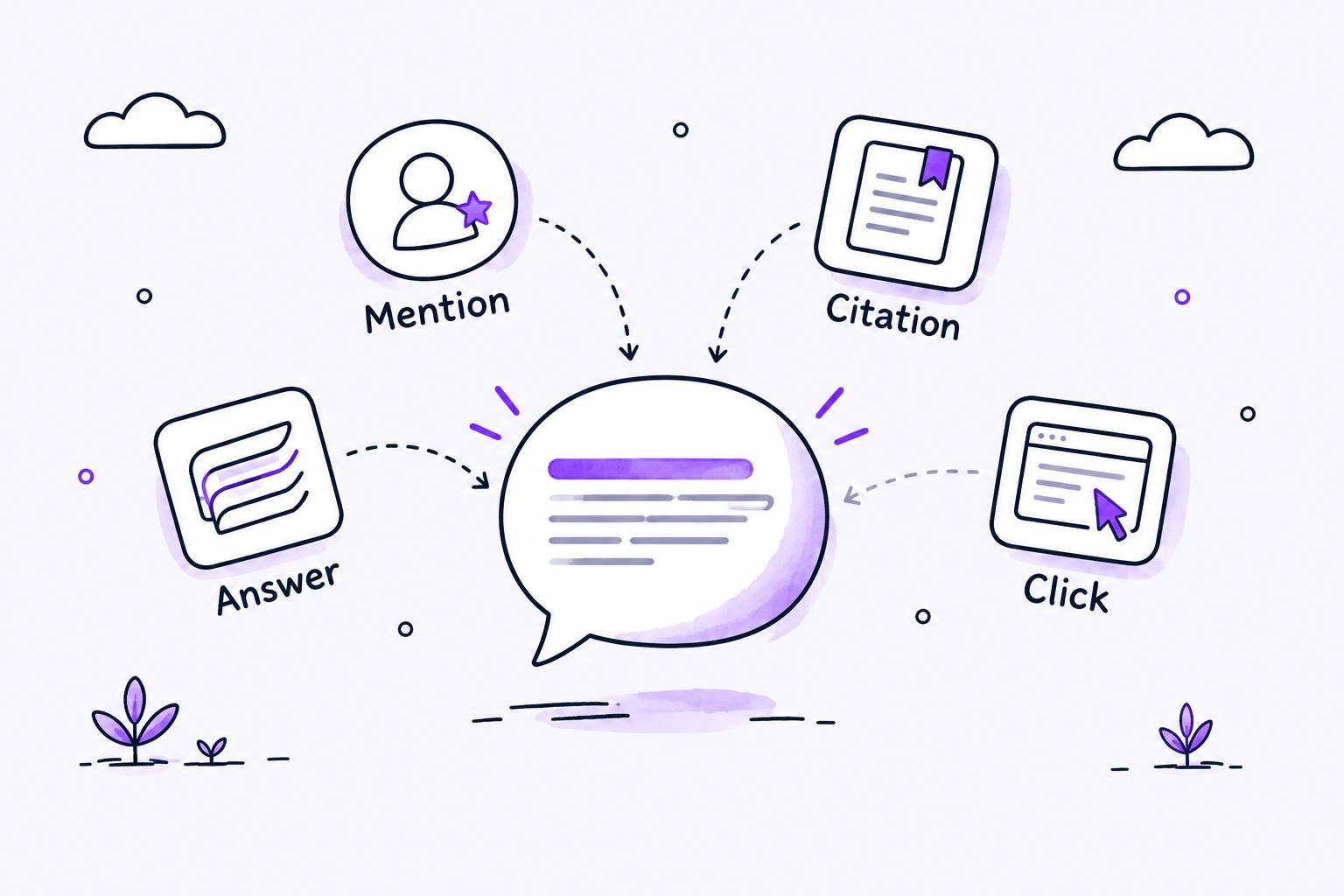
Visibility now has several distinct outcomes: a brand mention, a cited page, information folded into an answer, and a click. They aren’t interchangeable. A citation can introduce a brand during research without producing a visit, which makes attribution harder. Strong rankings don’t guarantee a spot in an AI answer either.
What Carries Over From Traditional SEO
Most of the foundation carries over: crawlability, indexability, useful content, internal links, and credible references. What changes is the unit of success and how you measure it.
| Traditional SEO | AI search optimization | |
|---|---|---|
| Goal | Rank pages for queries | Be mentioned and cited accurately in generated answers |
| Unit of success | Position and click | Presence and accurate citation |
| Content format | Pages built around keywords | Pages that answer questions directly, define key terms, and add original evidence |
| Measurement | Rankings and conversions | Sampled prompt tests, citation reports, identifiable referrals |
None of these formats is a confirmed requirement for AI citation. They’re sound clarity and credibility practices that also help traditional rankings, which is why they’re worth doing either way.
Set Your AI Search Strategy and Benchmark Current Visibility
An AI search strategy starts with business goals rather than tactics. Decide whether you want qualified discovery, accurate brand representation, referral traffic, leads, or influence during purchase research. Then assign owners across content, technical SEO, analytics, and subject-matter review, and prioritize by commercial relevance and effort.
Define Goals and the Prompts That Matter to Your Business
Build the prompt list from customer questions, sales conversations, and support requests. We use the benchmarking method below. It’s our own method and carries no official standing:
-
Group prompts by intent, such as informational, comparison, local, and commercial.
-
Include branded prompts to check accuracy and nonbranded prompts to see category presence.
-
Test each prompt across your priority platforms.
-
Log the prompt, platform, whether you were cited (Y/N), competitors cited, sentiment, and source page.
-
Record date, language, and location so reruns are comparable.
You’re done when every priority topic has a logged baseline. Treat that baseline as a sample. Wording, personalization, timing, and platform updates all change answers, and a fixed prompt set is never complete coverage.
Write Content AI Search Systems Can Understand and Cite
Clarity and substance matter most when optimizing content for AI search. Everything below is a clarity recommendation, and none of it is a confirmed retrieval requirement. Retrieval systems don’t share one chunking, embedding, ranking, or citation architecture. Google says there is no ideal page length and no requirement to break content into tiny pieces.
Lead With Direct Answers and Clear Definitions
Answer each section’s main question in the first sentence, then add evidence and qualifications. Name the subject explicitly instead of writing “it” or “this approach.” Use tables for comparisons and numbered steps for procedures, and keep terms for entities consistent. Microsoft recommends concise direct answers, clear headings, and lists or tables for procedures. To confirm it’s done, read each section alone and check that it still makes sense.
Add Original Research, Expert Input, and First-Hand Experience
Generic summaries are the easiest content to replace. Google’s guidance says a unique point of view, such as first-hand review, distinguishes content from summaries. Useful originals include proprietary data, surveys, experiments, documented observations, and named expert input. State the methodology, sample size, time period, and limitations, and separate observed outcomes from causal claims. Originality adds value, though it won’t automatically earn citations.
Cover the Topic in Depth on One Strong Page
Query fan-out doesn’t mean you should publish a page for every sub-query. Cover the topic thoroughly on one page and add a separate page only when a subtopic deserves its own treatment. Separate pages per query variation, made mainly to manipulate rankings or AI responses, violate Google’s scaled content abuse spam policy. Cut repetition, since length alone adds no depth.
A citable page typically has:
-
A direct answer up top
-
Precise definitions
-
Original data
-
Named expert quotes
-
Dated updates
-
A clear author and bio
Link related pages with descriptive anchors. One example split is a conceptual Answer Engine Optimization guide paired with an operational Generative Engine Optimization playbook. Those links help readers find their way around, and they aren’t a ranking trick.
Want this applied across a client roster? Our For Agencies page shows how we deliver it.
Build the Technical Foundation for AI Search Eligibility
Technical eligibility gets a page access, but selection and citation are separate questions. Audit whether priority pages can be fetched and rendered, then confirm they’re indexed, with essential content in accessible HTML.
Allow the Right Crawlers and Keep Pages Indexable
For Google, a supporting link in AI Overviews or AI Mode requires a page that is indexed and snippet-eligible. No extra technical requirements apply unless the site opted out through the Search Console generative AI control. Inclusion is the default, and the control had rolled out worldwide as of August 31, 2026.
For everything else, check this list:
-
Review robots.txt, robots meta directives, HTTP headers, canonicals, redirects, and response codes.
-
Check CDN and WAF rules that may block legitimate bots.
-
Allow OAI-SearchBot and PerplexityBot, along with their published IP ranges.
-
Inspect server logs for verified crawler activity.
OpenAI runs three separate crawlers. OAI-SearchBot handles discovery for ChatGPT search, GPTBot covers content that may train foundation models, and ChatGPT-User handles certain user-initiated requests. You can allow the first and restrict the second. OpenAI documents that sites opted out of OAI-SearchBot will not be shown in ChatGPT search answers, though they can still appear as navigational links.
Use Structured Data for Its Supported Purposes
Use structured data for documented search features, and make sure it matches visible content. Meeting the structured data policies makes a page eligible for rich results without guaranteeing display. Schema is standard search infrastructure, and it won’t earn you AI citations on its own.
Strengthen Entity, Source, and Trust Signals
Keep organization names, product names, and business facts consistent across your site and legitimate external profiles. Show real authors with relevant bios, dated updates, and expert review, and apply stronger review to health, financial, legal, and safety topics. Earn third-party coverage through genuine research. Never fabricate reviews or coordinate mention schemes.
E-E-A-T is a set of concepts Google uses to evaluate quality. Google says it is not a specific ranking factor and that trust is the most important aspect. Our EEAT scoring engine supports internal editorial review, and its scores are not Google measurements.
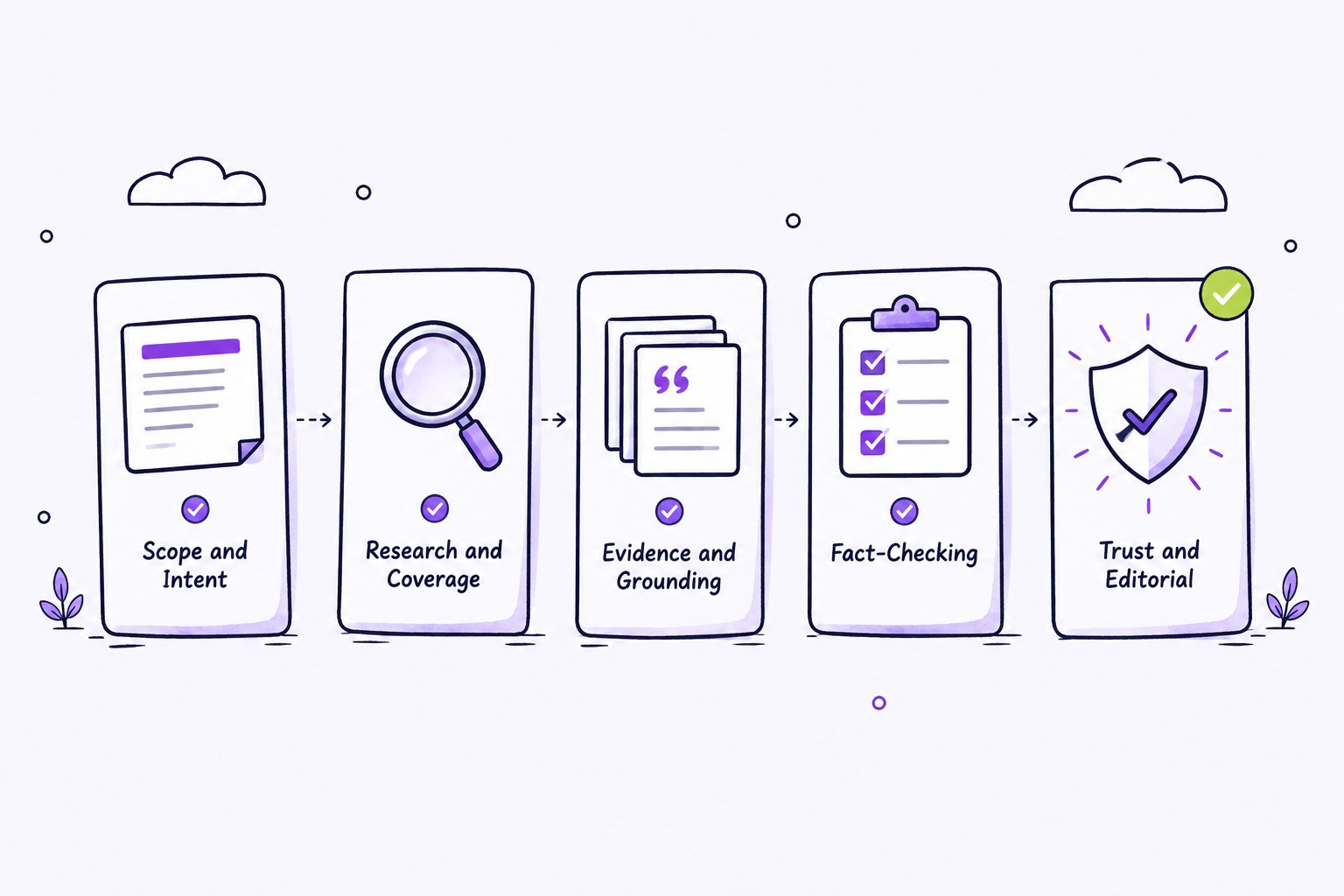
As Tom Winter, founder of SEOwind says,: “A process that can’t be measured can’t be fixed. A process that can’t be fixed can’t scale. Every tactic should state how to confirm it is done. A checkbox nobody can verify is theater.” Our five-gate framework applies it:
-
Scope and Intent. Confirm the audience, topic, search needs, geographic market, and objectives are defined in a signed-off brief.
-
Research and Coverage. Review primary sources and map the real questions. Competitor pages inform research but do not set its limits.
-
Evidence and Grounding. Collect reliable sources, expert input, and original data, and check that key assertions have support. Not every section needs a statistic or quote.
-
Fact-Checking and Consistency. Compare checkable statements with evidence. When a material claim changes, inspect dependent conclusions and examples. Automated checks assist but miss things, so high-impact claims get extra review.
-
Trust and Editorial Quality. Review accuracy, expertise, sourcing, and originality, plus organization and how limitations are handled.
At agency scale, template gates 1 to 3 per client and keep humans on fact-checking, brand voice, and expert input. AI should not run unsupervised there.
How to Approach Each AI Search Platform
Treat each platform as its own measurement channel. A page cited in one may not appear in another, and behavior changes over time, so treat reported preferences as observations to test.
| Platform | How it retrieves and cites | Prioritize | Measure |
|---|---|---|---|
| Google AI Overviews and AI Mode | Retrieves from Google’s Search index with grounding and possible query fan-out. Responses and links can differ between the two (Google Search Central). | Indexable, snippet-eligible pages, visible text, crawlable internal links | Search Console Generative AI report |
| ChatGPT Search | Uses OAI-SearchBot. Placement is not guaranteed (OpenAI Help). | Allow OAI-SearchBot in robots.txt and CDN rules. Changes may take about 24 hours. | Custom AI assistants channel group (Google Analytics Help) |
| Perplexity | PerplexityBot surfaces and links sites. Perplexity-User fetches on request and generally ignores robots.txt. No public citation formula exists (Perplexity Docs). | Allow PerplexityBot and combine user-agent matching with IP verification behind a WAF | Referral traffic in the same channel group |
| Microsoft Copilot and Bing | Public-web discovery runs through Bing. Microsoft 365 Copilot retrieval over a company’s own data is a separate thing. | Precise terms, consistent entity names, headings, tables, current information | Bing Webmaster Tools AI Performance report |
Google AI Overviews and AI Mode
Google needs no special optimization beyond sound SEO. Google says there is no need for special schema.org markup, llms.txt, tiny chunks, ideal page length, or special rewriting. Address the topic’s related concepts rather than one exact phrase, and keep listings and feeds accurate. The Search Console report doesn’t represent every prompt or a complete dataset of AI answers.
ChatGPT Search, Perplexity, and Microsoft Copilot
Allowing GPTBot isn’t a prerequisite for ChatGPT visibility, and OpenAI doesn’t document llms.txt as a requirement. For Perplexity, publishing research on other platforms may help distribution, but test the effect empirically. For Microsoft, the AI Performance report shows cited URLs, citation counts, and grounding queries. Grounding data is a sample, and citation counts don’t indicate ranking. The preview also adds Citation Share, an observational figure that doesn’t represent a share of traffic. Microsoft says citation patterns shift with model changes, freshness, and demand.
Measure AI Search Visibility and Iterate
No single metric captures total visibility or business impact. Track several dimensions:
-
Presence in observed AI answers
-
Citation frequency within your samples, with the denominator stated
-
Accuracy of citations and of statements about the business
-
Identifiable visits
-
Engagement and conversion
-
Change over time under comparable test conditions
Check whether each cited page actually supports the generated claim, since a citation is no proof that a claim is correct. Verify the source exists and confirm it supports the specific claim. Prefer primary over secondary sources, check dates, and never present correlations as causal.
Analytics only sees identifiable visits, which leaves out much of brand discovery. Google’s default AI Assistant channel excludes AI Overviews and AI Mode, which count as Organic Search.
For clients, report observed outcomes separately from inferred influence. Test focused changes and log implementation dates, so you don’t credit every later shift to your work. Review fast-moving topics more often.
AI Search Optimization Myths and Limitations to Keep in Mind
AI answers vary by query and session, citation tracking is imperfect, and results differ by industry and competition. Keep these limits in view:
-
No universal ranking factors are backed by authoritative evidence, and providers do not necessarily share identical RAG architectures.
-
No format, length, or schema type guarantees citations.
-
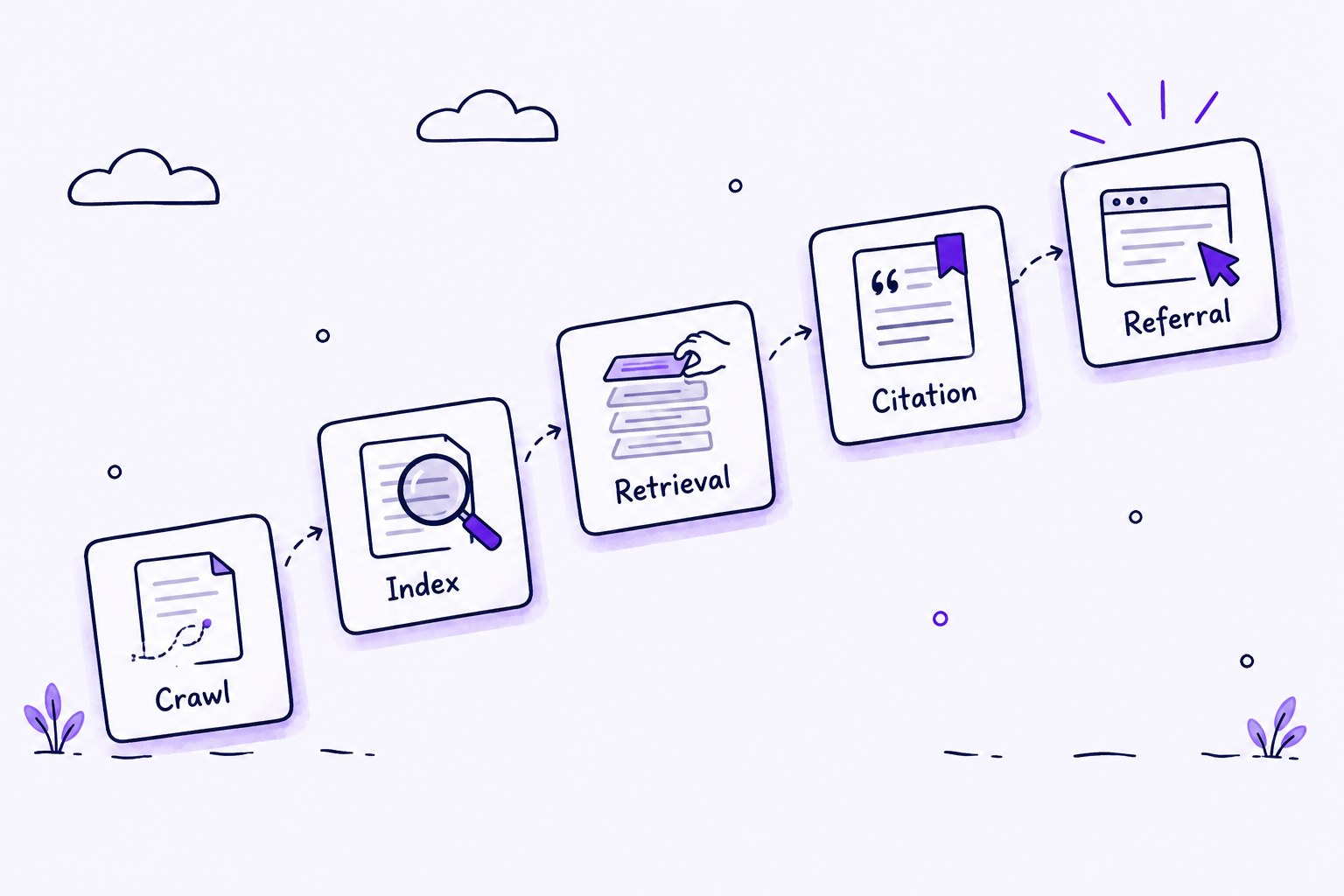
Crawl access, indexing, retrieval, citation, and referral traffic are separate stages.
-
llms.txt, “AI-specific schema tricks,” and prompt stuffing have no confirmed effect.
-
Internal editorial thresholds are not search-engine standards.
-
Official documentation, research, industry observation, and hypotheses are different kinds of evidence.
Good AI search optimization builds on reliable information, original expertise, technical accessibility, clear presentation, and measurable outcomes. The goal is content that genuinely helps readers and can be accurately interpreted and referenced, without relying on unverified assumptions about proprietary AI algorithms.
Get Started With AI Search Optimization at SEOwind
We deliver this playbook through the CyborgMethod, a system of brief, draft, score, refine. Multi-agent AI builds briefs and drafts, RAG grounds articles in real sources, and an EEAT scoring engine with automated quality gates triggers refinement. Human-in-the-loop editors handle tone, accuracy, and brand alignment. We deliver CMS-ready, white-label content.
Agencies provide keywords, topics, and sample content, and we handle research, production, and final QA. Onboarding starts with a sample test and pilot, then a feedback loop to match voice, then gradual scaling. Nothing here guarantees citations or controls generated answers.
Our company-reported scale is 2,500+ articles monthly for 500+ clients across 100+ countries. In one illustrative case, an agency handled 450+ articles per month across 130 clients. Its writing costs fell from about $740K to about $440K per year, and its internal team went from 6 to 4. Agencies can see 25-50% higher margins, though your own numbers will differ.
Ready to test it? Explore our White-Label Content Services and start with one commercially relevant topic. For the writing workflow itself, see our AI article writing approach.
Frequently Asked Questions About AI Search Optimization
Are AEO and GEO different from AI search optimization? They are common terms for the same practice. Some writers use AEO for conceptual answer-focused work and GEO for implementation, but the underlying work overlaps.
Is E-E-A-T a ranking factor? No. Google describes it as a set of concepts for evaluating quality, not a specific ranking factor, and says trust matters most.
Does crawler access guarantee citations? No. Access makes a page eligible, and selection depends on factors platforms do not fully publish.
Does a citation prove the answer is accurate? No. Open the source and confirm it supports the specific claim.
Does traditional SEO still matter? Yes. Indexing, crawlability, and useful content remain the foundation of ai search optimization.
Can I allow ChatGPT search but block GPTBot? Yes. OAI-SearchBot and GPTBot are separate crawlers, and allowing the training crawler is not required for visibility.