Volume breaks quality when correction happens only at the end. A team adds writers or AI, more drafts can mean bigger backlogs, and one overloaded editor becomes the only safeguard against wrong intent, thin research and unsupported claims. We built our content production process to avoid that trap. We deliver 2,500+ articles monthly for 500+ clients. The sections below show how.
Why Scaling Content Production Breaks Without Research and Correction Throughout
Content production is an operating system, and treating it as a writing task misses most of the work. It covers planning, research, drafting, review, approval and publishing. AI can multiply drafts, but research, fact-checking, expert review, brand review, approvals, publishing and maintenance stay capacity-constrained, so more drafts can mean bigger backlogs and higher correction costs rather than more completed output. Agencies feel this as missed deadlines and inconsistent output, plus client revisions that eat into margins.
Takeaway: Count your constraint downstream of drafting, because that is where scale stalls.
Why a Content Calendar With a Final Editorial Rescue Falls Short
A calendar coordinates deadlines. It can’t tell you whether a topic serves the audience, a brief is complete or a claim is supported. A project board differs from a production workflow, which also defines stages, dependencies, handoffs, approvals, escalation and ownership.
Final review is valuable, but an editor shouldn’t have to reconstruct missing research, repair an article built around the wrong search intent or discover basic factual problems earlier checks could have caught. By then the editor is rescuing the piece, and editing has gone out the window.
Our Content Production Process Foundation
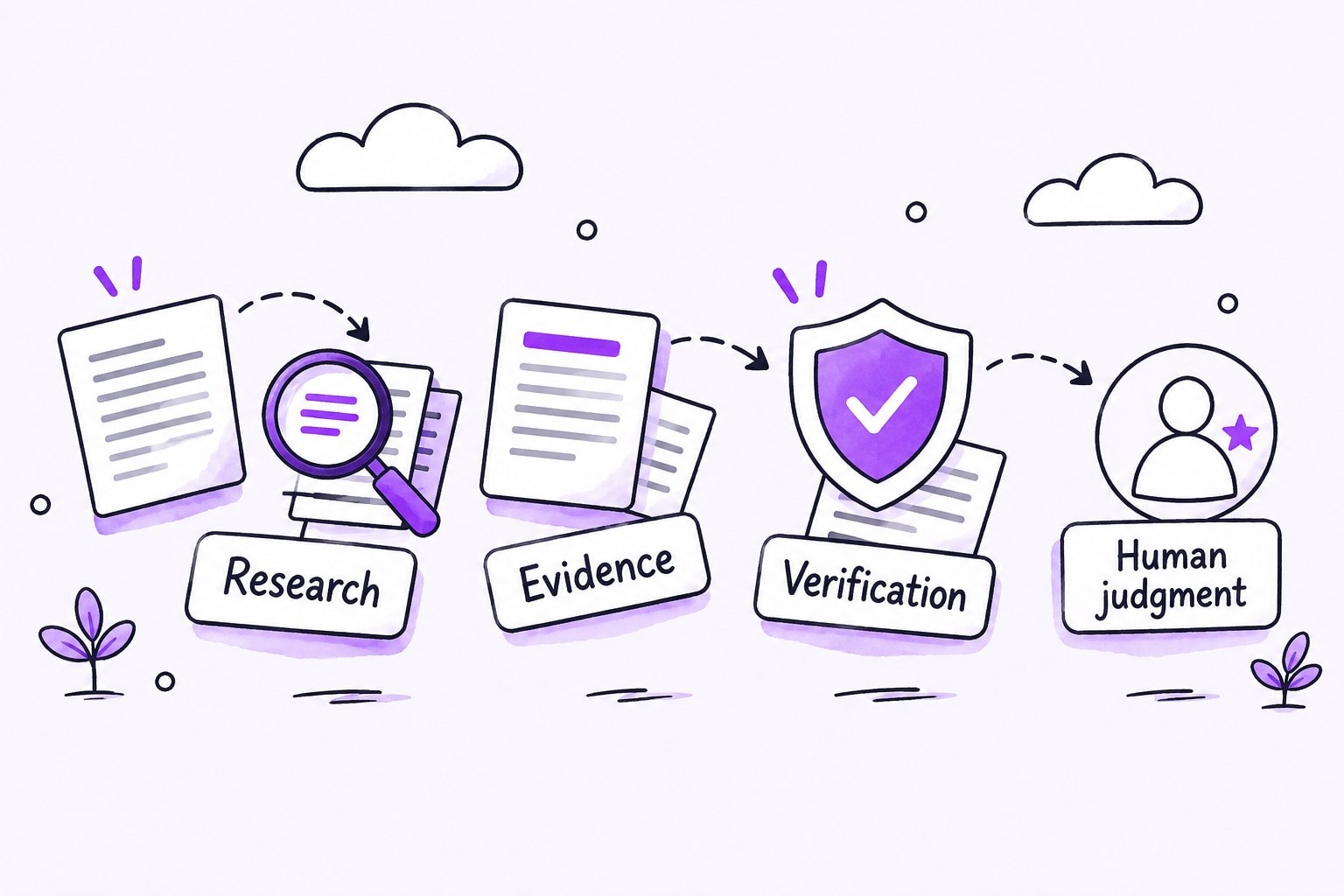
As we put it, “Research before writing. Evidence during writing. Verification after writing. Human judgment throughout.”
Research and verification happen at four points: order validation, brief creation, writing and final fact-checking. As Tom Winter says, “Research doesn’t stop when writing starts”.
We also start with the goal and what good looks like. When the desired outcome and quality standards are clear, there is often no need to prescribe every step or map exceptions in advance.
The 80/20 Research Rule as a Philosophy, Not a Time Allocation
The 80/20 Research Rule prioritizes research, context engineering and evidence preparation over text generation. It’s a strategic philosophy, and no fixed allocation applies to every article. Writing synthesizes research and expertise and doesn’t replace them. How deep you go should follow complexity and uncertainty, and how costly a wrong answer would be.
Takeaway: Treat research as an operating requirement for every assignment, scaled to risk.
Our Four Core Principles for Scalable Content Production
Repeatable output needs shared standards and clear ownership, plus assets people can actually reach. More capacity alone won’t supply them. Our operating framework rests on four principles. Each one answers a different way volume goes wrong.
Multi-Layer Research and Fact Grounding
Research supports content throughout its lifecycle. We combine company knowledge, topical research, section-level investigation, claim grounding, additional research during refinement and factual verification. These layers establish business context, guide the article, support individual sections and verify the resulting assertions. That layering is the technical core of our approach.
A completed brief doesn’t mean research is finished. Writing and evaluation can expose gaps that need new evidence.
Quality-Controlled Multi-Agent Production
Our multi-agent system uses specialized AI agents for research, briefing, writing, evaluation, refinement and verification. Defined standards and automated evaluation flag weaknesses and trigger improvements. They also decide when a human must step in.
Multiple agents don’t create quality by themselves. The workflow decides sequence and manages context handoffs, retry logic, stopping conditions, quality gates and escalation. A simpler model with deterministic checks and human review can outperform an unreliable multi-agent setup. Outputs need to be judged against a clear definition of good, with action taken on the findings.
The CyborgMethod™ and Human-in-the-Loop
The CyborgMethod™ pairs AI’s heavy lifting with human judgment, and the result ships white-label (seowind.io). Humans bring strategic direction, first-hand expertise, editorial judgment and accountability. AI handles scalable research, analysis, generation and repeatable production tasks.
Human-in-the-loop (HITL) involvement is built into the workflow and adjusted to content risk, complexity and quality requirements. It goes well beyond proofreading at the end. It helps decide what the article should say, how uncertainty is handled and whether the result is ready to deliver.
Scalable White-Label Content Operations
Generating articles and running a dependable content service are different challenges. Quality stays predictable across clients and volumes because of client onboarding, brand and knowledge calibration, bulk production management and client-specific quality standards. Human editing, white-label delivery, revision management and continuous improvement do the rest.
Agencies supply keywords and topics, published-content examples, a point of contact and brand guidelines or sample content. We handle research, briefs, production, alignment checks and delivery (seowind.io). If you run an agency, see our For Agencies page and our White-Label Content Services.
Takeaway: Judge any production setup on its standards, ownership and operations rather than its model count.
The Seven-Stage Content Production Process at a Glance
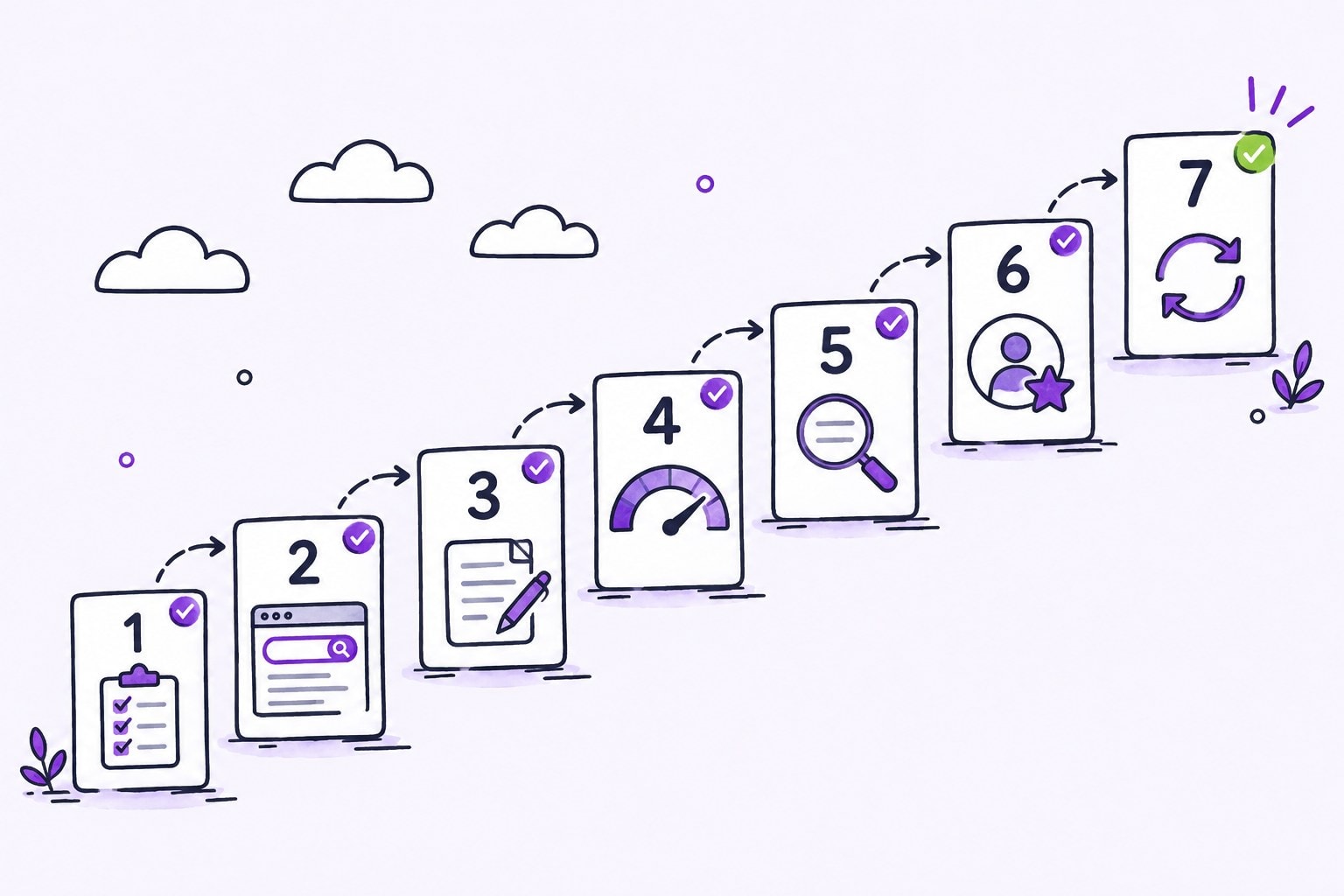
Seven stages make up the production workflow. Each has an owner and a checkpoint, and unresolved issues return to the stage best placed to fix them. A deadline passing never counts as approval.
The table below summarizes who or what owns each stage and the gate it must clear.
| Stage | What happens | Who or what owns it | Quality gate |
|---|---|---|---|
| 1. Content Request & Validation | Check keywords, title, audience, market, scope, links and instructions | Automated checks, with humans resolving strategic ambiguity | Requirements are complete, consistent and actionable |
| 2. Research & Strategic Briefing | Analyze search intent, SERPs, People Also Ask, competitors and keywords | AI research, with humans guiding the angle | Enough research, evidence and direction to write |
| 3. Contextual AI Writing & Continuous Research | Draft from brief, brand voice, company knowledge and evidence | AI writing, with humans resolving specialist questions | Draft follows the brief and incorporates evidence |
| 4. AI Evaluation, Scoring & Evidence-Driven Refinement | Evaluate against quality criteria and retrieve more evidence when needed | EEAT scoring engine and automated quality gates | Meets acceptance criteria or escalates |
| 5. Independent Fact-Checking, Verification & SEO Integration | Claim extraction, evidence retrieval, evidence preparation, verification and correction, downstream impact evaluation | Independent verification, with humans on conflicting evidence | Unsupported claims are corrected, qualified, removed or escalated |
| 6. Human Editorial Review & White-Label Delivery | Assess accuracy, usefulness, coherence and brand voice | Human editors | Approval against editorial and delivery standards |
| 7. Monitoring, Feedback & Continuous Improvement | Revisions, factual corrections and performance data inform updates | Feedback loop across stages | Recurring issues improve future production |
Takeaway: Give every stage an owner and a pass condition, or it is only a calendar entry.
Stages 1–2: Content Request Validation and Research-Led Briefing
Stage 1 takes in keywords, title, audience, market, scope, links and instructions. At Order Level, we load the order data, classify issues, research claims, correct the order, draft a message and save the results. Simple checks like required fields and URL validity can be deterministic. Contextual questions like topic fit, search-intent fit and product availability in the market need judgment (seowind.io).
Missing or contradictory requirements trigger rework. When a decision is ambiguous, a person makes the call and nobody settles it by assumption. The output is a validated request. A well-written article can still be wrong if it follows a flawed request.
Stage 2 takes in that validated request and analyzes search intent, SERPs, People Also Ask, competitor coverage and keywords. A good brief establishes what the article should achieve, what questions it must answer and what information supports those answers (seowind.io). Company expertise shapes it, and humans guide the angle.
Gaps in evidence or direction send the work back to research. The output is a researched brief. Validation settles what is being commissioned, while brief research settles how to approach it. Without Stage 2, articles drift toward generic coverage.
Takeaway: Validate the request before you brief, and brief before you draft.
Stages 3–4: Contextual AI Writing and Evidence-Driven Refinement
Stage 3 drafts section by section from the approved brief, brand voice, audience information, company knowledge, research and content already written. Google Search Console (GSC) insights inform the work. If important evidence is missing, the system researches further instead of letting the model fill the gap from memory (seowind.io). Section-level research retrieves statistics, case studies and quotations where needed.
A draft that ignores the brief or lacks evidence triggers rework. Humans resolve specialist questions. The output is a complete first draft, not a finished article. A brief can name a necessary section without anticipating every question that appears while writing it.
Stage 4 is the scoring step of our brief-draft-score-refine workflow. The EEAT scoring engine evaluates the draft against criteria including search intent, brief compliance, usefulness, depth, originality, evidence, readability, redundancy, brand voice and EEAT indicators (seowind.io). Work must meet acceptance criteria or escalate.
Why Refinement Sometimes Needs New Evidence Instead of New Wording
What failed decides the next step: rewrite, find better evidence, add company or expert context, or research again (seowind.io). Evidence problems need evidence. Better phrasing can’t repair an unsupported argument.
So when a passage lacks support, we retrieve more evidence, narrow the claim or remove it. Without this distinction, teams polish weak claims until they sound confident, which is worse than weak.
Takeaway: Diagnose whether a weak section needs new words or new evidence before you revise it.
Stage 5: Independent Fact-Checking, Verification and SEO Integration
Stage 5 takes in the draft’s checkable claims and the relevant evidence. Asking a second AI model “is this correct?” isn’t fact-checking, since nothing requires it to produce evidence. Reliable verification needs retrieval, sourcing and human judgment (seowind.io).
Five activities run in this order: claim extraction, evidence retrieval, evidence preparation, claim verification and correction, and downstream impact evaluation. A “claim census” finds every checkable claim so none are missed. Claims are classed as insufficient evidence, contradictory evidence, conflicting evidence or wrong scope (seowind.io). Unsupported or inaccurate claims are corrected, qualified, removed or escalated. Conflicting evidence is assessed explicitly, never silently reconciled.
SEO integration happens here too. Internal-link suggestions use GSC integration, and the gate confirms heading structure, formatting consistency and metadata presence before anything ships. Research can be sound while a resulting assertion is wrong, which is why we verify what the draft actually claims.
Research, Grounding and Verification Are Different Jobs
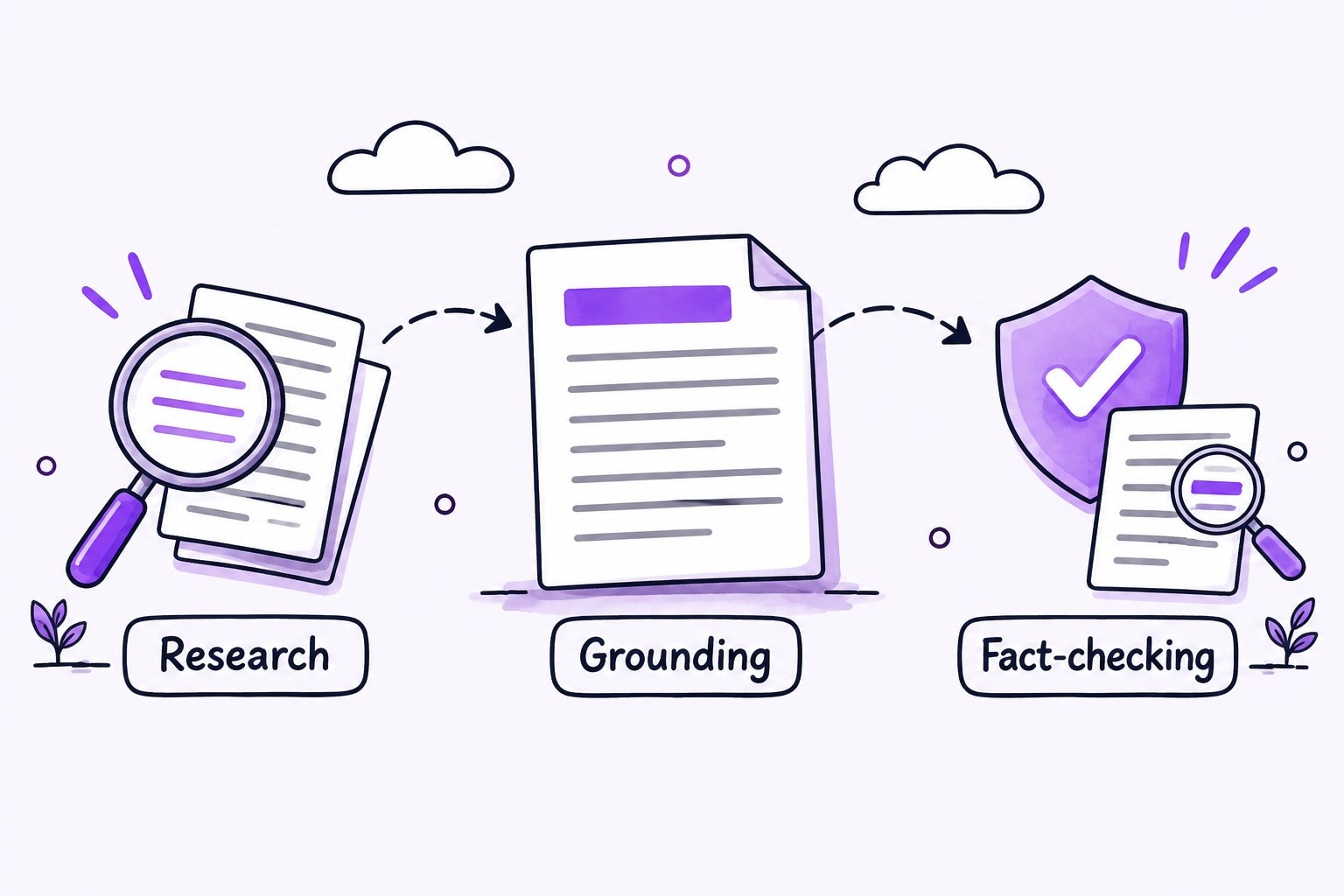
“Research finds the evidence. Grounding uses the evidence. Fact-checking verifies the resulting claims.”
Research locates sources. RAG grounding takes the retrieved material and passes it into drafting, and fact-checking tests the claims the article actually makes (seowind.io). A brief containing a fact doesn’t make it true, because the evidence still needs verification (seowind.io). Each job needs its own attention.
Downstream Impact: Finishing a Correction by Checking Its Consequences
A correction is unfinished until its consequences are checked. Fact-checkers trace a corrected claim through the rest of the article to see whether conclusions built on it need revision (seowind.io). An argument or conclusion may change when a supporting claim does. We then recheck the affected parts, and unresolved judgment calls go to a human.
Takeaway: Close a correction only after you have checked what depended on the sentence you changed.
Stages 6–7: Human Editorial Review, White-Label Delivery and Continuous Improvement
Stage 6 puts human editors on factual accuracy, usefulness, coherence and brand voice. They approve deliverables against editorial and delivery standards. Depth of scrutiny varies with client tier, content complexity and risk (seowind.io). Delivery is CMS-ready drafts in the client’s format under the client’s brand (seowind.io).
Final editorial review stays essential, but it shouldn’t be the first serious check of direction or evidence. Without earlier gates, editors become the rescue crew.
Stage 7 collects editorial corrections, client feedback, revision requests, recurring rejection reasons and issues found after delivery. Recurring problems can change validation rules, research instructions, writer context, evaluation criteria or editorial guidance (seowind.io). When reusable company facts change, related instructions get updated. Where appropriate, published pages that used outdated information return through research and evaluation.
Fixing a single article corrects one instance, while updating shared knowledge and production guidance addresses the wider problem.
Cross-Article Checks for Duplicate Explanations and Keyword Cannibalization
Quality extends beyond the single article. An article can work in isolation while creating problems in the wider portfolio. We check for duplicate explanations, overlapping search intent and keyword cannibalization.
The mechanism is simple. We review a piece against existing coverage and ask whether overlapping pieces serve distinct reader purposes. Repeated explanations are kept consistent or removed. A shared keyword alone is fine, but overlapping intent is the problem. Findings feed back into future briefs.
Takeaway: Review each article against your existing library, not only against its own brief.
How the Four Research Passes Fit the Seven Stages
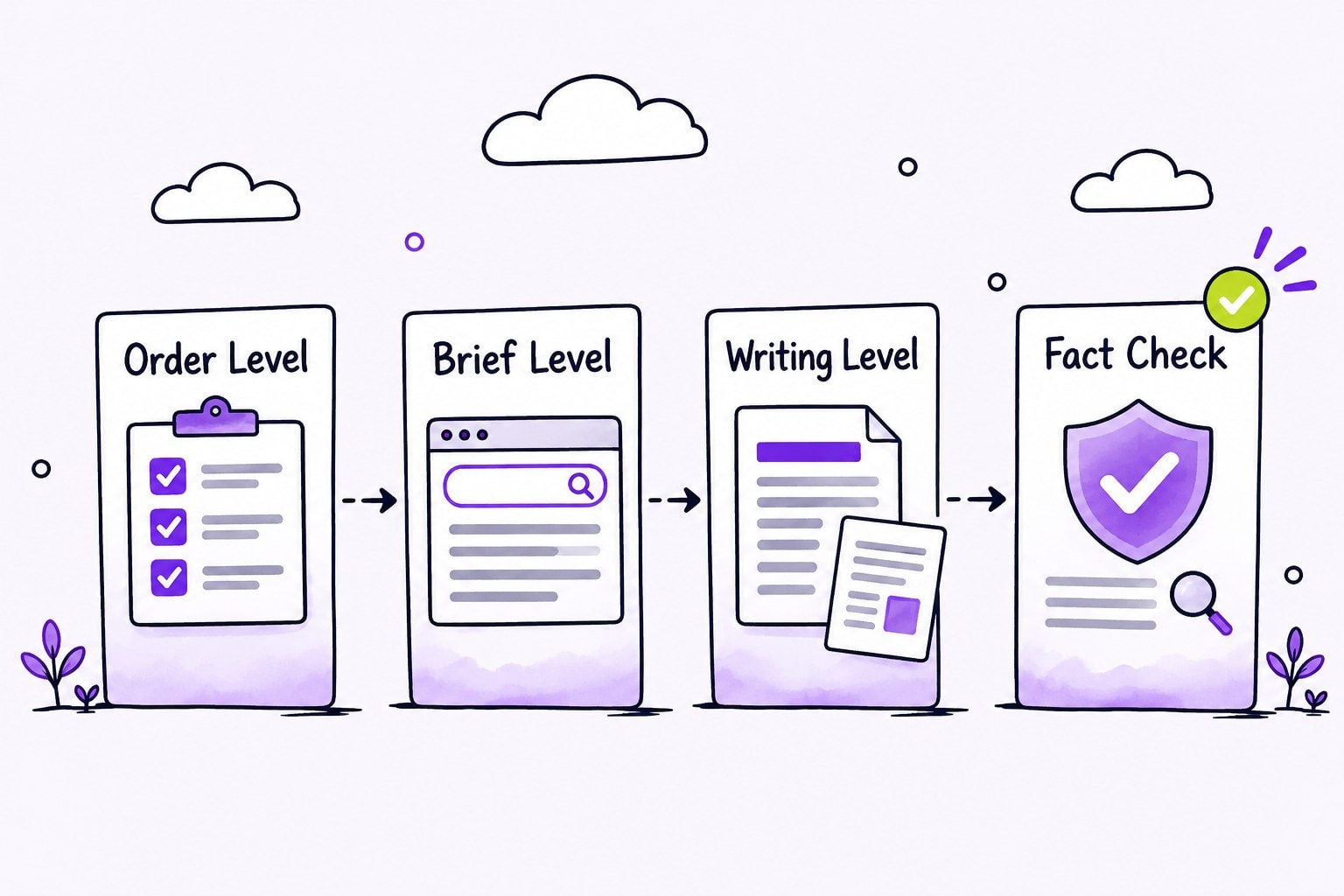
The seven stages are the production workflow. The four research passes are the major research and validation checkpoints inside it. They are complementary views of one process and don’t compete as frameworks. Each pass answers a question the previous one cannot.
| Research pass | Inputs | Checks | Resulting actions |
|---|---|---|---|
| Order Level (Stage 1) | Audience, objective, scope, market and instructions | Completeness and consistency. Mechanical omissions are separated from context-dependent questions such as business relevance and search-intent fit | Correct missing or contradictory requirements before drafting. Strategic ambiguity goes to a human. |
| Brief Level (Stage 2) | Search intent, SERPs, People Also Ask, competitor coverage, keywords, external sources and client knowledge | Gaps, differentiation opportunities, evidence needs. Source and scope details are retained for later stages | A researched direction, with evidence and cautions passed forward to writing and checking. |
| Writing Level (Stages 3–4) | Approved brief, brand and audience context, company knowledge, research and the evolving draft | Intent, brief compliance, usefulness, depth, originality, evidence, readability, redundancy and voice. Research continues when the work exposes a gap | First draft, then refinement against evaluation findings. Evidence weaknesses are treated as evidence issues rather than style issues. |
| Fact Check (Stage 5) | The draft’s checkable claims and relevant evidence | Enumerate claims, verify against evidence, classify outcomes, check whether a correction affects dependent claims | Correct, escalate or reject by evidence status, then recheck affected parts of the article. |
At Order Level the question is whether the request is sound. Brief Level checks that we know enough to write. By Writing Level, the concern is whether the draft is grounded and whether new gaps need research. Fact Check closes the loop by confirming the claims hold and the article stays consistent after corrections.
Takeaway: Give each research pass a distinct question so extra passes are never repeat work.
Where Human Judgment Sits Inside the Workflow
Human editors stay involved at every stage, applying judgment on conflicts, ambiguity and consequential claims (seowind.io). Upstream, humans supply business strategy, customer understanding, SME knowledge, proprietary data, point of view, examples, brand context and the definition of quality. Downstream, they step in for conflicting evidence, strategic ambiguity and unusual risk (seowind.io).
The table shows the human decision at each stage.
| Stage | Human decision |
|---|---|
| 1. Content Request & Validation | Resolve strategic ambiguity |
| 2. Research & Strategic Briefing | Guide the angle |
| 3. Contextual AI Writing & Continuous Research | Resolve specialist questions |
| 4. AI Evaluation, Scoring & Evidence-Driven Refinement | Take over when work cannot meet acceptance criteria (escalation) |
| 5. Independent Fact-Checking, Verification & SEO Integration | Assess conflicting evidence |
| 6. Human Editorial Review & White-Label Delivery | Give editorial approval |
| 7. Monitoring, Feedback & Continuous Improvement | Decide process updates |
Humans also step in when scope cannot be pinned down, key evidence is unavailable, YMYL or compliance risk is high or a piece keeps missing the quality bar (seowind.io). A quality score alone should not decide sensitive publication decisions. Gates have a standard, a verification method and a failure action, with outcomes of PASS, REFINE, ESCALATE or REJECT (seowind.io). Automation doesn’t eliminate errors. It routes them to the right place.
Takeaway: Write down who decides at each handoff, and never let a score approve sensitive work.
Operating a Dependable Content Service: Accepted Content, Not Draft Volume

Throughput alone doesn’t show what content achieves. Cost per approved asset accounts for production and coordination costs relative to accepted assets (seowind.io). That’s why our monthly figure counts delivered work that cleared editorial and delivery standards, and generated text doesn’t factor in.
“Scale accepted, quality-controlled content, not simply article generation.”
For your own operation, define an accepted article through explicit requirements for scope, factual support, editorial quality, brand alignment and delivery completeness. Then watch on-time acceptance, revision frequency, approval delays and recurring quality issues. Measure audience and business outcomes separately, with tools suited to each question. GSC covers search performance, while engagement and conversion usually need other systems.
Takeaway: Report accepted articles and cost per approved asset instead of drafts produced.
Build Your Content Production Process With SEOwind
Start with one defined use case and explicit acceptance criteria, then expand volume. We handle research, briefs, AI-assisted drafting, human editorial input, brand and quality checks and CMS-ready white-label delivery. Your strategists, subject-matter experts and editors keep the strategic calls.
-
Onboarding begins with a sample test and pilot, followed by a feedback loop that matches your voice.
-
Volume scales gradually once the output matches your standard.
-
Automated quality gates and human oversight apply at every step.
Explore For Agencies or our White-Label Content Services to start.