
Every agency has lived through this moment: a client spots an error in published content before your team does. Maybe it’s a wrong statistic, or a claim that doesn’t hold up, or a tone that just doesn’t sound like the brand. By the time it reaches the client, calling it a QA process is generous. It’s damage control at that point.
Content QA exists so that moment never happens. Good QA builds checkpoints throughout production that catch problems while they’re still cheap to fix, rather than relying on a harder proofread at the end. That’s what a real content QA system looks like, and it’s the system we’ve built at SEOwind.
Content QA as a Control System, Not a Proofreading Pass
Most teams treat QA as a final read-through before publishing. That approach relies on hope more than process.
A real content QA system works like a control system, with checkpoints built into every stage of production, not just the end. A factual gap gets caught during research, not during final review. A brief mismatch gets flagged during outlining, before the draft is even finished. Shifting checks earlier in the pipeline matters because the earlier a defect is caught, the cheaper it is to fix. A commonly cited estimate from software development suggests the cost of fixing an error can rise roughly 6x from design to implementation, and climb even higher after release. Whether or not you buy the exact multiplier, the direction is undeniable: errors caught late cost more than errors caught early, in time, money, and client trust.
The Question Every Caught Error Should Trigger: Where Should This Have Failed Earlier?
When an error surfaces in our final QA review, we ask one question before we even fix it: where should this have failed earlier? Correcting a wrong statistic isn’t enough on its own. We also need to figure out why the research stage didn’t catch it, why the brief didn’t require a source, or why the evaluator missed the mismatch.
This question turns every caught error into diagnostic information instead of just a fixed mistake. Skip it, and you’ll keep catching the same category of error forever, just later and more expensively than you should.
Universal Verification vs. Risk-Based Editorial Depth
Not every piece of content carries the same risk, and treating them identically wastes resources. Our operating rule is simple: universal verification runs on every single article, regardless of client or content type. Every article gets checked against the brief, checked for factual accuracy, and checked for formatting and metadata.
What scales up or down is editorial depth. Higher client tiers, more complex content types, and higher-risk categories get more human scrutiny layered on top of that baseline. Content touching YMYL topics, health, financial stability, safety, or other higher-liability categories, gets stricter review because the cost of getting it wrong is categorically higher. This is a resource allocation decision, not a shortcut.
What Every Quality Gate Needs: Standard, Verification Method, Failure Action
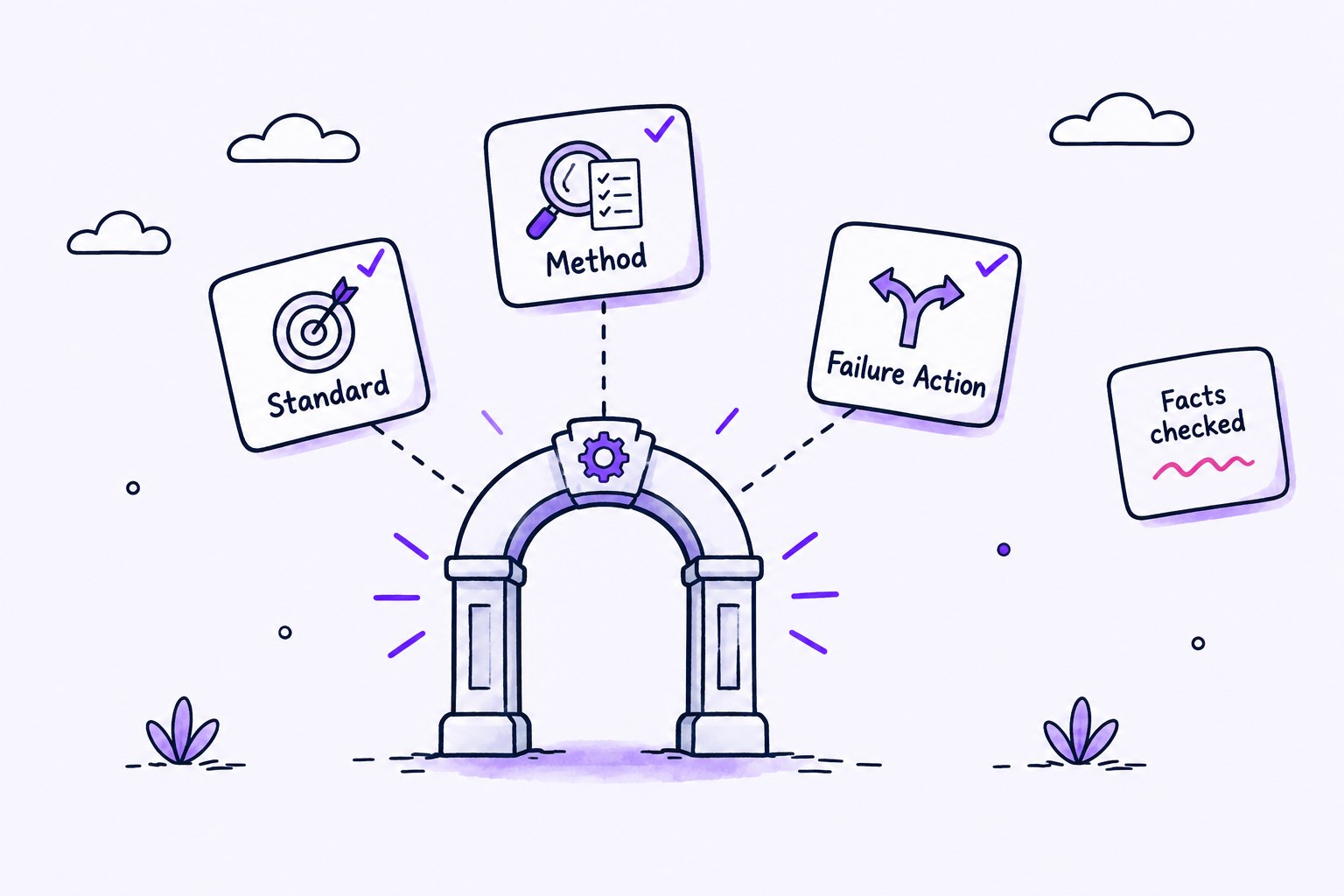
A quality gate isn’t something a checklist checks off out of habit. A real quality gate has three parts:
-
a standard to measure against,
-
a verification method that proves whether the standard was met, and
-
a failure action that defines what happens when it wasn’t.
Miss any one of those three, and the gate is theater. It looks like QA on the surface, but the mechanics underneath aren’t there.
Why ‘Facts Checked’ Is Not a Gate
“Facts checked” is the phrase that gives QA a bad reputation, because it sounds like a gate but isn’t one. It has:
-
no standard (checked against what?),
-
no defined method (how, exactly?), and
-
no failure action (what happens when something’s wrong?).
The actual gate looks like this: enumerate the checkable claims in the piece, verify each one against appropriate evidence, classify the result, then act on that classification by correcting, escalating, or rejecting the claim. Four concrete steps with a defined outcome at each one. “Facts checked” is a status update. The four-step version is an actual gate. If your process can’t describe what happens when a claim fails, you don’t have a gate.
Deterministic Checks, Evaluator Judgment, and Human Judgment
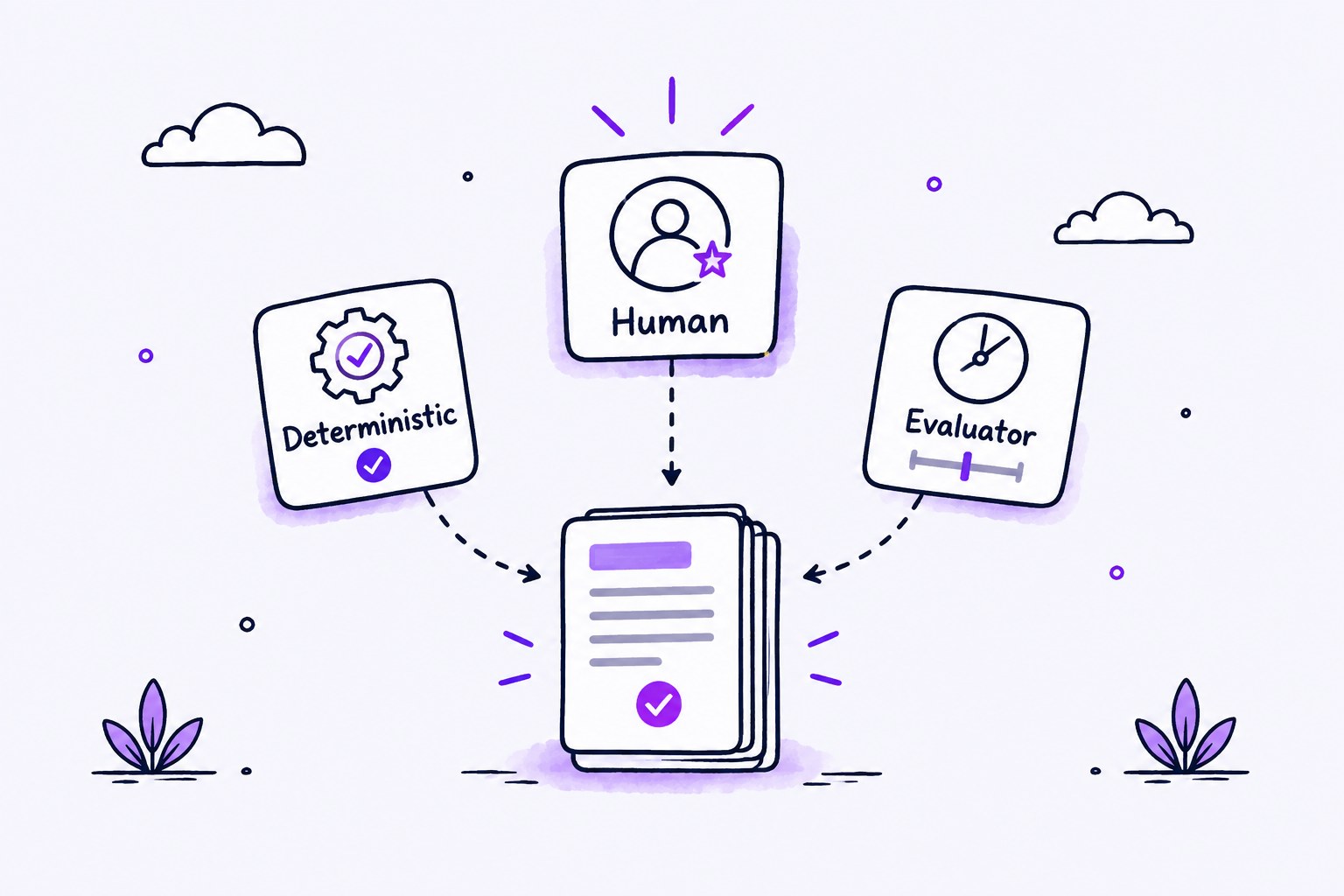
Not every quality question can be answered the same way, and pretending otherwise is where a lot of QA systems fall apart. We think about verification in three distinct layers, and confusing them is a common mistake.
What Machines Prove, What Evaluators Judge, What Humans Own
Deterministic checks handle anything mechanically provable: does the metadata exist, is the word count in range, is the internal linking structure present, does a specific fact match a specific source. These checks are binary. They pass or they fail, with no ambiguity.
AI-evaluator judgment sits one layer up. This covers contextual assessment: tone, relevance, E-E-A-T signals, whether a section actually answers the reader’s question. Evaluator scoring is inherently non-deterministic. The same content run through the same evaluator can produce a slightly different score with no code change at all, which means these gates need calibration, thresholds with margin, and comparison against a stable baseline rather than a single pass or fail number.
Human judgment owns everything else: ambiguity that has no clean rule, business and brand decisions that require context a model doesn’t have, and any escalation with real consequences. This is also where accountability lives. Editors stay accountable for gate outcomes even when the system executes most of the checking, because a system doesn’t carry responsibility. People do.
Editing and QA get confused constantly, and it’s worth separating them cleanly here. Editing improves how something reads, while QA verifies it against requirements, facts, brand standards, and technical rules. A beautifully written sentence that states a false fact is an editing success and a QA failure at the same time.
Inside Our Fact-Checking Process: A Coverage Layer, Not Just Verification
Most fact-checking conversations focus entirely on accuracy: did we verify this claim correctly? That’s the wrong first question. The right first question is whether the claim ever made it onto the checking worklist in the first place.
The Claim Census: Catching What Never Made the Worklist
We built what we call a claim census after realizing that some of our errors weren’t verification failures at all. They were coverage failures. The claim was never flagged as something to check, so it sailed through untouched, and every downstream metric looked fine because nothing had technically failed. A QA system can look highly accurate on everything it checked while completely missing everything it forgot to check in the first place.
A claim census means systematically walking the content and enumerating every checkable claim before verification starts, rather than relying on whoever’s editing to notice claims as they read. This validates coverage, not just accuracy, and it’s a distinction most QA processes never make.
Evidence Semantics: Verified, Contradicted, Insufficient, Conflicting, Wrong Scope
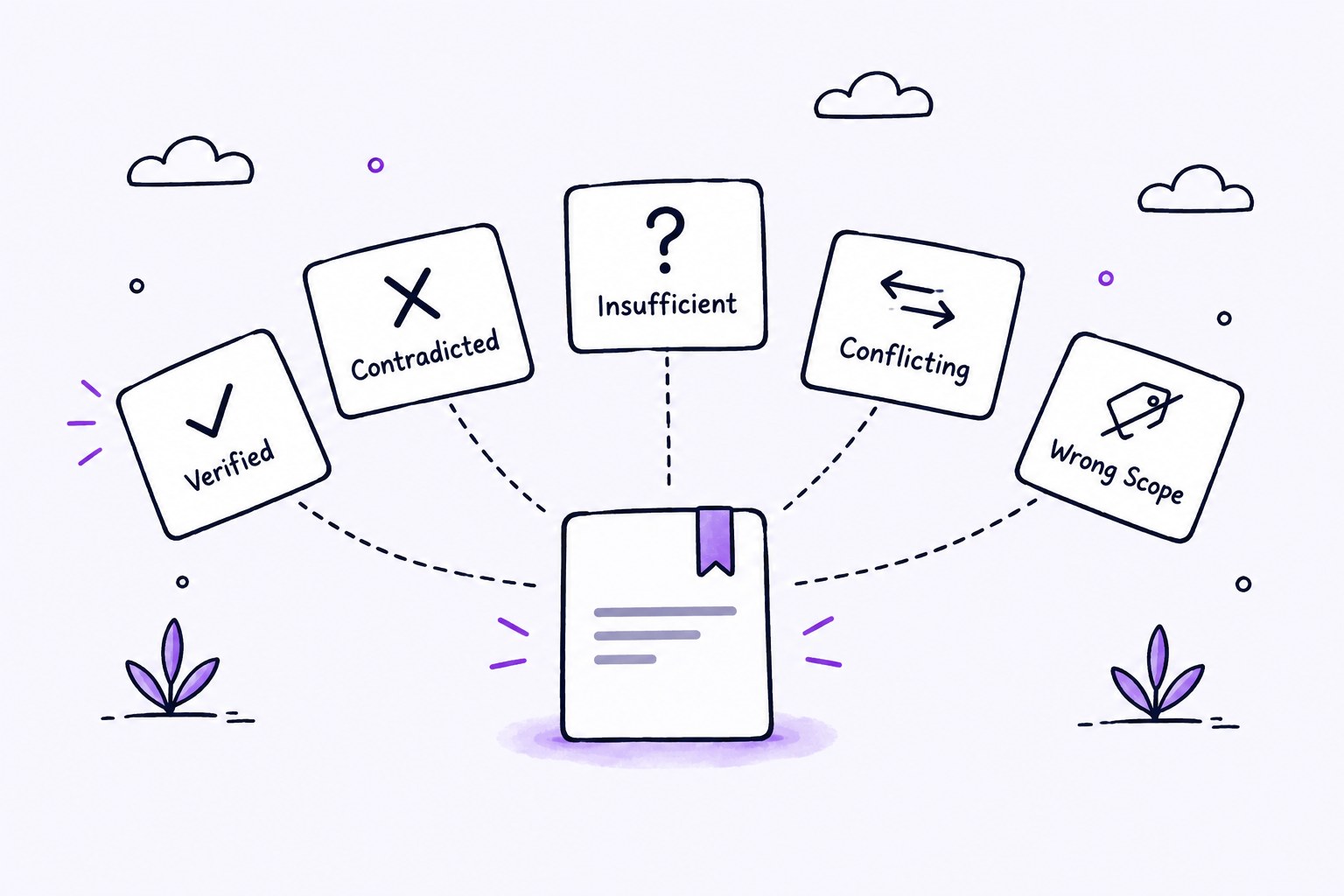
Once a claim is on the worklist, treating the outcome as binary (true or false) throws away information you need. We classify every checked claim into one of five outcomes:
-
Verified: the claim matches credible, appropriate evidence.
-
Contradicted: credible evidence directly disagrees with the claim.
-
Insufficient evidence: we couldn’t find support for or against the claim. This is a distinct category, not a soft version of “probably false.”
-
Conflicting evidence: credible sources disagree with each other. This calls for escalation, not invented certainty.
-
Wrong scope: the claim might be true somewhere, but not here. Typical causes are a mismatch in year, geography, product, model, version, pricing basis, entity, or date.
Collapsing these five outcomes into a simple pass or fail throws away exactly the information an editor needs to decide what to do next.
The Ripple Effect: Following Dependency Chains, Not Just Sentences
Fixing a wrong statistic feels like closing the loop. It usually isn’t. If a conclusion, a comparison, a recommendation, a table, or a later sentence was built on that number, correcting the original claim without checking what depended on it just relocates the error somewhere else in the piece.
The unit of fact-checking isn’t always the sentence. Sometimes it’s the dependency chain. A single corrected data point can ripple through three more paragraphs that referenced it, and a QA process that stops at the first fix will ship the other three broken.
The Full Gate Checklist: Brief to CMS-Ready
A content QA process worth the name runs checkpoints starting at the brief and continuing through CMS-ready delivery, not just at the finish line.
Brief Adherence and Search-Intent Alignment
Content can be flawless prose and still fail QA if it doesn’t answer what the brief and the searcher actually needed. This gate checks the piece against its brief and against search intent, confirming the content matches the angle, depth, and audience it was built for.
E-E-A-T, Expert Input, and Source Quality
E-E-A-T isn’t a direct Google ranking factor. It’s a rater-guideline framework Google’s quality raters are trained to use, with their feedback helping confirm that Google’s algorithms are producing good results, and Google gives more weight to strong E-E-A-T signals for YMYL content covering health, financial stability, safety, and societal well-being. Of its four components, Experience, Expertise, Authoritativeness, and Trustworthiness, trust is generally treated as the most important. This gate checks whether expert input was used where relevant, and whether sources meet a credible bar rather than just existing on the page.
Internal Links, Structure, Formatting, and Metadata
Contextual links placed early in a piece, where the topic is first introduced, read as editorial endorsements and tend to carry more weight than navigational links buried in a sidebar. Most volume guidance lands in a similar range: 5 to 10 internal links per 2,000 words, or 2 to 5 contextual links per 1,000 words, with some practitioners also capping total page links at 150. We treat these as directional ranges rather than hard rules. Google’s link best practices set two baselines worth checking explicitly rather than assuming writers get them right by default. First, every page you care about should have at least one internal link pointing to it. Content with no internal links misses those discovery paths and link signals, though search engines may still find it through sitemaps or external links. Second, anchor text should be descriptive, concise, and relevant to both the linking page and the destination. This gate also confirms heading structure, formatting consistency, and metadata presence before anything ships.
A Practical, Copyable Content QA Checklist
Below is a version of our gate structure adapted for your own team to use. Each item follows the standard, verification method, failure action, and owner format, because that’s what separates a real gate from a good intention.
Factual accuracy
-
What to check: every checkable claim in the piece.
-
How to verify: run the claim census, check each against appropriate evidence, classify by outcome.
-
Pass condition: all claims are Verified or explicitly resolved.
-
Failure action: correct, escalate, or reject depending on classification.
-
Owner: fact-checker or content quality analyst.
Brief adherence
-
What to check: topic, angle, and depth against the original brief.
-
How to verify: side-by-side comparison.
-
Pass condition: content matches brief intent.
-
Failure action: return to writer with specific gaps noted.
-
Owner: editor.
Brand voice
-
What to check: tone, vocabulary, and style consistency.
-
How to verify: evaluator scoring plus human spot-check.
-
Pass condition: passes calibrated threshold.
-
Failure action: revise flagged sections.
-
Owner: editor or content quality associate.
Compliance and sensitive-topic screening
-
What to check: claims substantiation, accessibility considerations, regulated-industry language.
-
How to verify: manual review against category-specific standards.
-
Pass condition: no unsupported claims or flagged risk language.
-
Failure action: escalate to senior reviewer before publishing.
-
Owner: senior editor.
SEO and metadata
-
What to check: title tags, meta descriptions, headings, internal links, keyword placement.
-
How to verify: deterministic checks against a technical checklist.
-
Pass condition: all fields present and correctly formatted.
-
Failure action: auto-flag missing fields for correction.
-
Owner: production system with human sign-off.
Keep this checklist visible, not buried in a document nobody reopens. A gate nobody references before publishing isn’t really a gate.
How This Runs Across 2,500+ Articles a Month at SEOwind
We run this exact structure across more than 2,500 articles a month, and volume is precisely why the gate structure has to be mechanical rather than personality-dependent. At that scale, “the senior editor will catch it” isn’t a plan.
Our workflow follows a structured brief, draft, score, refine cycle. A multi-agent AI system builds the initial brief and draft, RAG grounds the content in real sources to keep it anchored to verifiable information rather than plausible-sounding invention, and an EEAT scoring engine plus automated quality gates flag content that doesn’t meet standard before a human ever sees it. We’ve written more on how this scoring works in our content quality metrics article, and on the full brief-draft-score-refine mechanics in our content production process article, both worth a look if you want the underlying workflow in more detail.
Scaling Editorial Depth by Client Tier, Content Type, and Risk
Universal verification runs on all 2,500-plus articles without exception. What scales is how much human editorial depth sits on top of that baseline. A standard blog post for a lower-risk client tier moves through fewer manual touchpoints than a piece for a higher-tier client, a technical topic, or content in a higher-liability category. That tiering isn’t about cutting corners on the baseline; it’s about not spending senior editorial hours on content that doesn’t carry proportional risk, so those hours are available where they matter most.
Manual In-House QA vs. Freelancer-Managed QA vs. AI-Assisted, HITL QA
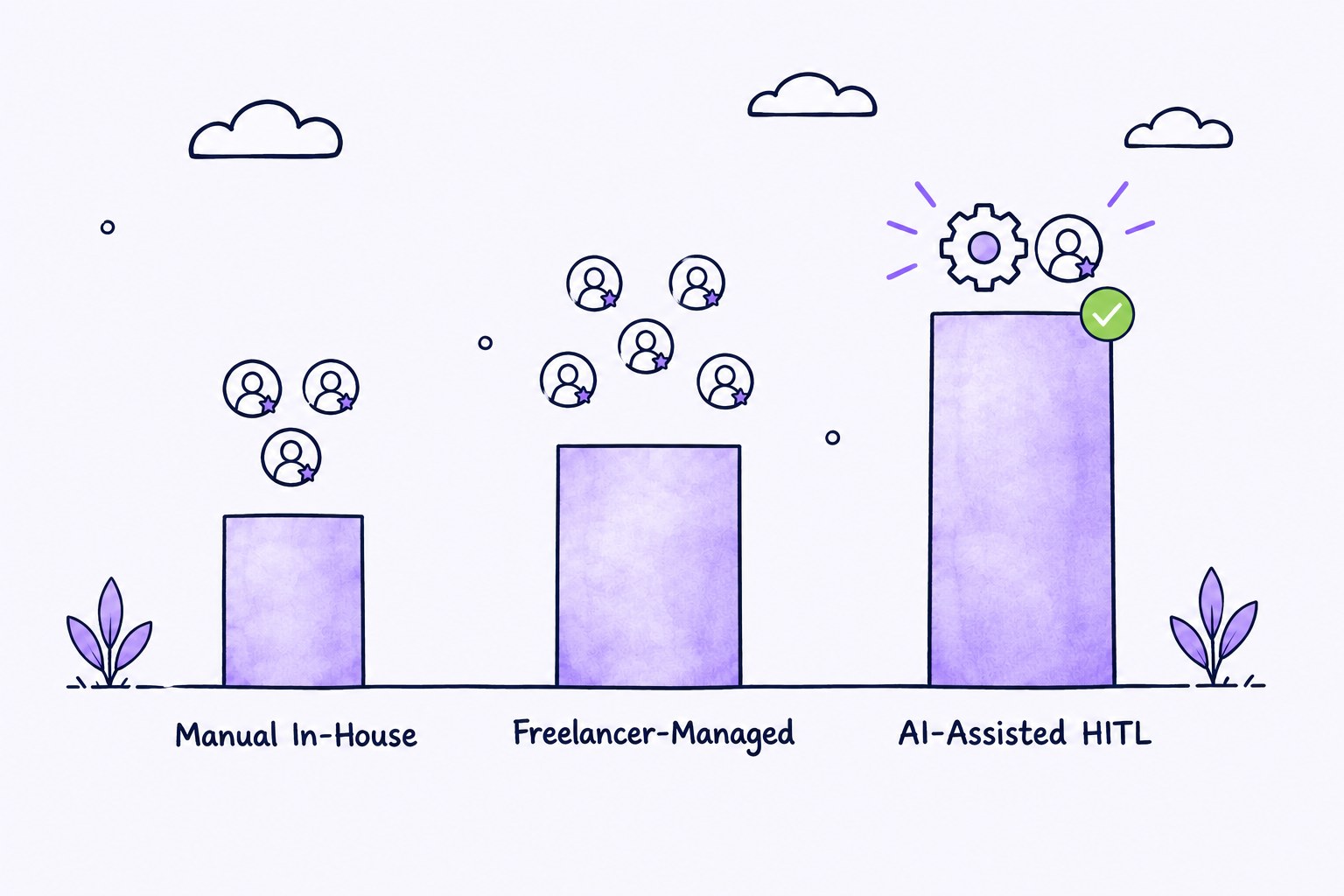
The three most common ways agencies structure content QA differ less in what they check and more in how consistently they check it and how well the checking scales.
Manual in-house teams can hold quality bars high, but only as far as their editors’ available hours stretch. Freelancer-managed pools scale headcount easily, but the same mistake tends to resurface from a different writer each week because the correction never becomes a process change. A hybrid system like CyborgMethod, our human-in-the-loop (HITL) approach, runs deterministic and evaluator checks on every article at volume, then routes human editorial attention to where ambiguity, brand judgment, or risk actually require it.
| Model | Scalability | Human oversight | Consistency across volume |
|---|---|---|---|
| Manual In-House QA | Limited by editor headcount | High, but concentrated in a few people | Strong per-editor, weak across editors |
| Freelancer-Managed QA | Scales in headcount but not in consistency | Variable, depends on each freelancer | Lessons often stay trapped with one writer or editor |
| AI-Assisted, HITL QA (CyborgMethod) | Scales with volume without proportional headcount growth | Selective, applied where judgment matters most | Consistent because deterministic and evaluator layers run the same way every time |
Agencies looking to apply this kind of tiered structure without building it themselves are exactly who our AI services for agencies support. If your team is stretched thin managing freelancers at inconsistent quality levels, it’s worth seeing what a structured system looks like in practice.
The Feedback Loop: From Article-Level Fixes to System-Level Prevention
Fixing an error in one article is the easy part. The harder, more valuable part is making sure that same error doesn’t show up in the next 500 articles.
First Occurrence Is an Execution Error, Recurring Occurrence Is a Process Error
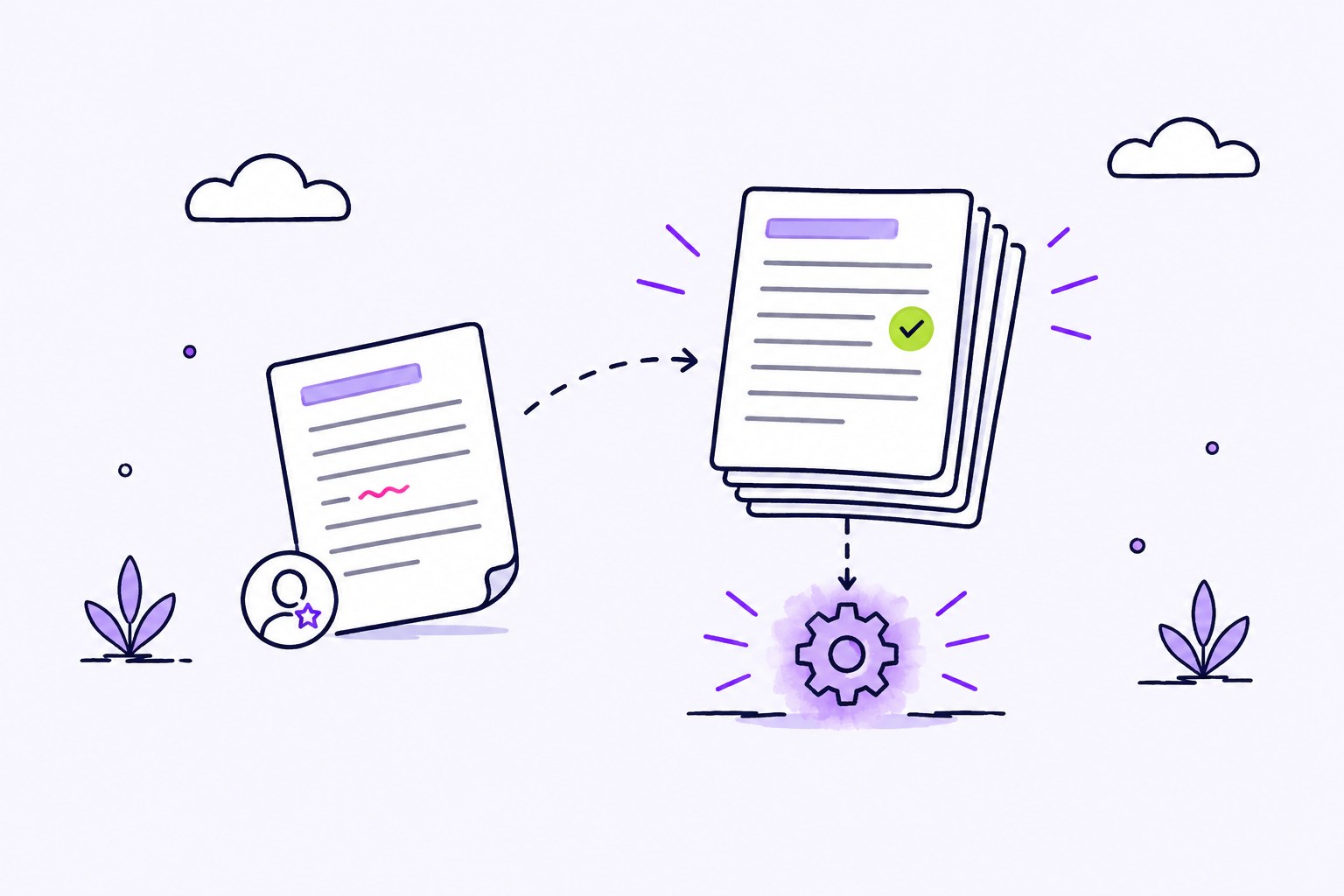
Every meaningful recurring failure gets logged by type and traced back to a root cause. The rule we hold ourselves to is straightforward: the first time a mistake happens, it’s an execution error, a single writer missing something on a single draft. The second time the same category of mistake happens, it’s a process error, and the process owner owns that failure, not the individual who happened to make it.
This distinction changes what “fixing” something means. Article-level QA fixes the one unsupported statistic in the one article where it appeared. System-level QA fixes that statistic and updates the brief template or the research requirements or the source hierarchy or the evaluator criteria, whichever piece actually broke, so the next 2,500 articles are less likely to carry the same problem. Only doing the first keeps you running damage control on a loop. Doing the second should make your error rate trend down over time instead of staying flat.
Why Unmanaged Freelancer Pools Repeat the Same Mistakes
Unmanaged freelancer pools tend to fall apart right here. The same factual gap, the same formatting inconsistency, or the same brand-voice miss shows up again a month later from another writer, because the lesson from the first correction stayed trapped inside that one article or inside one editor’s head. Nobody fed it back into a brief template or a checklist that the next writer would actually see.
In a systematic pipeline, errors become training data for the process itself. The correction doesn’t just fix the article. It updates the system that produces the next one. That’s the operational difference between managing freelancers and running a QA process, and it’s a big part of why agencies eventually look at outsourcing content production entirely rather than continuing to patch a leaky freelancer pipeline article by article.
QA of QA: Validating Your Own Checking Process
It’s tempting to assume a newer, more sophisticated checking process is automatically better than what you had before. It usually isn’t, at least not automatically, and assuming so is its own failure mode.
Before we roll out any change to our checking logic, we run it against the current production baseline using the same inputs, so we’re comparing like against like rather than trusting that “newer” equals “better.” Just as important, we inspect false passes as carefully as caught errors. Seeing what a new check catches that the old one missed only tells half the story. We also need to see what it might wrongly flag, or wrongly clear, that the old process handled fine. A check that catches more real errors while also generating more false alarms hasn’t necessarily improved anythin. It might just have moved the noise somewhere else.
We also compare finished articles side by side rather than trusting stage-level metrics in isolation. A gate can show a great pass rate at its own stage and still let something through that shows up as a problem in the finished piece, because stage metrics measure the gate, not the outcome. If you want a simple way to start tracking this yourself, three numbers will tell you most of what you need to know: client escape rate (errors that reach the client instead of getting caught internally), revision cycle count (how many rounds it takes to get a piece to final), and error rate by category (which types of mistakes keep recurring). Track those three consistently and you’ll know within a few weeks whether your gates are actually working or just look like they are.
Frequently Asked Questions About Content QA
What is a quality assurance framework in content production?
A quality assurance framework is a structured system of checkpoints, standards, and escalation rules applied throughout content production, not just at the end. It defines what gets checked, how it gets verified, and what happens when something fails, at every stage from brief to publication.
What is a QA framework, specifically, versus general editing?
A QA framework verifies content against defined requirements: facts, brand standards, legal and compliance rules, and technical specs. Editing improves how the content reads. The two overlap in practice but serve different purposes, and conflating them is how errors slip through disguised as “the piece was edited.”
What does a content analyst or content quality analyst actually do?
A content quality analyst or content quality associate runs the verification layer of the QA process: checking claims against evidence, confirming brief and metadata compliance, and flagging content that fails defined standards for correction or escalation. It’s a distinct role from writing or editing, focused specifically on verification against requirements.
How is content QA different from a standard QA review?
A QA review in most technical fields checks a finished product against a spec. Content QA does the same thing, but the “spec” includes the brief, factual accuracy, brand voice, SEO requirements, and increasingly, E-E-A-T signals, since content quality now covers reader trust as well as technical correctness.
Can content QA be automated?
Parts of it, yes. Deterministic checks like formatting, metadata, and specific fact-pattern matches automate well, and AI-assisted tools can flag likely issues quickly. But contextual judgment, brand nuance, and any decision with real consequences still need a human reviewer with the authority to make the final call. That split is how we run QA in our white-label content service for agencies: automated gates handle the first layer of verification, and our editors own the judgment calls and final sign-off.
Where Would the Next Error Fail?
If you’re rethinking how content QA works inside your agency, whether that means building tighter internal gates or handing the whole pipeline to a partner that’s already run this at scale, it’s worth starting with the question this whole process is built around: where would the next error fail if you weren’t catching it now?