Most agency owners we talk to share one fear about bulk content creation: that volume itself will get a client’s site flagged. It won’t. A broken process running faster does the damage. “Bad process × AI = faster bad results.” And at scale, your worst-performing article defines your average brand output, and the best piece in the batch doesn’t change that.
We built SEOwind around that reality. We will show you how we keep volume and quality together, and how an agency can test the same approach through a pilot batch.
Why Bulk Content Creation Triggers Spam Penalties (and When It Doesn’t)
Google looks at purpose and value. Page count doesn’t enter into it. Sites that break Google’s spam policies may rank lower or not appear at all, so the stakes are real. What triggers a penalty is what the pages do for readers, however many you ship.
What Google’s Scaled Content Abuse Policy Actually Targets
Google Search Central defines scaled content abuse as many pages generated mainly to manipulate rankings instead of helping users. It targets large amounts of unoriginal content with little or no value, regardless of how the content is created.
That final clause is easy to miss. Google does not prohibit generative AI. AI can help with research and with adding structure to original content. The policy applies when many pages get generated without adding value.
Common Bulk Content Patterns That Get Flagged
The spam policy lists the patterns: generative AI used to produce many pages without adding user value, scraped feeds or search results that are synonymized or translated, pages stitched together without added value, and pages that make little sense but carry search keywords. Doorway abuse and keyword stuffing sit nearby, such as near-identical city pages or unnaturally repeated phrases.
The helpful content self-assessment adds more warning signs: extensive automation across many topics, mainly summarizing others, entering topics without real expertise, easily verified factual errors, and mass production where individual pages get less care. Every one of these is a process failure.
From Vanilla Prompts to Orchestrated AI Workflows
The common shortcut is free-form, single-prompt generation in tools like ChatGPT or Claude. At volume it yields “AI slop,” which is repetitive and shallow, with a habit of hallucinating. The process is the problem, since the tools themselves are fine.
LLMs are strong logical engines that transform structured data well. They can’t pull facts from thin air, so they make poor research engines. Google notes that generative models predict likely word sequences rather than retrieve facts, so output can contain inaccuracies.
Relying on one talented editor to rescue every draft doesn’t fix this either, because individual heroics create bottlenecks. Real bulk production needs an assembly line: an AI system that runs an entire SOP instead of isolated one-off prompts.
Map the Human Workflow First: The Human-as-a-Service Approach
Before automating anything, we run the workflow manually. We map and execute every step for 10 articles. That exercise exposes edge cases, required inputs, and what the ideal output looks like. This is our Human-as-a-Service (HaaS) approach.
It also shows why humans alone can’t carry volume. People skip steps during repetitive, high-volume work, and quality drifts. So the division of labor is deliberate. AI handles scalable research and structured drafting, plus the repetitive checks. Humans bring strategic direction and proprietary experience, and they stay accountable for brand alignment.
The 80/20 Blueprint: Multi-Pass Research Before Writing
High-volume content fails when research gets compressed or skipped. Our operating philosophy flips the usual ratio: 80% of effort goes into research and briefing, 20% into text generation. It’s our own philosophy, not an industry statistic. Four research passes keep quality strict across thousands of articles per month.
Validating Orders, Topics, and Search Intent
Pass #1 is Order Level Validation. Before any work enters the pipeline, it checks naming accuracy and scope, and confirms the brief is complete. “Nothing enters unvalidated.” The validation step also checks whether the angle matches search intent and whether the audience, geography, and business goal are clear. It flags YMYL and other high-risk topics early.
Building Unique, Intent-Matched Briefs With Expert Input
Pass #2, Brief Level & Intent Mapping, analyzes top Google SERP results and scrapes competitor structures. It clusters keywords too, then locks the content angle before drafting. Pass #3: Writing Level & Context Enrichment injects brand voice, product details, and proprietary data into each section draft, along with real SME insights. That is the CyborgMethod™ at work, and it keeps articles from reading like everyone else’s. Pass #4: Independent Fact-Checking verifies all extracted claims against primary sources.
Replacing End-of-Line Editing With Quality Gates
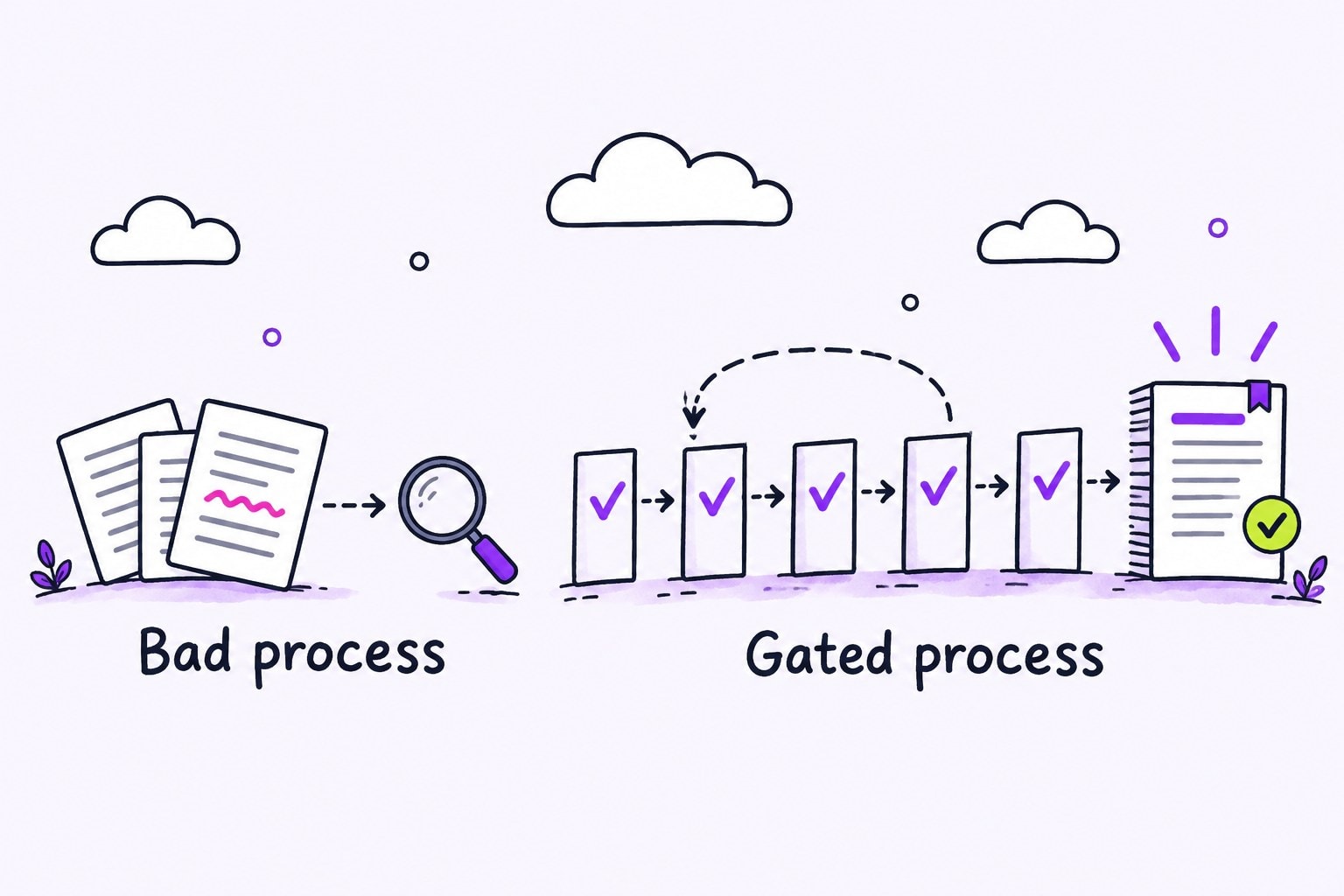
Treating quality control as a final proofreading pass is damage control, and it fails when volume scales. Automating a vague process only amplifies errors faster. Our rule: “Quality gates, not end-of-line inspections.”
A quality gate needs a standard, a verification method, and an action for when the check fails. Failing content is automatically refined or flagged, and humans review nuance and risk. Escalations and corrections feed back into context, evaluators, and rules, so repeat issues need less intervention.
Human-in-the-loop AI can run in three modes: human approval before a workflow continues, human monitoring with intervention on exceptions, and automated processing with periodic audits. One workflow can mix them at different steps.
| Approach | Where quality gets checked | Result at volume |
|---|---|---|
| Bad process | One proofreading pass at the end | Errors pile up, the worst article sets the average |
| Gated process | Order, brief, draft, E-E-A-T, fact-check | Poor inputs fail early, fixes feed back into the rules |
How to Define What Good Looks Like With E-E-A-T Scoring
You can’t scale a process when quality is a matter of opinion. Define pass/fail criteria before automating, and treat them as hypotheses to test and refine. E-E-A-T stands for Experience, Expertise, Authoritativeness, and Trustworthiness, with trust the most important.
Google provides no numerical E-E-A-T score. Any rubric is the publisher’s own, built around criteria, a pass/fail threshold, and who or what checks it. A publisher could adopt a rubric like this one.
| Gate | Criterion | Pass/fail threshold | Who or what checks it |
|---|---|---|---|
| Order | Naming, scope, and brief are complete | Fails if any element is missing or ambiguous | Automated validation plus human review |
| Brief | Angle matches search intent and audience is clear | Fails if the angle conflicts with what the SERP rewards | Research agent, human spot check |
| Draft | Brand voice, product details, and unique input present | Fails if sections read as generic | Automated editorial check |
| E-E-A-T | First-hand experience, expertise, and trust signals | Fails if the publisher’s rubric criteria are not met | E-E-A-T scoring engine, human QA |
| Fact-check | Every checkable claim supported by a source | Fails if any claim is unverified or contradicted | Independent fact-check, editor on conflicts |
Red Flags That Should Stop an Article From Publishing
Some problems should halt publication outright. Fabricated author names or credentials are among them, and Google flags these as deceptive.
-
Unverified claims.
-
A brief that doesn’t match intent.
-
No unique input.
-
Unsupported or generic content.
-
Fabricated authorship or credentials.
Fact-Checking and Downstream Integrity at Scale
Google recommends reviewing and manually fact-checking generated content before publication. At scale, we isolate individual claims and verify them against trusted context or vector databases using RAG.
The sequence runs in order: identify checkable claims, define scope (entity, geography, date, product version, price basis, study population), retrieve evidence, apply a source hierarchy, and check whether sources actually support the claim’s wording. We separate false claims from unverified ones. Conflicts between authoritative sources go to an editor.
Then comes downstream impact. When a statistic is corrected in one section, the system checks whether conclusions elsewhere need adjusting. That prevents the quiet contradictions that make long articles feel untrustworthy.
How SEOwind’s 6-Stage Production System Supports Bulk Content Creation
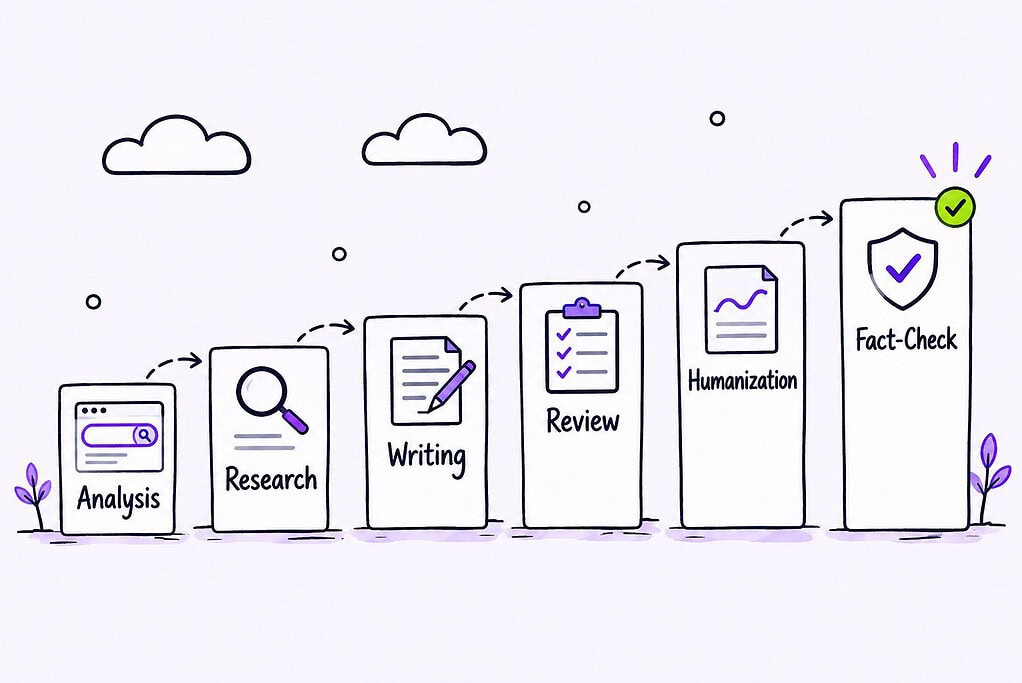
Instead of one general-purpose prompt, we use separate, specialized stages with structured handoffs. The four research passes run inside these stages: Pass #1 and Pass #2 shape stages 1 and 2, Pass #3 drives stage 3, and Pass #4 closes with stage 6.
-
Search Analysis & Content Planning. We analyze the top 10 Google SERP results, competitor structures, content length, and secondary keywords with search volume to build the plan and brief.
-
Deep Research & Source Verification. An AI Research Agent runs two independent research runs across websites, PDFs, and official documents. Facts are verified against original source pages, and client insights and SME knowledge are locked in as protected instructions.
-
Research-Backed Article Writing. The AI writer produces the full article in a single pass for narrative coherence, using verified facts, brand voice, and company profile data instead of assumptions.
-
AI Editorial Review & Revision. An automated check evaluates the draft against the brief, fixes structural gaps, confirms required links and formatting, and removes repetitive phrasing.
-
AI Content Humanization. We correct formulaic AI patterns and keep the factual meaning, headings, links, and FAQ blocks intact.
-
Independent Fact-Checking. A final pass extracts claims, verifies them one by one, validates corrections, and checks downstream consistency.
Humans stay in the loop throughout, and a multi-agent system with RAG and an E-E-A-T scoring engine triggers refinement when standards aren’t met. If you want to see how this runs on your clients’ content, talk to us about a pilot batch. It’s how an agency tests fit.
Publishing in Controlled Batches and Monitoring Performance
Even a gated system deserves a staged release. Publish in small groups, review signals, then expand. No batch size is magic, and no outcome is guaranteed.
Start with the Performance report in Google Search Console, which shows clicks, impressions, click-through rate, and average position by query, page, country, device, and date. Weekly and monthly views smooth daily swings, while daily data helps spot spikes or issues. Then check the Index Coverage report, which shows pages Google indexed or tried to index, with errors and warnings. Google suggests checking about once a month or after content changes.
If a batch shows indexing problems or weak engagement, trace the cause back to a gate and adjust the rules before releasing the next group.
Scaling Bulk Content Creation Across Clients With a White-Label Framework
We wrap the 6-stage engine in a managed white-label service. Agencies scale production under their own brand without building an in-house operations team.
The agency provides target keywords and topics per client, brand guidelines or sample content, client context or internal SME docs if available, and a single point of contact. We handle multi-layer research, AI and human draft production, E-E-A-T and brand alignment checks, human editorial QA, and CMS-ready white-label delivery.
The table below compares three approaches.
| Single-prompt generation | Freelancer-led production | Orchestrated white-label system | |
|---|---|---|---|
| Scalability | Fast to start, inconsistent as volume grows | Limited by headcount and coordination | Expands monthly volume without added headcount |
| Quality control | Depends on whoever reviews each output | Varies by freelancer | Quality gates at every stage |
| Human oversight | Ad hoc | Individual writers and editors | Human-in-the-loop QA built into each step |
| Customization | Rebuilt in every prompt | Depends on each writer’s grasp of the client | Client profiles calibrated through a feedback loop |
| Turnaround | Quick drafts, slow cleanup | Subject to individual availability | Predictable assembly line |
| Cost structure | Low tool cost, hidden editing time | Writing fees plus 5-10 hours per week of management per freelancer | Managed service replacing freelancer overhead |
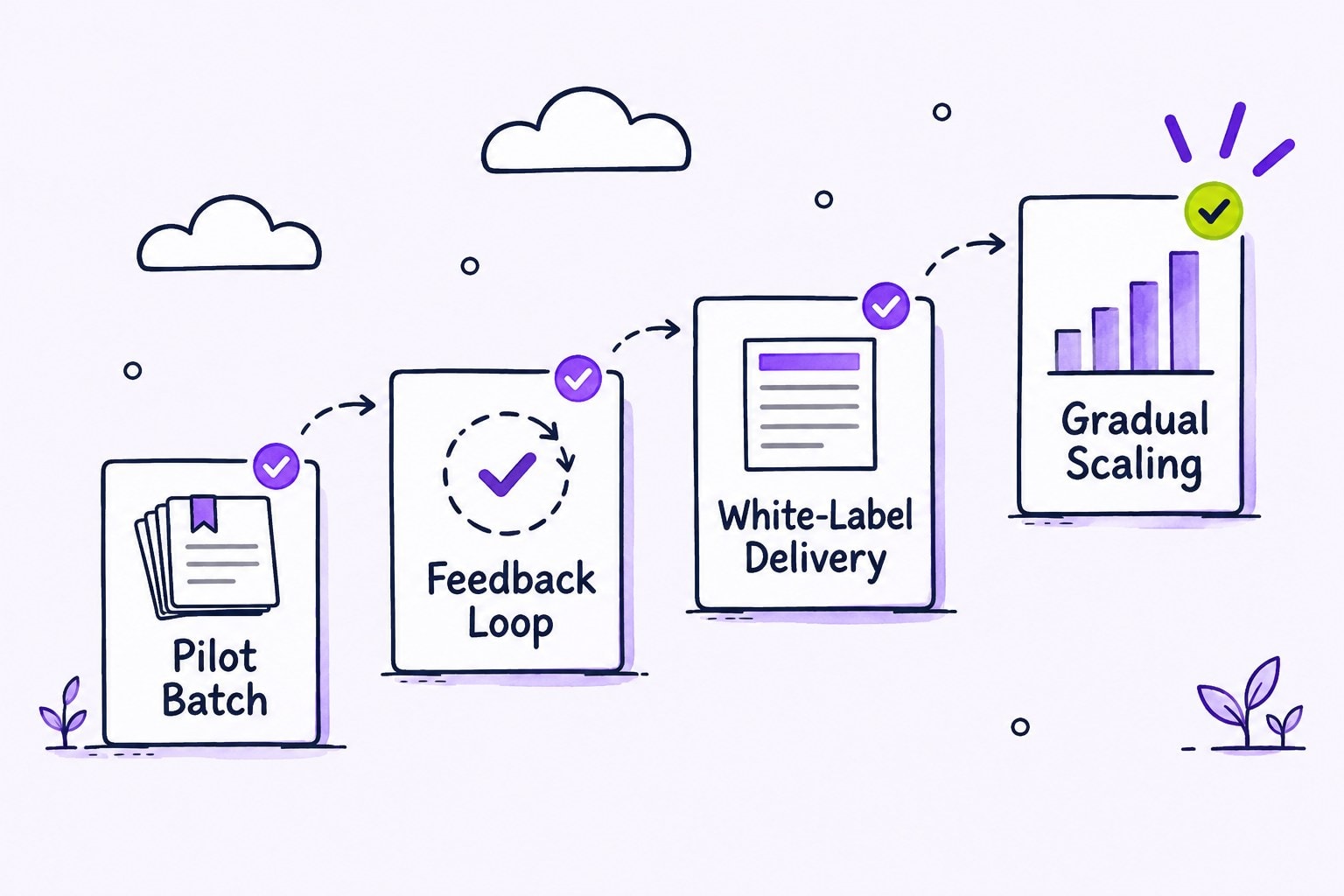
The 4-Step Pilot-to-Scale Onboarding Process
-
Pilot Batch (5-20 articles). You review tone and SEO depth, plus how well the structure aligns. It takes about 3 hours of agency time.
-
Feedback Loop. You approve the first batch so we can calibrate client profiles and fine-tune production rules.
-
White-Label Delivery. You receive CMS-ready, fully white-labeled drafts formatted to your specifications under your brand.
-
Gradual Scaling. Monthly volume grows without disrupting your workflows or adding headcount.
Curious what a pilot would look like for your client mix? Start a pilot-batch conversation with our team.
Agency Economics and a Real-World Case Study
Agencies we partner with can expect the following, though results vary by industry, competition, and execution:
-
5-10 hours per week saved per freelancer managed.
-
25-50% lower writing costs, depending on volume.
-
25-50% better margins, which come from the process itself.
-
More consistent tone and structure, plus better SEO.
-
Fewer client revisions from E-E-A-T-optimized first drafts.
One unnamed agency produced 450+ articles per month for 130 clients with 23 freelancers at $740K per year and 6 internal team members. After switching to SEOwind, it kept the same volume and clients, spent $420K per year, saved $320K per year, and now runs with a team of 4. That is a single agency’s result and carries no promise.
Bulk Content Creation Mistakes to Avoid
Most failures start when a team automates a chaotic process. These are the patterns we see most.
-
Scaling an unstandardized workflow, which creates more output while the process stays broken.
-
Treating prompts as infrastructure.
-
Starting with weak business context.
-
Generating without evaluation.
-
Refining endlessly with no stopping rules.
-
Skipping feedback loops, so the same issues return.
-
Compressing research to save time.
All of them trace back to one equation: bad process × AI = faster bad results.
Next Steps: Build Quality Gates Into a Repeatable System
Bulk content creation works when the system does the heavy lifting and humans own judgment. Gates let you publish at volume without adding to the risk, which end-of-line inspections can’t do. Run through this checklist before your next batch:
-
Map the workflow manually for 10 articles.
-
Define pass/fail criteria for order, brief, draft, E-E-A-T, and fact-check.
-
Set the action that triggers when each gate fails.
-
Choose a human-in-the-loop mode for each step.
-
Publish in small groups and review Search Console before expanding.
-
Feed corrections back into your rules.
If you’d rather not build this yourself, SEOwind already runs it. A pilot batch is how an agency tests fit, and we’re glad to start that conversation.