Content operations (ContentOps) is the system layer that makes content production, publishing and management repeatable and scalable. It coordinates people, processes, standards, technology and measurement so content strategy becomes content that actually gets published, maintained and does its job. We run content operations for 500+ clients, and our lesson is blunt: quality comes from workflows, standards and quality gates. Heroics don’t produce it. Results vary by industry, competition, team maturity and execution, but the system below travels well.
What Is Content Operations (ContentOps)? The System Behind Content Production
ContentOps covers the full lifecycle: planning and production, review, publishing, distribution, performance measurement, updates, repurposing and retirement. It rests on three connected layers. The people layer covers roles, ownership, skills and decision-making authority. Processes take in briefs, production workflows, QA, publication, maintenance and feedback loops. Technology and Measurement handles tools, systems of record, automation, analytics and reporting.
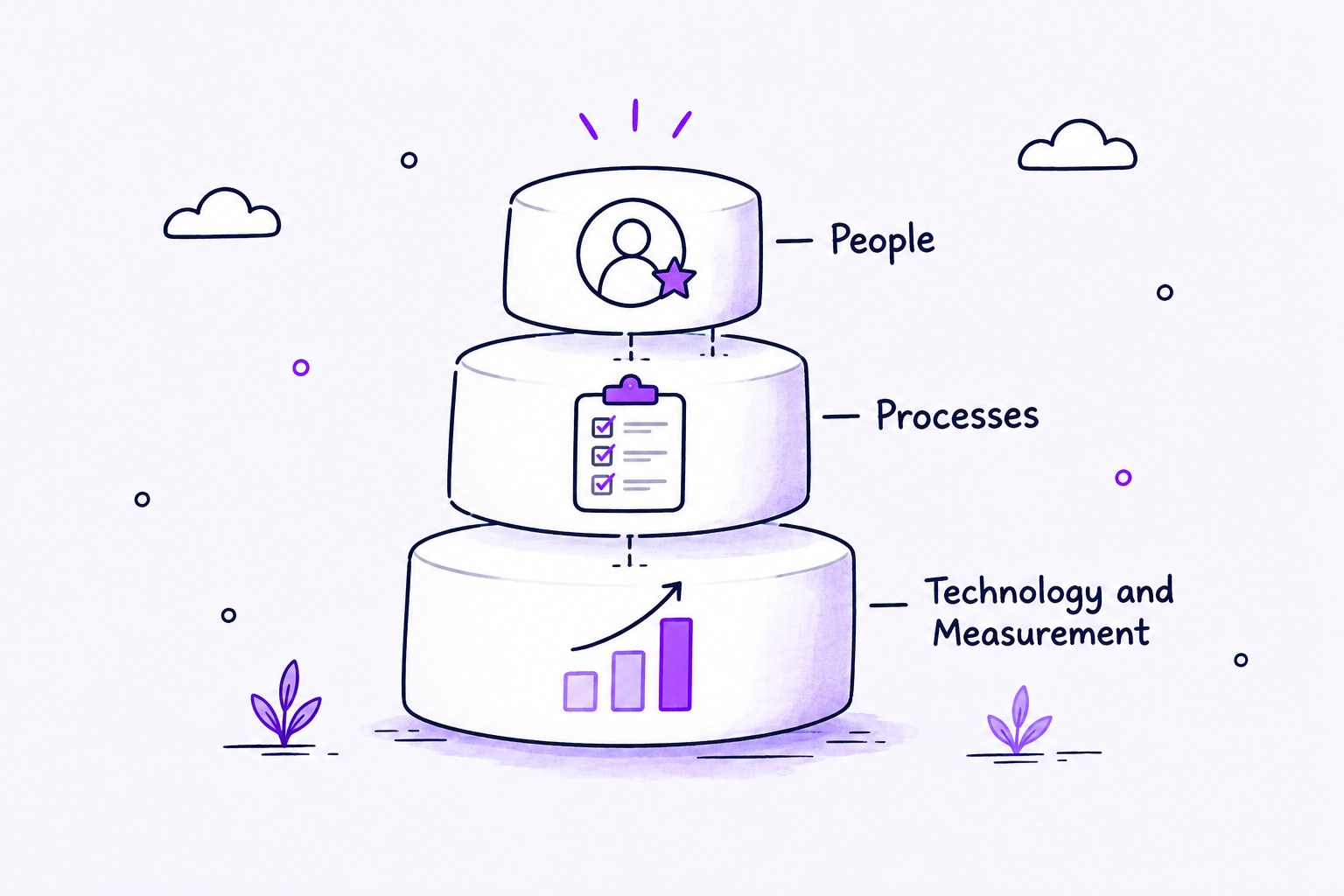
The reach goes well beyond the editorial team. Subject matter experts, designers, developers, legal reviewers and channel owners all influence whether useful content gets to its audience.
You don’t need sophisticated software, AI agents or a large team. A small company with shared documents, consistent briefs and a defined editorial workflow can run effective content operations. The Content Marketing Institute also considers a spreadsheet an acceptable starting tool. Match the operating model to your scale.
Check this week: write down who owns each stage of your most common content type.
Content Operations vs. Content Strategy vs. Project Management
These three get blurred constantly. Content strategy sets direction. Project management runs individual projects. ContentOps builds the recurring conditions that make delivery reliable across every one of them.
| Discipline | Core question | Purpose |
|---|---|---|
| Content Strategy | What should we create, for whom, and why? | Objectives, audiences, priorities, direction |
| Content Operations | How do we produce and manage content consistently? | Repeatable processes, ownership, standards, measurement |
| Project Management | Who does what, and by when? | Individual projects, resources, tasks, deadlines |
Check: if a question your team argues about doesn’t fit one row, you have a gap.
Why Your Content Process Is Often Aspirational Fiction
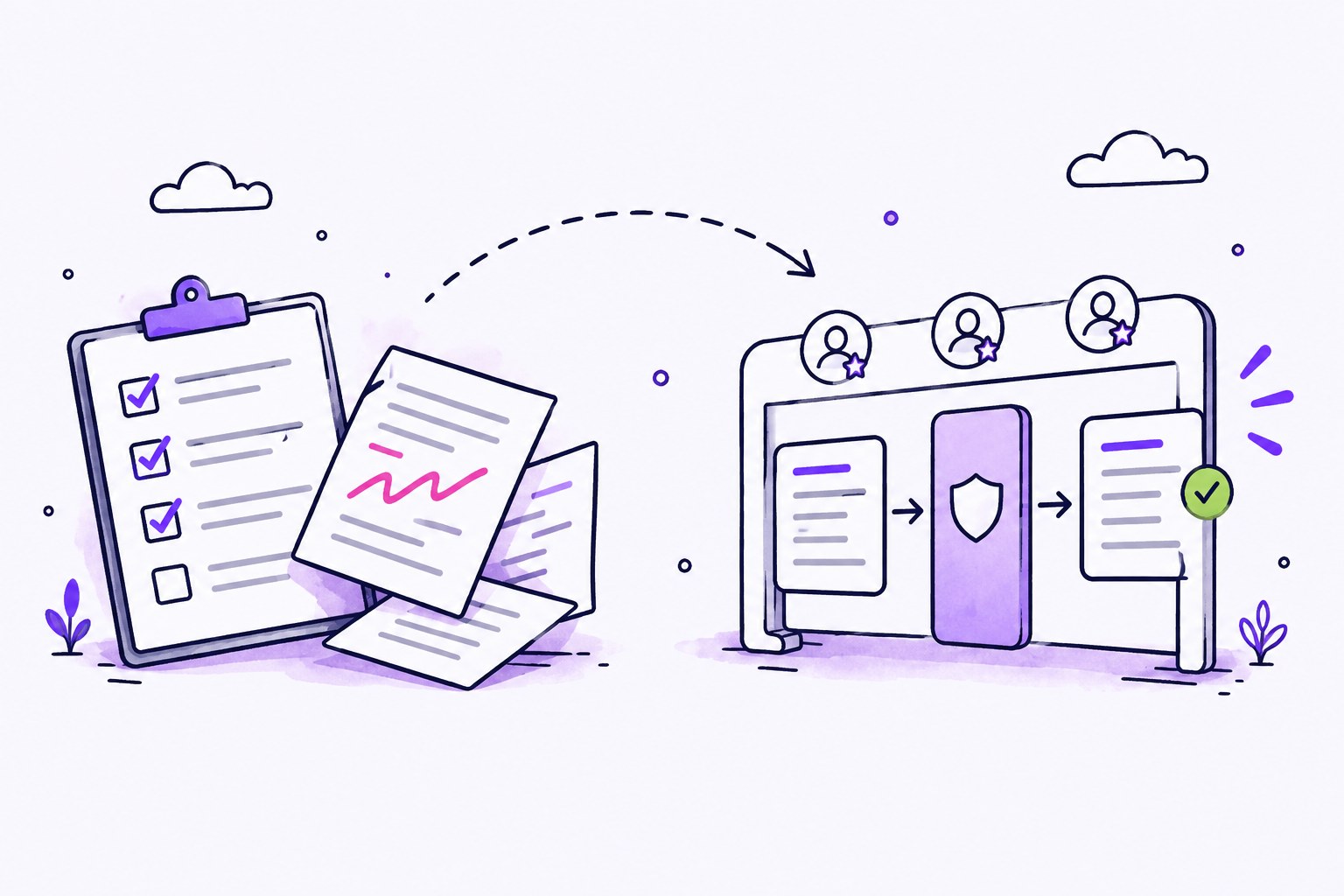
On paper, your content process includes deep research, verified claims, structured briefs, several editing passes and careful QA. Under production pressure, people skip steps, rely on memory, rush reviews and put deadlines before standards. The documented process ends up as fiction.
Weak talent or commitment seldom causes this. The organization designed a process that leans too heavily on individual discipline, memory and available time. Unrecorded requests, informal approvals and scattered files make an orderly-looking process unreliable. A good operating model has to work on an ordinary Tuesday, not only in ideal conditions.
Try these questions on your own process:
-
When did a deadline last override a step in your documented process, and did anyone log it?
-
Could a new editor find the current brief, standards and approved version without asking a colleague?
-
Does every request arrive through one channel, or do some arrive through chat and hallway conversations?
-
If a published article went stale, would anyone notice?
Why Process Consistency Beats Talent at Scale
A team of 10 may have several exceptional contributors whose expertise masks weak processes. At 50, informal mechanisms stop being reliable. Variability creeps into briefs, research depth and editorial judgment, and people interpret client requirements differently. More writers also means more coordination, review, onboarding and approval work, so without standards, hiring amplifies inconsistency.
Writers aren’t interchangeable, and talent performs better inside a reliable system. Scaling means building an operating system that delivers useful content without proportionally increasing coordination costs or sacrificing quality. More hires or more output won’t get you there alone, and neither will automation. CMI describes an ideal of creating 70% or more of an organization’s content in the same or a similar way.
Check: list the three requirements your writers most often interpret differently.
Repeatability Without Burnout
Teams are rarely held back by talent. What stops them is the lack of repeatability without burnout. Unclear briefs, duplicate work, repeated revisions and delayed approvals eat the hours that should go to research and original thinking. Clear briefs, responsibilities, quality expectations and handoffs free writers and editors for the work only they can do.
We standardize requirements and quality expectations, and leave every sentence and creative decision alone. Workflows can still vary by content type and risk. Capacity is a planning constraint too. Adding assignments without adding review, production and maintenance capacity just moves the bottleneck.
→ Check: ask your editors which avoidable confusion cost them the most time last month.
The Six-Part Content Operations Framework
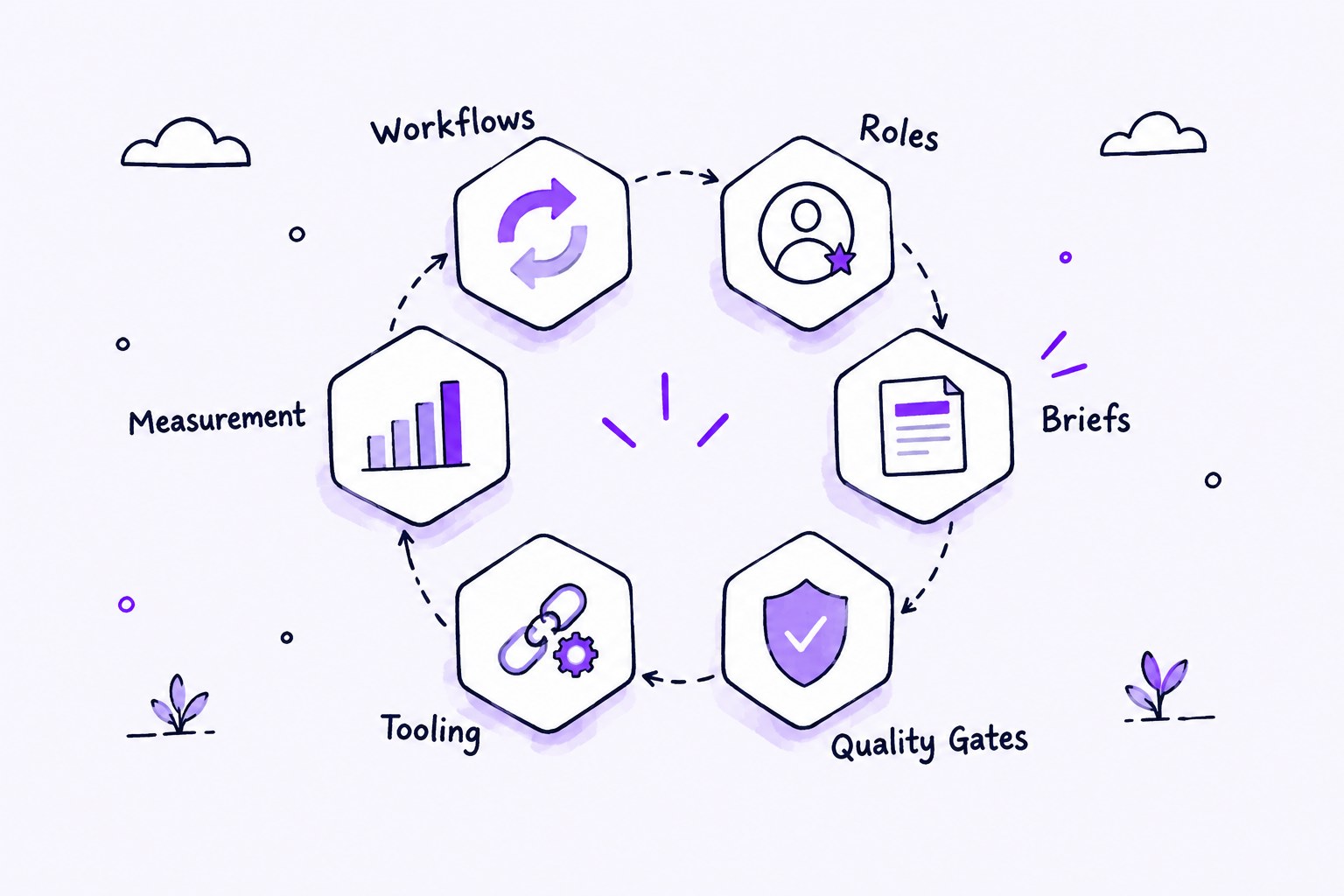
Quality can’t hinge on whether someone is having a good day, or on individual memory and energy. That’s why we organize content operations into six parts. This is our own practical model, not an industry standard.
| Component | Purpose | If missing |
|---|---|---|
| 1. Workflows | Define how work progresses and what must be true before it moves | Tasks fall through the cracks |
| 2. Roles and Responsibilities | Make ownership and accountability explicit | Dropped tasks, duplicated work, approval delays |
| 3. Content Briefs and Standards | Turn strategy into executable requirements | Variable output and endless revisions |
| 4. Quality Gates and Governance | Set criteria and decision rights before work advances | Errors reach publication |
| 5. Tooling and Coordination | Connect systems with clear responsibilities | Scattered files, lost status |
| 6. Measurement and Continuous Improvement | Expose bottlenecks and rework | Problems repeat unseen |
Workflows, Roles and Responsibilities
A workflow maps the lifecycle from intake and prioritization through creation, review, publication, distribution, measurement and maintenance. It defines stages and dependencies, entry and exit requirements, handoffs, approvals, escalation paths and who owns post-publication tasks. A project board alone doesn’t do this. Roles then say who owns each activity, who approves decisions and who is accountable for the whole system. We separate strategists, writers, editors, subject matter experts, content operations managers and publishing teams.
Without defined roles, shared responsibility turns into no responsibility. One person can hold several roles, especially in small teams, but ownership must stay explicit. Good looks like every stage having one named owner, one output and a clear condition for moving forward.
→ Check: pick any article in progress and name its owner at this moment.
Content Briefs and Standards
Structured briefs are one of the most effective ways to reduce production variability. We use templated briefs so requirements stay consistent across many assignments and clients. Templates improve consistency without forcing identical structure. Without them, every writer guesses, and revisions pile up.
A good brief covers:
-
Audience and user needs.
-
Search intent, where relevant.
-
Business objectives.
-
Scope and format.
-
Required evidence and sources.
-
Brand positioning.
-
Editorial expectations.
-
Constraints and approvals.
Keep voice, terminology and structure standards where contributors actually work.
→ Check: hand last month’s brief to a stranger and see whether they could write the piece.
Quality Gates and Governance
Agree on what “good” means before you automate anything. Many organizations raise production before agreeing what acceptable output looks like, so they can’t tell whether a workflow is improving or just producing more. Quality doesn’t depend on an editor’s subjective opinion. It rests on clear criteria and still leaves room for professional judgment.
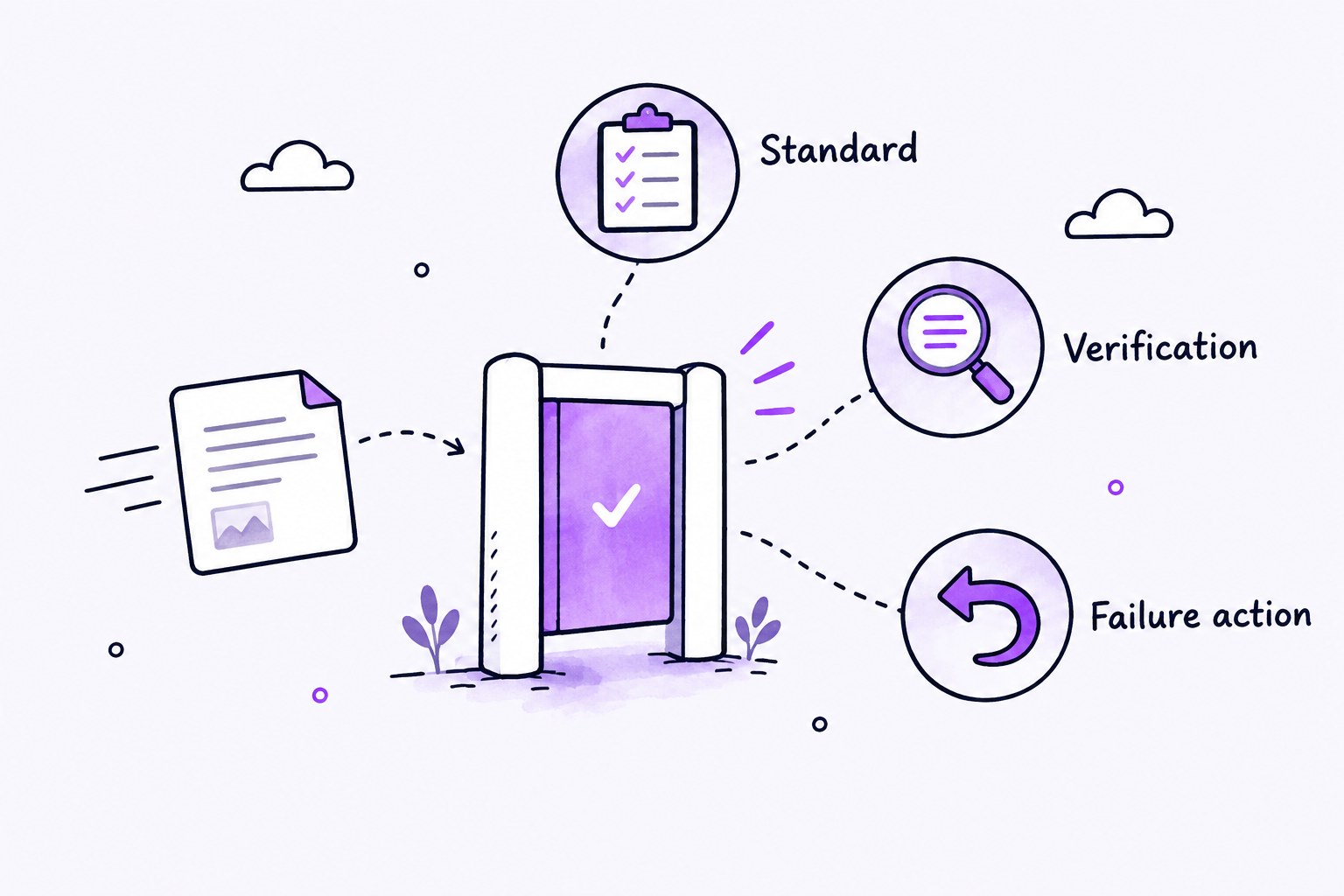
Criteria typically include factual accuracy, usefulness and completeness, brief adherence, brand consistency, editorial standards, compliance where relevant and final approval. Checks can be manual, automated or hybrid. Impact notes that quality control belongs in every workflow step, not only final review. A real quality gate needs a standard (what is evaluated) and a verification method (who or what checks it). It also needs a failure action, which says what happens when the check fails.
Governance adds decision rights, publishing permissions and escalation routes.
→ Check: pick one gate and confirm the standard, the verification method and the failure action all exist in writing.
Tooling and Coordination & Measurement and Continuous Improvement
Calendars, project management systems, CMS platforms, shared documentation and analytics must work together. We coordinate requests, status updates and escalations through a defined channel with clear owners. Coordination tools stay separate from durable systems of record, and each type of information gets one authoritative home. Settle workflows and ownership before choosing tools, because buying a platform doesn’t create an operating model.
A process that can’t be measured can’t scale. Tom Winter, founder of SEOwind, goes further: a process that can’t be fixed can’t scale, and every tactic should state how to confirm it is done. Documentation alone doesn’t make operations mature. Feedback loops that show what works are what you need. Without them, the same friction returns every month.
→ Check: for your last process change, can you say how you confirmed it worked?
A Practical Content Operations Workflow From Intake to Updates
This workflow is technology-independent and shows how responsibility transfers. Nothing enters production with unclear requirements. At order validation we check audience, objective, scope, market and instructions, and we catch missing or contradictory requirements before anyone drafts.
| Stage | Owner (role) | Output |
|---|---|---|
| Intake | Content operations manager | Validated request |
| Prioritization | Strategist | Ranked queue, reuse check |
| Brief | Strategist or editor | Locked angle, purpose, requirements |
| Production | Writer, subject matter expert | Draft |
| Review | Editor | Draft checked against brief and standards |
| Approval | Accountable approver | Signed-off version |
| Publishing | Publishing team | Live, formatted, metadata-complete page |
| Distribution | Channel owner | Scheduled and shared content |
| Measurement | Content operations manager | Performance and error data |
| Updates | Named content owner | Refreshed, repurposed or retired asset |
Batching in production reduces repetitive setup and context switching, though excessive batching creates waiting time. Assign maintenance ownership before publication, and feed measurement insights back into planning.
Scaling writers isn’t the same as scaling content operations. More writing capacity adds no research, editing, review, approval or publishing capacity. A team can double its drafts and simply build an editorial backlog. Check: find the stage with the longest queue, because that stage sets your real capacity limit.
Content Operations Team Structure: 10, 100, and 1,000 Articles per Month
These are illustrative scenarios, not staffing benchmarks. Content types differ in research, editing, specialist input and approval, so volume alone doesn’t set staffing. Roles can be combined, but every critical responsibility needs an owner. Maintenance load also grows with every article you publish.
| Volume | Core responsibilities | Ownership | Operational risks | Typical changes |
|---|---|---|---|---|
| About 10 | One person may plan, coordinate, write, edit and publish | Documented even when one person holds everything | Memory-based process, single points of failure | Lightweight documentation, dependable workflow |
| About 100 | Separate coordination, production, editing and publishing where useful | Explicit handoffs and quality controls | Review and approval bottlenecks despite enough writers | Capacity planning across stages |
| About 1,000 | Multiple production teams under central governance | Clear accountability per team, dedicated quality oversight | Drifting standards across clients, departments and formats | Centralized governance, stronger reporting |
At 1,000, distributed production can work alongside centralized quality requirements. If you want this system without building it, we run it as a white-label content production partner for agencies.
→ Check: name your single most overloaded role and what would break if that person left.
Content Operations Metrics: What to Measure and Why Logged Errors Matter
Operational metrics describe how the system works. They say nothing about what content achieves. Higher throughput and lower costs don’t imply stronger search performance, engagement or business impact, so track those separately. Read the metrics together. Rising throughput with a rising revision rate means rework is hiding inside your output.
| Metric | Definition | Diagnoses |
|---|---|---|
| Throughput | Assets completed or published in a defined period | Capacity and output trends |
| Revision Rate | Revision cycles divided by completed assets | Rework, inconsistent requirements |
| Time to Publish | Time from request or ideation to publication | Delays and bottlenecks |
| Error Rate per Article | Recorded errors divided by completed assets | Quality issues, recurring failure types |
| Review Turnaround | Time spent awaiting editorial or stakeholder review | Approval and capacity problems |
| Cost per Approved Asset | Production and coordination costs divided by accepted assets | Economics and efficiency |
When the same mistake keeps happening, stop fixing the article and start fixing the process. One mistake may be a misunderstanding. A repeating category points to the brief template, instructions, training, quality checks or approval process. We log recurring failures by type, trace them to a root cause and change the process.
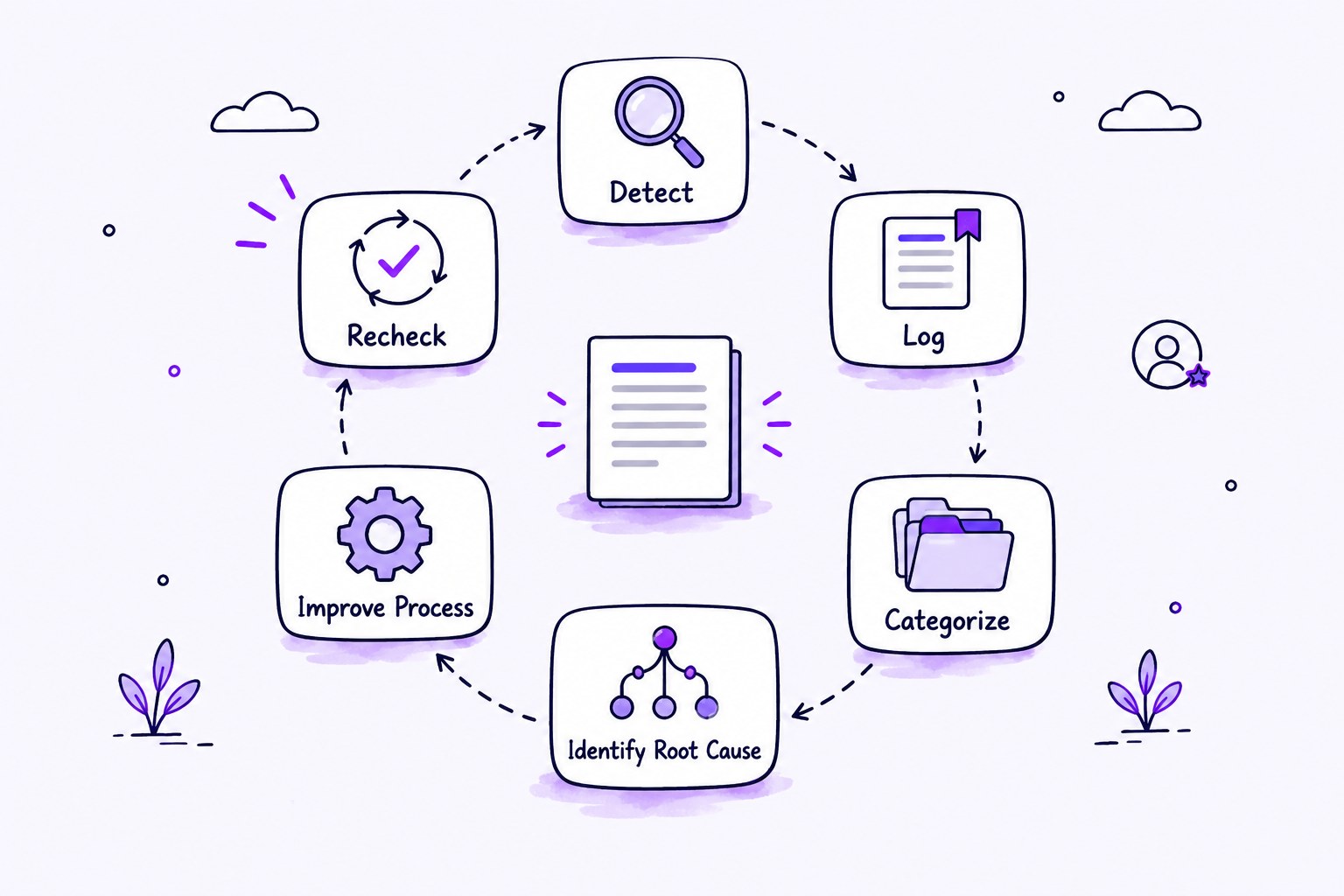
The loop runs Detect, Log, Categorize, Identify Root Cause, Improve Process, Recheck. Each log entry records:
-
Error type.
-
Stage found.
-
Root cause.
-
Fix.
Nobody should treat the log as a blame list. An early rise in logged errors may reflect better detection rather than worse quality. Human and AI errors both need proper quality processes.
→ Check: start the log today and review categories after two weeks.
Content Operations Maturity Model
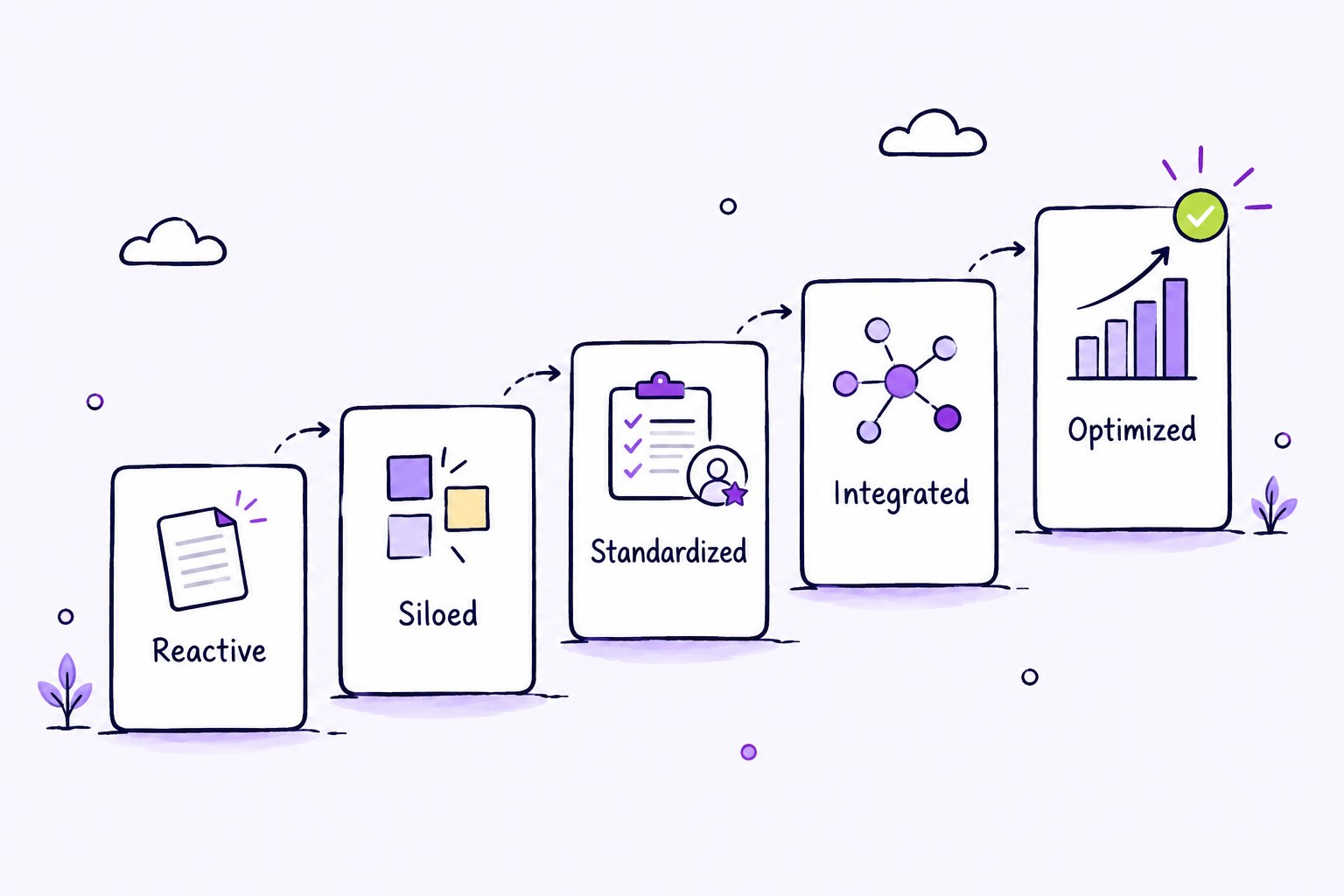
This is our own proposed model. It describes observable behavior and ignores team size, tool spending, content volume and AI adoption. Assess each capability separately, because a team can have strong publishing controls and weak maintenance.
| Level | Observable behavior |
|---|---|
| Level 1: Reactive | Work handled individually, limited documentation, inconsistent standards |
| Level 2: Siloed | Teams have established practices, but workflows, tools and responsibilities stay fragmented |
| Level 3: Standardized | Shared briefs, documented workflows, roles and quality requirements in place |
| Level 4: Integrated | Workflows, tools, approvals and performance data connect across teams and lifecycle stages |
| Level 5: Optimized | Performance is measured, recurring problems identified, processes systematically improved |
For a quick self-assessment, ask whether a colleague would describe your process the same way you do. To move up one level, pick one gap. At Level 1, write one shared brief. At Level 2, agree one workflow. At Level 3, connect one performance report to planning.
Common Content Operations Challenges and Practical Fixes
An operations manager, marketing leader or agency owner can change each fix below this quarter.
| Problem | Underlying cause | Practical fix |
|---|---|---|
| Reactive requests, unclear priorities | No single intake path or ranking rule | One intake form, a weekly prioritization slot, a reuse check |
| Undefined responsibilities and handoffs | Roles assumed, not written | Name who creates, reviews, approves, publishes and maintains each item |
| Inconsistent briefs and editorial standards | Standards live in people’s heads | Templated brief, standards stored where writers work |
| Review and approval bottlenecks | Reviewers lack expectations or capacity | Review expectations, visible dependencies, escalation route |
| Fragmented tools, documentation and inventories | Tools added before ownership was defined | One authoritative location per information type, one shared inventory |
| Resource shortages, poor capacity planning | Capacity counted only at the writing stage | Plan capacity at every stage, including maintenance |
| Neglected distribution, updates, maintenance | Work ends at publication | Assign maintenance owners and review dates before publishing |
→ Check: score each row red, amber or green, then fix only the worst one.
How AI Is Changing Content Operations
AI can accelerate research, briefing, drafting, repetitive coordination and some quality-control tasks. It doesn’t fix unclear ownership, weak editorial standards or broken workflows, and automation can amplify existing weaknesses. As execution gets cheaper, judgment gets more valuable. Human value shifts toward strategy, audience understanding, original insight, quality assessment and consequential decisions.
Tom Winter’s Law of Good Laziness captures the right instinct. Eliminate unnecessary repetitive work without compromising quality or removing responsibility. That means less manual data collection, standardized information gathering, simpler handoffs and automated rules-based checks. It never means skipping valuable work.
AI only adds value when several pieces work together: reliable business and audience context, structured AI-assisted workflows, automated and human quality evaluation, HITL oversight, feedback mechanisms and governance with clear accountability. AI doesn’t run autonomously, and human editors stay in the loop for accuracy, tone and brand alignment.
Our approach is a system, not a single prompt. The CyborgMethod is a brief, draft, score, refine workflow with HITL control and CMS-ready white-label delivery.
→ Check: before automating a task, confirm its rules are written down and its exceptions have an owner.
A 30-Day ContentOps Implementation Plan and Next Steps
A perfect operating system isn’t the goal. Build a reliable process for one content type, improve it, then expand deliberately.
| Week | Focus | Actions |
|---|---|---|
| Week 1 | Map Your Current Process | Choose one content type, document the workflow from request through publication and maintenance, note recurring problems, unclear ownership and bottlenecks |
| Week 2 | Standardize the Essentials | Introduce a reusable brief, assign clear responsibilities, define one or two quality gates |
| Week 3 | Establish Measurement | Track throughput, turnaround time, revisions and recurring errors, and set a baseline before major changes |
| Week 4 | Improve the Workflow | Review logged issues, remove unnecessary steps, clarify handoffs, sharpen briefs and standards, expand only when it works reliably |
Scaling content means building a system that makes consistently good content easier to produce, manage and improve. Producing more is secondary. Effective ContentOps combines people, processes, standards, tools, governance and measurement, so scale doesn’t depend on individual heroics. It removes unnecessary variability and makes responsibilities clear, without adding bureaucracy or forcing everyone to work identically. ContentOps makes quality repeatable, and AI ContentOps builds on that foundation while humans stay responsible for defining and maintaining quality.
If you’d rather have this system than build it, SEOwind runs it for agencies as a white-label content production partner, delivering 2,500+ articles monthly for 500+ clients across 100+ countries.