
Every month, we run roughly 2,500 AI-assisted articles through fact-checking before they reach a client’s CMS, based on our own internal production tracking. Some of that content lives in automotive, where a wrong price, model year, or eligibility detail isn’t a typo, it’s a liability. We didn’t get comfortable with that volume by trusting a single AI pass. Verification became a system for us, not a vibe check tacked onto the end of a workflow.
This article walks through how that system works, where AI genuinely helps with fact verification, where it introduces new risk, and why the phrase “AI fact-checking” hides two different problems that most teams never separate.
AI Fact-Checking: Two Problems, One System
“AI fact-checking” gets used to mean two different things, and conflating them is where most content teams get into trouble. The first meaning is using AI as a fact-checking tool, an assistant that helps a human verify claims faster. The second is fact-checking AI-generated content itself, catching the errors a model introduced while drafting. Both matter, and neither works in isolation.
Using AI to Fact-Check Content vs. Fact-Checking AI-Generated Content
An AI fact-checking tool can scan a draft, flag statements that look like claims, and pull candidate sources. That’s genuinely useful. What it struggles with is judging, on its own, whether a source actually supports the claim, whether the claim is scoped correctly, or whether a plausible-sounding statistic is attached to the right study. Fluent isn’t the same as true, and a model that writes a confident sentence hasn’t necessarily verified anything behind it.
Why Verification Must Be a System, Not a Final Editorial Check
Bolting a fact-check onto the end of a content pipeline treats verification like a gate you pass through once. That doesn’t scale, and it misses the failures that matter most, the ones where a wrong fact quietly reshapes a paragraph’s conclusion. Verification needs to run through the whole process, catching errors close to where they’re introduced instead of after they’ve already influenced three more sentences down the line.
Why AI Fact-Checking Is Not Just Asking Another AI
A lot of teams fall into the same habit: draft with one model, then ask a second model, “is this correct?” It feels like fact-checking. In reality, you’re just asking a probabilistic system to grade another probabilistic system, with no evidence requirement in between. Reliable AI fact-checking means building an evidence architecture around the model, one that forces retrieval, sourcing, and human judgment into the loop.
The Hallucination Problem in Production Content
AI hallucination is increasingly framed as a governance failure rather than merely a model quality limitation. The problem is well documented at this point, but its shape in production content is specific. A model doesn’t just get things wrong randomly, it gets things wrong confidently, in sentences that read exactly like correct ones. Retrieval-augmented generation, or RAG, changes the model’s job from “know everything” to “find and use the right information,” and that shift meaningfully reduces hallucination in tasks where a correct reference document exists. In agentic, multi-step workflows, though, an intermediate hallucinated claim can be used as context for later steps, causing errors to propagate and reinforce rather than get caught.
RAG isn’t a fix-all. LLMs show attribution bias, meaning they’ll cite a retrieved passage that’s topically related but doesn’t actually support the specific claim being made. Retrieval quality and attribution safety aren’t the same thing, and that gap is exactly where unchecked AI content slips through.
From Model Error to Process Failure: Where Responsibility Actually Lies
If AI invents a fact during a chat, that’s a model error. A fact that survives your production workflow and reaches the reader is a process failure, and most teams don’t want to admit how much that distinction matters. Once a probabilistic model is in production, hallucination stops being a research curiosity and becomes a system-design problem you’re responsible for managing. The useful diagnostic question isn’t why the AI made something up, it’s whether the failure came from missing process, missing context, missing sources, or missing tools. That question is actionable. “Why do models hallucinate” isn’t, not for a team trying to ship 2,500 articles a month without an incident.
Inside SEOwind’s Fact-Checking Workflow for 2,500+ Articles a Month
This is the machinery behind how we work, built on four pillars: RAG grounding, an EEAT scoring engine, automated quality gates, and human-in-the-loop review. We call the broader production model CyborgMethod. It runs brief, draft, score, and refine, with fact-checking threaded through every stage rather than parked at the end. We deploy a mix of models, including Claude, Gemini, Perplexity, Gemini and GPT, with specialized AI agents pulling from multiple data sources rather than relying on any single model’s memory. As we tell clients directly, research is 90% of the work for us, and AI writing is a cherry on top. Below is the ten-step breakdown of how that plays out claim by claim.
Step 1: Find Every Checkable Claim
Before anything gets verified, it has to get identified. We scan every draft for names, dates, statistics, quotes, specifications, and relationships that make a factual assertion a reader could check. Skipping this step is how vague-sounding but false claims slip through untouched, because nobody flagged them as claims in the first place.
Step 2: Define the Scope of Each Claim
A correct fact applied to the wrong scope is still wrong. We define exactly what entity, geography, date, product version, model year, price basis, or study population each claim refers to, because a true statistic about one country, year, or trim level is often false the moment it’s applied to another.
Step 3: Retrieve Evidence Instead of Trusting Model Memory
This is where a lot of AI fact-checking tools quietly fail. We don’t ask a model to recall whether a claim is accurate, we retrieve the actual source and check it. Grounding verification in inspectable evidence rather than model memory is the single biggest lever for reducing hallucinated specifics.
Step 4: Apply a Source Hierarchy
Sources don’t carry equal weight. We prioritize primary and authoritative sources, official documentation, manufacturer data, government or regulatory publications, over secondary aggregation. When no primary source exists, we define a clear fallback rather than letting the process quietly accept whatever ranks first in a search.
Step 5: Separate Context from Evidence
Briefs, prior articles, and researcher notes are useful context, but they aren’t proof. We treat internal documentation as background that shapes understanding, never as a substitute for an actual verifiable source. Confusing the two is a fast way to let an earlier error propagate through every article that references it.
Step 6: Cross-Check That Sources Actually Support the Claim
Finding a source isn’t the same as confirming it supports the claim. We check that the quoted information genuinely appears on the page, and that the date, scope, and entity in the source match the claim as written. Citation-source mismatches are common enough that this step alone catches a meaningful share of errors.
Step 7: Distinguish False Claims from Unverified Claims
Missing evidence for a claim doesn’t automatically make the claim false, and treating it that way leads to bad corrections. We separate a fact-check status false result, where evidence actively contradicts the claim, from an unverified result, where evidence simply doesn’t exist yet. Those get handled differently, and conflating them is a common way fact-checking tools overcorrect.
Step 8: Handle Conflicting Authoritative Sources
Sometimes two credible sources disagree. We don’t let an AI system quietly pick a winner. Conflicts get surfaced explicitly and escalated to a human who can weigh which source is more recent, better sourced, or more rigorously produced, rather than getting buried by a model defaulting to whichever source it retrieved first.
Step 9: Check the Ripple Effect of Corrections
A single wrong fact rarely stays contained. When we correct a claim, we trace it forward through the article to see what conclusions were built on top of it. A downstream paragraph that drew a conclusion from a now-corrected fact needs its own fix, not just the original sentence.
Step 10: Escalate Judgment, Not Repetitive Checking
Humans add the most value on conflicting evidence, ambiguous scope, and high-consequence claims where nothing quite settles the question. Rather than having a human re-verify every claim from scratch, our process escalates exactly those judgment calls to editorial review, which keeps the human-in-the-loop layer focused where it matters most.
This is the kind of infrastructure that lets us scale AI services for agencies without inheriting the accuracy risk that usually comes with high-volume production, and it’s the same engine behind our AI article writer workflow.
A Taxonomy of AI Factual Failures We See in Production
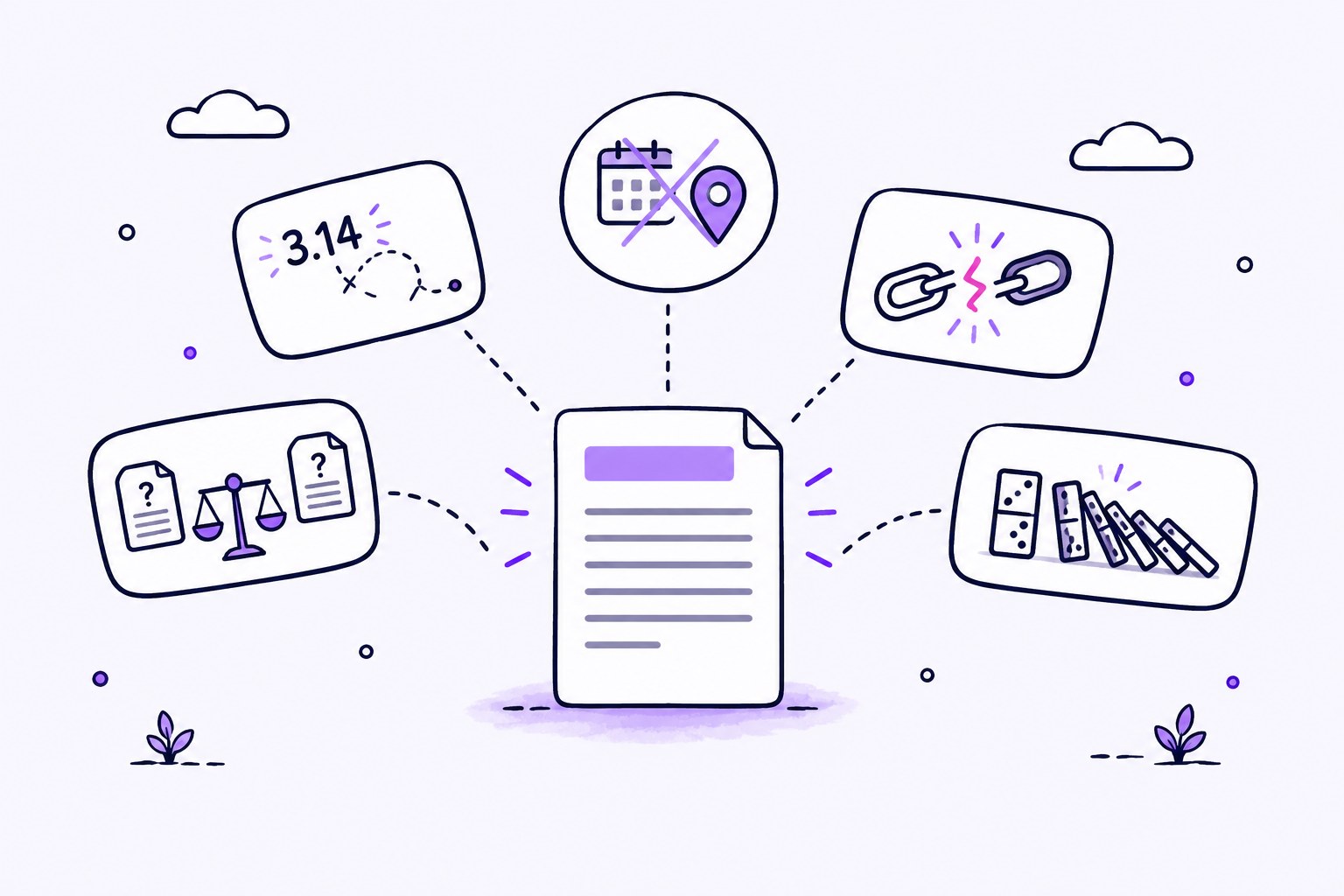
Calling every AI error a “hallucination” flattens a problem that actually has distinct, recurring shapes. Naming the specific failure type is what lets a fact-checker fix it instead of just flagging it.
Invented or Unsupported Specifics
This is the classic case, a number, name, or detail that sounds plausible but has no source behind it anywhere. It’s the easiest failure to catch with retrieval, and the most damaging when it slips through unchecked.
Outdated Facts and Wrong-Scope Facts
A fact can be true and still wrong for the article. Pricing from a prior model year, a regulation that’s since changed, a statistic correct for one region but applied globally: these are technically sourced facts used in the wrong context.
Misattributed Statistics and Citation-Source Mismatches
A number gets attached to the wrong study, or a citation points to a source that never actually contained the claim. Research on LLM citation verification found that models can recognize apparently incorrect citations but often reject correct ones too, with recall as low as 16 to 17%. They’re also sensitive to small terminology differences that shouldn’t matter. Separate research shows that citation correctness, whether a source supports a claim, doesn’t guarantee citation faithfulness, whether that source was actually the one used to generate the statement.
Conflicting Sources and Unverifiable Claims Presented as Certain
Two authoritative sources disagree, or no source settles the question at all, yet the draft states the claim with total confidence. This failure is dangerous specifically because it hides uncertainty instead of surfacing it.
Downstream Conclusions That Break After a Fact Changes
A correction to one fact can quietly invalidate a conclusion three paragraphs later that was built on it. Most fact-checking tools miss this entirely, because they check claims in isolation instead of tracing dependencies.
Why Automotive and Other High-Stakes Content Raises the Stakes
A vague statistic in a lifestyle post is a minor embarrassment. A wrong number in automotive content is a different category of problem entirely, because readers make purchase and financing decisions based on it.
Specifications, Prices, Model Years, and Eligibility Details That Must Be Right
Specifications, prices, model years, and eligibility criteria are the kind of detail where “close enough” isn’t close enough. An outdated trim spec, a misquoted starting price, or an eligibility rule pulled from the wrong model year can mislead a reader making a real financial decision, and it reflects directly on the publisher’s credibility. This is exactly the kind of content where source hierarchy and scope checking, steps 2 and 4 in our workflow, do the heaviest lifting.
What the Research Actually Says About AI Hallucination Rates
Anyone asking whether AI gives accurate information deserves a more specific answer than a single percentage. It depends entirely on which model, which task, and which definition of hallucination you’re using.
Why There’s No Single Universal Hallucination Percentage
Stanford’s 2026 AI Index assessed hallucination rates across 26 leading frontier models and found a range from 22% to 94%, depending on the model and evaluation conditions. GPT-4o’s accuracy dropped from 98.2% to 64.4% and DeepSeek R1 fell from over 90% to 14.4% across different conditions. The same report notes that the AI Incident Database recorded 362 AI-related incidents in 2025, up from 233 in 2024.
Vectara’s Hallucination Leaderboard showed LLMs hallucinating anywhere from 1% to nearly 30%, even in open-book generation where reference material is provided. Those figures reflect the prior benchmark version, since Vectara replaced the leaderboard with a harder, larger dataset in November 2025.
These numbers aren’t in tension with each other. They’re measuring different things. There’s no single universal AI hallucination rate, and any claim that states one flatly should raise a flag on its own.Reading Studies Correctly: Model, Task, and Definition Matter
Why Models Hallucinate in the First Place
OpenAI’s research found that hallucinations happen partly because standard training and evaluation methods reward confident guessing over admitting uncertainty. Newer models like GPT-5 show fewer hallucinations, especially on reasoning tasks, but the problem remains fundamental to how LLMs generalize beyond their training data.
What the Numbers Look Like in Medicine and Law
In specialized domains the numbers shift further. A 2025 clinical study found a 1.47% hallucination rate across nearly 13,000 clinician-annotated sentences of AI-generated medical text. A Stanford-led evaluation of Lexis+ AI, Westlaw AI-Assisted Research, and Ask Practical Law AI found hallucination rates between 17% and 33%, despite vendor claims to the contrary. General-purpose chatbots answering questions about federal court cases hallucinated at rates from 58% for ChatGPT-4 to 88% for Llama 2.
When Hallucinations Reach the Courtroom
A database tracking AI hallucination cases in litigation had logged 1,598 cases worldwide as of June 2026, growing by roughly eight per day. They include the Oregon federal case Couvrette v. Wisnovsky, where plaintiffs’ claims were dismissed with prejudice and their lawyers faced a $15,500 penalty plus $94,704.38 in fees and costs.
Reading any single stat without its model, task, and definition is how confident-sounding but misleading claims about AI accuracy end up in circulation.
Humans vs. AI: Comparing Predictable Failure Modes

Neither side of this equation is inherently more trustworthy. Both fail in predictable, specific ways, and the fix is designing around both failure modes rather than picking a side to trust by default.
Common Human Verification Failures
In our experience, human fact-checkers trust memory instead of checking sources, skip verification under deadline pressure, overlook how a fact connects to conclusions elsewhere in a piece, and apply inconsistent standards for what counts as sufficient evidence. Overconfidence on familiar subjects is a particularly common trap. Editors tend to move faster and check less on topics they already feel they understand.
Automation bias compounds this. Parasuraman and Manzey found that people skip independent verification when they receive automated advice, especially under cognitive load. That over-reliance can persist even when contradictory information is available. The effect isn’t uniform either. One study found automation bias occurs more often among people with lower AI knowledge and levels off at higher expertise.
Research on journalism accuracy offers a sobering comparison point. Studies of newspaper accuracy have found that 40 to 60% of stories contain some type of error, yet only about 2% of factual errors get corrected. Of 130 stories where sources directly reported an inaccuracy, only 4 resulted in a published correction. Cross-national research found 69% of analyzed stories contained errors, mainly from relying on secondary sources instead of primary ones. Human fact-checking, unaided by systematic process, has never been a solved problem either.
Designing a Process Where Neither Is Trusted Without Evidence
We’re building a workflow where neither humans nor AI gets a pass without evidence. AI retrieves and flags at speed and scale, humans apply judgment on conflicts, ambiguity, and consequence. That combination is what actually holds up in high-volume production. An anonymized agency case we’ve worked with illustrates the point without naming names: a lean two-person editorial team was able to oversee a volume of AI-assisted output that would have previously required a much larger freelance bench, specifically because the verification system did the repetitive work and let humans focus on judgment calls. That’s illustrative, not a guarantee, results vary by content type and stakes.
AI Fact-Checking Checklist: What to Verify
Run every AI-assisted claim against this list before you trust it.
-
Is this claim specific enough to be checkable, a name, number, date, spec, or quote, rather than a vague assertion.
-
What’s the exact scope, which entity, date, geography, product version, or population does this claim actually apply to.
-
Does a primary or authoritative source exist, and does it actually say what the draft claims it says.
-
Did you retrieve the source directly, rather than trusting the model’s memory of what a source probably says.
-
Does the quoted language actually appear in the source, and does the context match.
-
Are there conflicting sources on this claim, and if so, has that conflict been surfaced rather than silently resolved.
-
If a fact is corrected, what other conclusions in the piece depend on it and need to be re-checked.
-
Does this claim’s consequence level, financial, medical, legal, or safety, justify a higher level of scrutiny than a routine fact.
How SEOwind Builds Fact-Checking Into Every AI-Assisted Article
The Workflow Behind Every Article
Fact-checking isn’t a separate service we bolt onto content production, it’s built into the CyborgMethod workflow itself. During the brief and draft stages, RAG grounding pulls from real, inspectable sources rather than letting a model rely on memory. The EEAT scoring engine and automated quality gates flag drafts that don’t meet defined standards and route them back into refinement automatically. Human editors stay involved at every stage, not just at final sign-off, applying the judgment calls that steps 8 and 10 in our workflow depend on.
Built for Agencies and White-Label Delivery
Everything ships CMS-ready and fully white-labeled, so agencies get a verification system built on years of refinement without having to build that infrastructure themselves. If you’re evaluating SEOwind as a white-label partner, this fact-checking layer is the part of the system that protects your agency’s name on every article that goes out.
Frequently Asked Questions
Can AI Reliably Fact-Check Its Own Output?
Not entirely. An AI fact-checker can flag claims and retrieve candidate sources, but confirming whether a source truly supports a claim, resolving conflicting sources, and judging ambiguous scope all require human review. Vectara has noted that using an LLM as a judge for hallucination detection may not be robust, since a model update can flip its assessment or produce otherwise unreliable results.
What’s the Difference Between an Unverified Claim and a False One?
A false claim has been checked against evidence that contradicts it, earning a fact-check status false. An unverified claim simply lacks available evidence either way. Treating unverified claims as automatically false leads to bad corrections just as often as ignoring them does.
How Do You Handle Conflicting Sources During Fact-Checking?
Conflicts between authoritative sources get surfaced explicitly rather than resolved automatically. A human reviewer then weighs factors like recency, methodology, and source authority to make the call, instead of letting an AI system quietly default to whichever source it happened to retrieve first.
Should Every AI-Assisted Article Get the Same Level of Scrutiny?
No. Scrutiny should scale with consequence. A lifestyle piece and an automotive specifications page carry very different risks if a fact is wrong, and a well-designed fact-checking process allocates human judgment toward the claims where being wrong actually costs something.