A content production agency takes an agreed editorial direction and turns it into content the client can publish. That covers research, briefs, writing, editing, fact-checking, revisions and delivery. In our framework, a content marketing agency typically also decides whom to reach, what to publish and how to distribute it. What separates the two is which responsibilities the partner actually takes on, whatever its website calls it. This is our framing, and the industry has no fixed definition.
How Does a Content Production Agency Differ from a Marketing Agency?
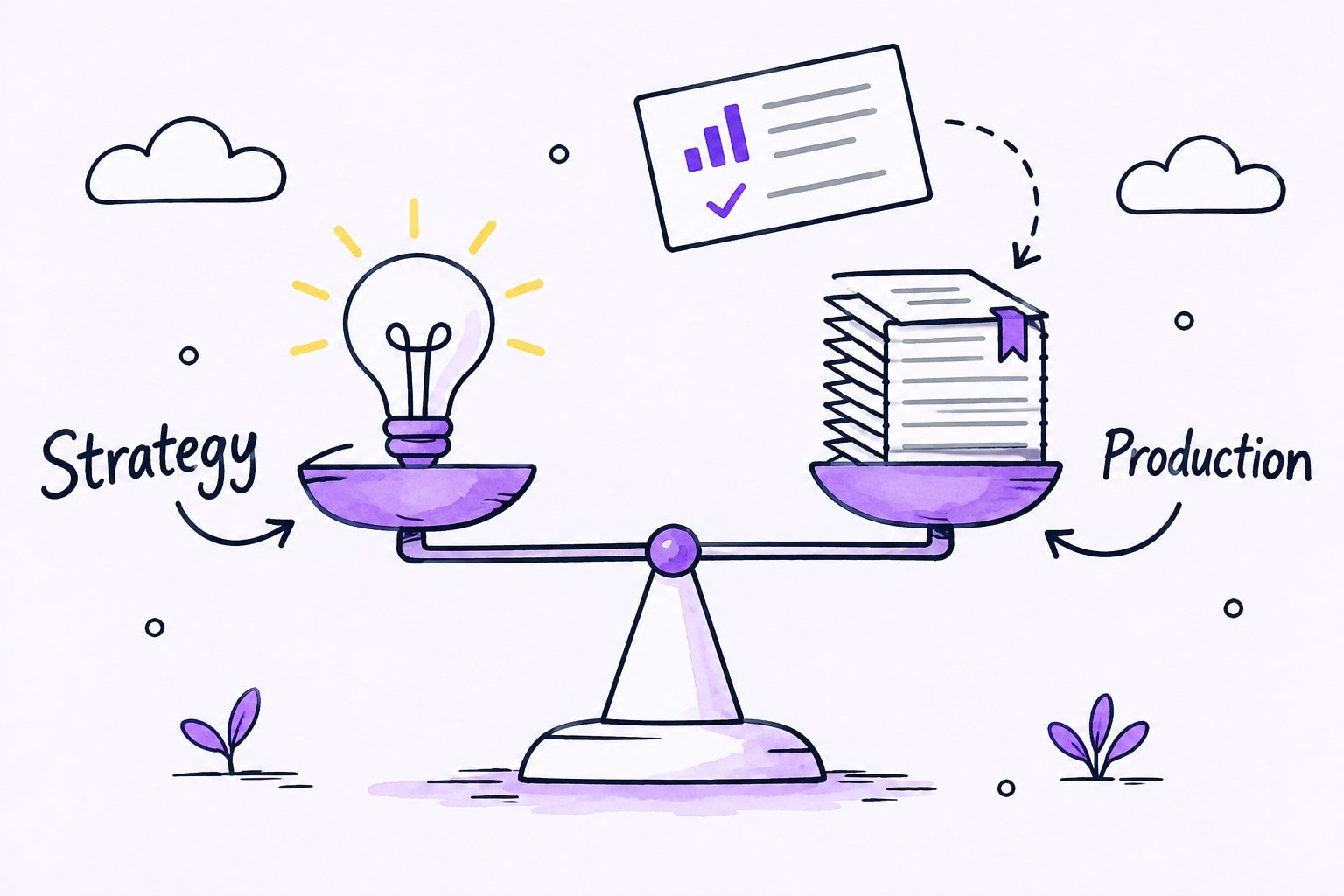
The right partner depends on which problem you actually have. Strategy covers what to create, for whom and why. Operations covers how to produce and manage it consistently. Run a quick check:
-
If you don’t know what to publish or why, you need strategy.
-
If you have a plan but your editors spend too much time coordinating writers, checking sources and fixing drafts, you need production.
-
Operations metrics will tell you which one it is: revision rate, time to publish, review turnaround and cost per approved asset.
What a Content Production Agency Takes Responsibility For
A production partner owns the path from brief to client-ready asset. Confirm exactly which steps are included, because delivering an edited asset, uploading it to a CMS and publishing it are different responsibilities.
What you get is consistent, quality-controlled, client-ready content that cuts the coordination and editing overhead on your side, rather than just a larger pile of drafts.
Content Production Agency vs. Content Marketing Agency
Content Marketing Institute describes content marketing as a strategic approach focused on creating and distributing valuable, relevant, consistent content to attract and retain a clearly defined audience and drive profitable customer action. A content marketing agency tends to own those strategic decisions, whereas a production partner carries out the direction you set. Some production partners specialize in one format or subject, while others coordinate several formats, so choose based on the depth and cadence your work requires.
Signs You Need Production Rather Than Strategy
Production problems show up as undefined responsibilities and handoffs, inconsistent briefs and editorial standards, and bottlenecks in review and approval. Your audience and goals are clear, yet the team can’t reliably turn briefs into finished work. If the team is still debating direction, you need strategic support first.
How Does White-Label Content Production Work?
In white-label content production, the agency keeps the client relationship and controls strategic and editorial direction. We handle production behind the scenes, from research through final quality assurance. This is how it runs in SEOwind’s white-label content production, from the agency’s side.
Step 1: Start with a Pilot
You provide topics or keywords for each client, examples of published content, brand guidelines where available and one point of contact. Internal documents and expert insights add company-specific context. The pilot is 20–50 articles to calibrate tone, depth and structure. Setup takes around three hours of your involvement, which is not three hours from order to delivery.
Step 2: Produce and Review the First Batch
We research topics, create briefs, write articles and run quality checks using CyborgMethod™, an orchestrated system of specialized AI agents supported by human editorial expertise. You review the first batch. Your feedback informs subsequent briefs and articles, so turn recurring corrections into written standards before the next batch.
Step 3: Deliver Under the Agency’s Brand
Content arrives CMS-ready in your requested format and naming conventions, without SEOwind branding. You and your clients own the content. It is ready for client approval without an account manager rewriting or reformatting it.
Step 4: Scale After the Pilot Works
Volume grows once quality and delivery expectations are met. Each client’s brand voice and requirements stay intact, along with their feedback, while quality standards hold steady across accounts. Scaling means expanding output without disrupting workflows, with output flexing up or down with demand.
How Does a Content Production Agency Ensure Quality?
Quality is built into the whole system, with checkpoints running throughout production instead of a single check at the end. A working gate specifies what is evaluated, how it is verified and what happens when work fails. You can see this first-hand in our content production process.
How SEOwind content production process looks like?
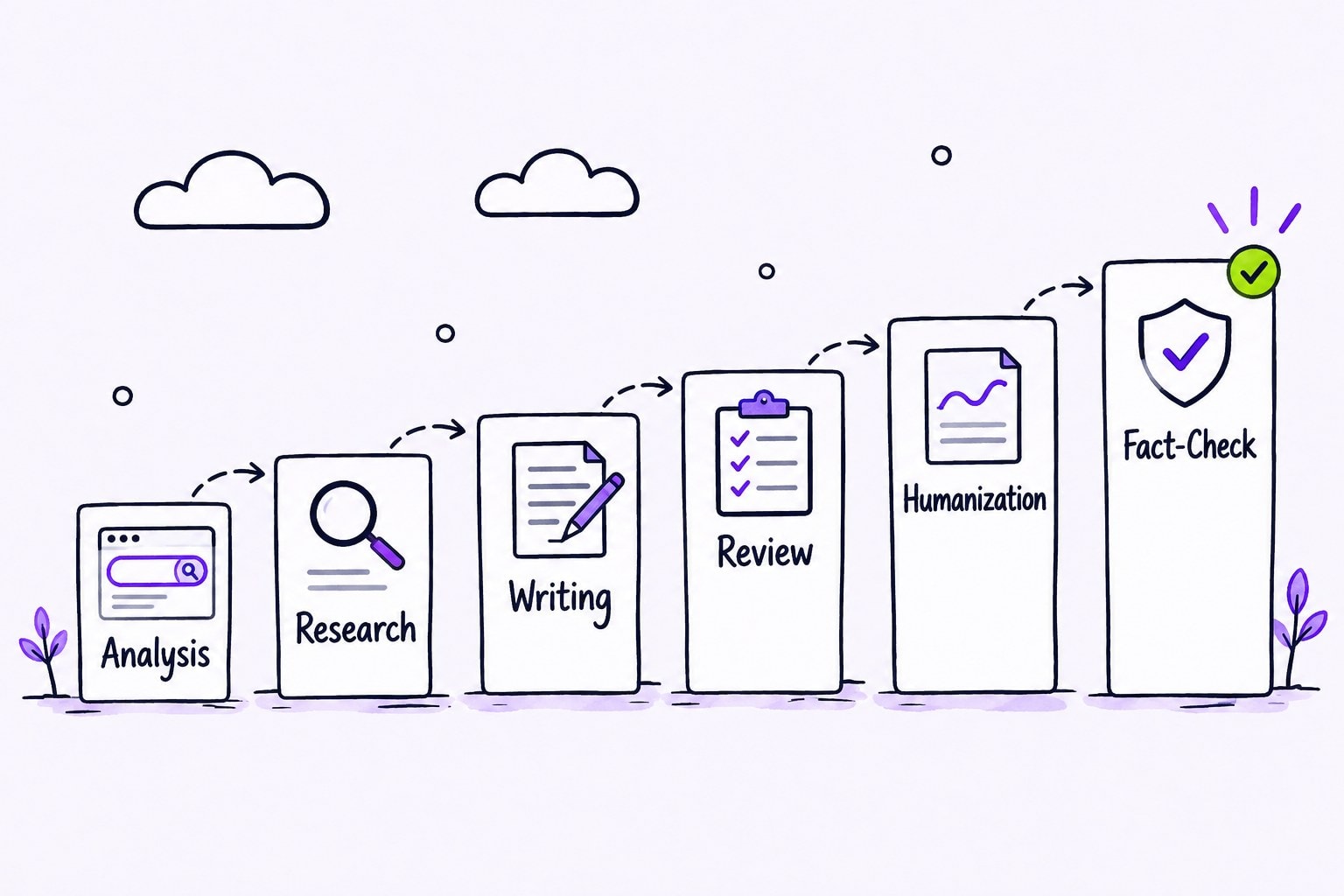
Each article follows through the stages:
-
Search Analysis & Content Planning: We analyze search results and competing pages, along with ranking keywords, to understand search intent, find content opportunities and plan the article around what readers need.
-
Deep Research & Source Verification: We combine multiple independent research runs, check facts against original sources and bring the client’s expertise, internal knowledge and examples into the brief. This builds a stronger factual foundation and differentiates the article from competing content.
-
Research-Backed Article Writing: We draft from verified research, company knowledge and expert input in the client’s brand voice. Material claims get credible evidence instead of generic AI-generated statements.
-
AI Editorial Review & Revision: We evaluate the draft against the brief, find missing information, improve structure and flow, strengthen weak sections and remove repetition. When evidence is insufficient, we return to research rather than rewording an unsupported claim.
-
AI Content Humanization: We find and revise unnatural phrasing and formulaic AI patterns. Facts, meaning, links and structure are preserved.
-
Independent Fact-Checking: We run AI fact-checking to verify the finished article claim by claim against reliable sources. When a statistic or fact changes, we review every comparison, conclusion or recommendation that depends on it.
Human editorial review, white-label delivery and client feedback are part of the wider production service. They are not automated CyborgMethod™ stages, and production is never fully automated.
Four Research Passes: Order, Brief, Writing, and Fact Check Levels
Research and verification run throughout production, with no single upfront pass. This way we ensure the article quality.
-
At the Order Level, we clarify audience, market, scope and client requirements before production starts.
-
At the Brief Level, we build the evidence base, validate sources, define the article’s angle and incorporate client expertise.
-
At the Writing Level, we keep researching and verifying while drafting, especially when more evidence is needed.
-
At the Fact Check level, we independently validate the completed article’s claims and correct unsupported or inaccurate information.
What Happens When Fact-Checking Finds an Error
Take a hypothetical case. Fact-checking finds an incorrect statistic in paragraph two. Correcting the number alone falls short, because a later comparison or recommendation may have relied on it. The process must revisit everything downstream.
Claims are classified as verified, contradicted, insufficient evidence, conflicting evidence or wrong scope. That classification decides whether to correct, escalate or reject. Insufficient evidence returns the draft to research.
Humans step in for strategic ambiguity, specialist questions, conflicting evidence and escalations that can’t meet acceptance criteria. Deterministic checks cover anything that can be verified mechanically. AI evaluators take contextual qualities such as tone and relevance. Humans get the ambiguous calls and brand or business decisions.
Unresolved issues are not passed on as finished work. They return to the stage best placed to fix them, and a deadline passing never counts as approval. Weak evidence goes back to research, and brand mismatches go to client feedback.
Why Consistency at Scale Matters
We deliver 2,500+ articles monthly for 500+ clients. Consistency matters more than volume here. The last article of the month meets the same acceptance criteria as the first, whatever the client, industry or market. A production partner works this way; a provider chasing draft volume doesn’t. As we put it, “Scale accepted, quality-controlled content, not simply article generation.”
Where Do AI Agents End and Human Editorial Judgment Begin?
Specialized AI agents handle research, writing, verification and iteration at scale. Humans provide oversight and judgment, including the subtle calls. Human editors assess accuracy, usefulness, coherence and brand voice before approval. A draft can pass a checklist and still fail those tests. Neither side replaces the other, and nothing is publishable without client approval.
How Much Does a Content Production Agency Cost?
Compare equivalent scopes rather than headline fees. Volume, research depth, specialist involvement and turnaround all change what a quote really covers, as does format.
What a Per-Article Fee Should Include
A per-article fee should include research, briefing, writing, editing, revisions, fact-checking, formatting and CMS preparation where included. Ask about usage rights, revision limits and fees for scope changes in writing.
Cost per Accepted Article, Not Cost per Draft
Stop pricing drafts. Measure cost per approved asset: production and coordination costs divided by accepted assets. Count your own editing, coordination and rework time, and keep rejected drafts in the numerator. A cheaper provider isn’t necessarily more cost-effective if your editors spend hours rewriting, correcting facts and fixing formatting. As SEOwind agency we charge per article, not per word count.
Case Study: 450+ Monthly Articles Across 130 Clients
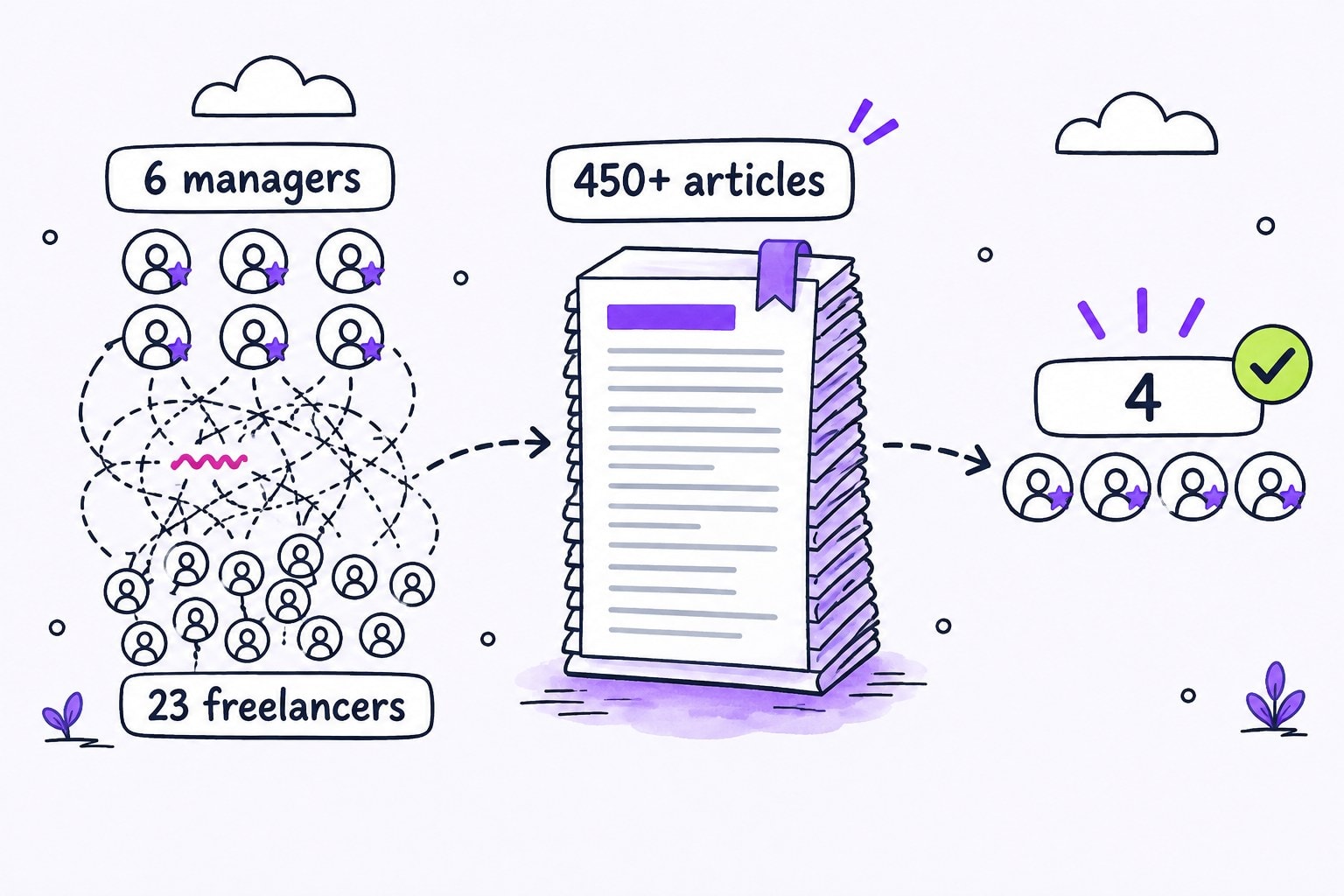
One agency we work with through white-label content production kept 450+ articles monthly across 130 clients. The operational result was the same output with much less coordination and management overhead. It moved from six internal managers coordinating 23 freelancers to a team of 4 and decreased operational cost from $740k to $420k per year. That’s one agency’s result, and no promise of yours.
Typical ranges vary by volume and execution and are never guarantees. They include 5–10 hours per week saved per freelancer managed, 25–50% lower writing costs and 25–50% better margins.
How Does a Content Production Agency Compare to In-House Teams, Freelancers, and Marketing Agencies?
These models can coexist. An internal lead can own strategy and voice while a production partner handles recurring output. The table below compares them on the points that matter most.
| In-house team | Freelancers | Marketing agency | Content production agency | |
|---|---|---|---|---|
| Scalability | Limited by editor headcount | Scalable through added headcount | Spans strategy, creation and distribution | Scales without proportional headcount growth |
| Quality control and consistency | Strong per editor, weaker across editors | Variable, lessons often stay with individual writers | Depends on the engagement | Deterministic and evaluator layers applied consistently across volume |
| Coordination burden | Editors manage workflow | Heavy: six managers coordinated 23 freelancers in our case study | Shared with the agency | Reduced on your side |
| Brand-voice handling | Direct access to experts and voice | Depends on each writer | Depends on the engagement | Client-specific voices maintained per account |
| Human oversight | Editors | Your editors | Agency team | Applied selectively |
How Do You Choose the Right Content Production Agency?
Start with the work itself: formats, subject complexity, publishing cadence and who owns which responsibilities. Then ask for evidence instead of taking promises on faith.
Questions to Ask and Evidence to Request
-
Responsibilities: What do you need from us, and what will our editors still have to do before publishing?
-
Research and expertise: Can you show a brief and a finished article that reveal how client knowledge or expert input changed the content?
-
Quality assurance: Can you show a draft that failed review, why it failed, and how it was resolved and approved?
-
Fact-checking: When a claim changes, how do you verify that related comparisons and conclusions remain accurate?
-
Feedback and continuous improvement: If our client corrects the tone during the pilot, can you show how that changes the next brief, and not only the current draft?
-
White-label delivery: Can you maintain separate brand voices, formatting requirements and editorial standards across multiple client accounts without exposing your own branding?
-
Pricing and rework: What does the volume price include, how many revision rounds are covered, and who pays for additional rework?
-
Pilot comparison: Will you run a small blind pilot against our current provider?
How to Run a Blind Pilot Against Your Current Provider
We always encourage potential clients to run a blind test, much like the famous Pepsi vs. Coca-Cola taste challenge. Give both providers identical briefs, remove any identifying information, and evaluate the articles without knowing who produced them. This helps eliminate preconceived biases, particularly around AI-assisted content, and keeps the focus where it belongs: on quality.
We’re always happy when SEOwind content comes out on top, but the real value of the test is helping agencies choose a content partner based on results rather than assumptions.
To make the comparison meaningful, agree on acceptance criteria before the pilot begins. Define an accepted article through explicit requirements for scope, factual accuracy, editorial quality, brand alignment, and delivery completeness. Test several assignments rather than relying on a single article, so one unusually strong or weak draft doesn’t skew the results.
Then compare both providers across four key metrics:
| Metric | Provider A | Provider B |
|---|---|---|
| First-pass acceptance | ||
| On-time delivery | ||
| Internal editing time | ||
| Cot per accepted article |
The best provider isn’t necessarily the one producing the cheapest drafts. It’s the one consistently delivering publish-ready content with the least internal effort, predictable turnaround times, and the lowest total cost per accepted article.
FAQs About Content Production Agencies
What is the difference between a content production agency and a marketing agency? A content production agency turns an agreed editorial direction into publishable content. A marketing agency typically also decides whom to reach, what to publish and how to distribute it. The difference is what each partner takes responsibility for.
Is white-label content disclosed? Content is delivered under the agency’s brand without SEOwind branding. The agency and its clients own it.
How many articles does a pilot need? A pilot needs 20–50 articles to calibrate tone, depth and structure.
Next Steps: Evaluate a Production Partner with a Pilot
Start with a defined use case, explicit acceptance criteria and a 20–50 article pilot. Judge the results against your scorecard, then scale only if quality and delivery hold. Results vary by industry, volume and execution, so let the pilot decide. To test it with your own briefs, explore SEOwind’s white-label content production offering.